
Space & Astronomy
6 min read
James Webb Telescope Uncovers the Heart of the Eye of God Nebula
WION
January 21, 2026•1 day ago
AI-Generated SummaryAuto-generated
The James Webb Space Telescope has captured new images of the Helix Nebula, revealing the white dwarf core of a dying star. This remnant is expelling hot material that interacts with surrounding gas and dust. The telescope's observations highlight the nebula's structure, including comet-like knots and flame-like pillars, and show how the star's remnants will contribute to future planet and star formation.
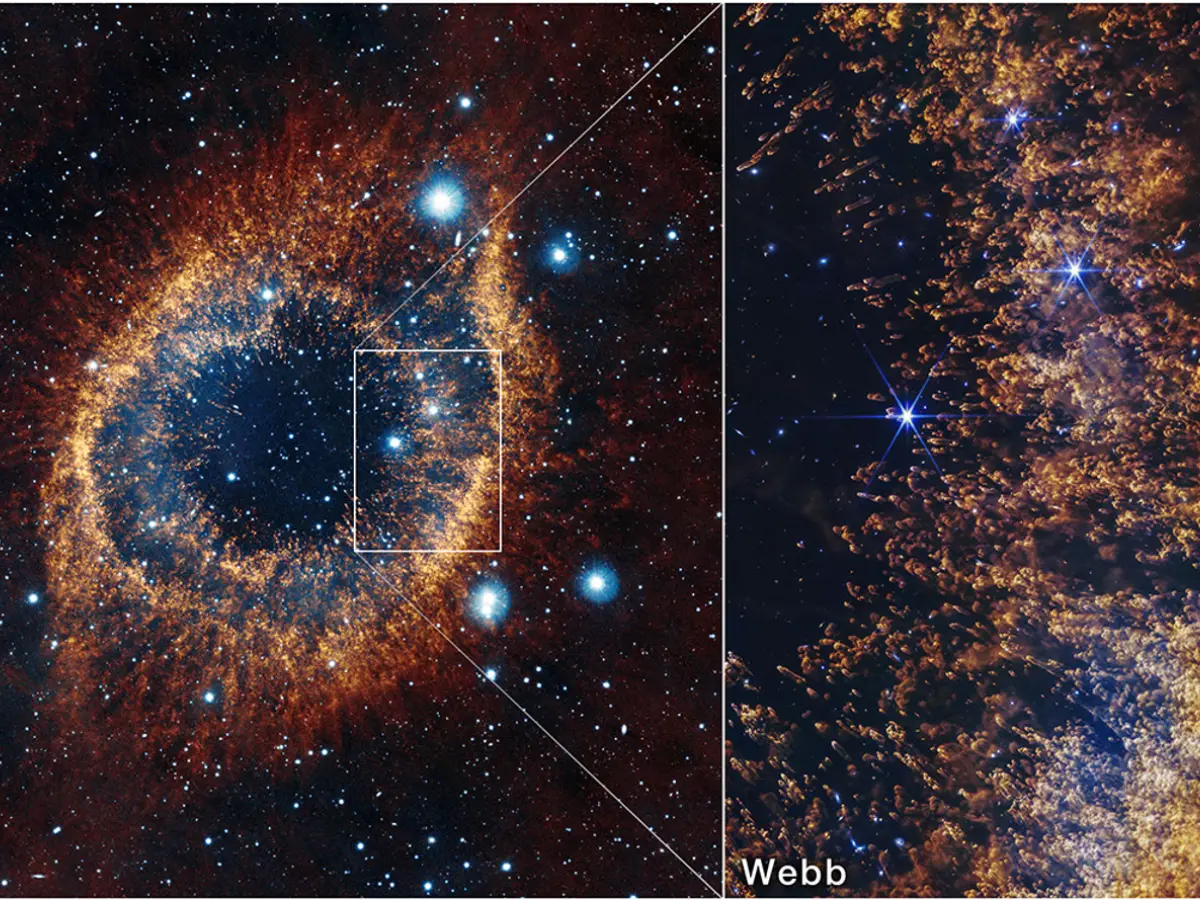
The James Webb Space Telescope has taken a closer look at the Eye of Sauron or Eye of God. Layers of gas shed by a dying star can be seen in new images of the Helix nebula, with a white dwarf, the remnant of the core of a dead star, clearly visible. This white dwarf is shedding a ton of hot material that is crashing into the cold shell of gas and dust. Everything that this dead star is releasing will become the source for the formation of new planets and stars. This is exactly what will happen to our Sun also one day, billions of years from now, when it will die. Webb’s NIRCam (Near-Infrared Camera) got a good look at a tiny portion of the nebula to reveal knots in it that appear like comets, along with gas and stellar winds. Inside an expanding shell of gas are cloudy pillars that look like flames. The nebula's unique shape comes from how the hot gas interacts with the cold shell.
Fast-moving fiery gas collides with the slower, colder shells of gas and dust that were shed by the star way back. Deep inside the heart of this nebula lies the white dwarf. It is extremely bright because of the intense radiation being released by it. This acts as a cosmic spotlight, illuminating stellar material discarded in the past that is present in layers. Near the white dwarf is hot ionised gas, with cooler molecular hydrogen farther out. Dust clouds contain pockets where, in the future, more complex molecules will form, providing the raw material for planets and star systems.
Sharing details of the image of the Eye of God, NASA said that the blue hue shows the hottest gas in this field, energised by intense ultraviolet light from the white dwarf. The cool has is represented in the yellow regions where hydrogen atoms join into molecules. At the edges of the nebula, the reddish colour shows the coolest material. The Helix Nebula, or NGC 7293, resides in the constellation Aquarius, 650 light-years from Earth. It looks like a giant eye in space, thus lending it this iconic name.
Rate this article
Login to rate this article
Comments
Please login to comment
No comments yet. Be the first to comment!