
Geopolitics
15 min read
Finland Leads the Way: Why the US is Buying Icebreakers
BBC
January 19, 2026•3 days ago
AI-Generated SummaryAuto-generated
The US is purchasing icebreakers from Finland due to the country's leading expertise in icebreaker technology. This move allows the US to bolster its Arctic presence and capabilities, acquiring advanced vessels to navigate increasingly accessible Arctic waters. The deal includes Finnish designs and construction for US Coast Guard ships, aiming to counter growing activity from Russia and China in the region.
'The finest in the world': Why the US is buying icebreakers from Finland
1 hour ago
Adrienne MurrayBusiness reporter, Helsinki
As President Donald Trump continues to insist that the US needs to own Greenland, his wider focus on the Arctic region has seen Washington order new icebreakers.
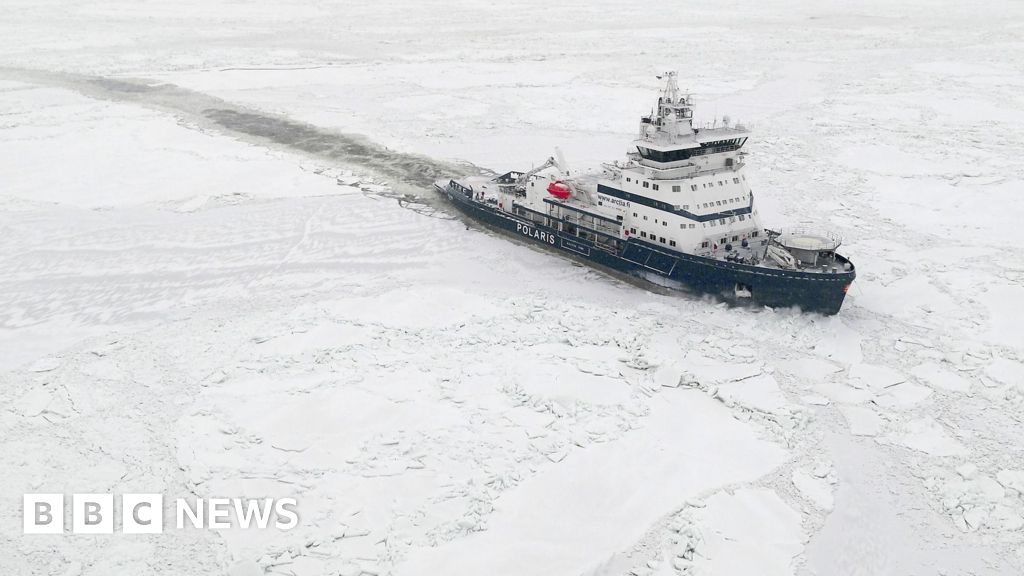
For these ships, which can sail through seas covered in solid ice, the US has gone to the world expert – Finland.
Temperatures are sub-zero inside Aker Arctic Technology's ice laboratory, as the scale model of an icebreaker cruises down a 70m-long simulation tank.
It ploughs a neat channel through the frozen surface of the water.
Undergoing testing at a facility in Helsinki, Finland's capital, this is a design for the next generation of the country's icebreakers.
"It's crucial that it has sufficient structural strength and engine power," says ice performance engineer, Riikka Matala.
Mika Hovilainen, the firm's chief executive, adds that the shape of the vessel is also crucial. "You have to have a hull form that breaks ice by bending it downwards," he says. "It's not cutting, it's not slicing."
Finland is the undisputed world leader when it comes to icebreakers. Finnish companies have designed 80% of all those currently in operation, and 60% were built at shipyards in Finland.
The country leads the way out of necessity, explains Maunu Visuri, president and chief executive of Finnish state-owned company Artica, which operates a fleet of eight icebreakers.
"Finland is the only country in the world where all the harbours may freeze during wintertime," he says, adding that 97% of all goods to the country are imported by sea.
During the coldest months, icebreakers keep Finland's ports open, and work as pathfinders for big cargo ships. "It's really a necessity for Finland. We say that Finland is an island."
It was this expertise that saw Trump announce in October that the US planned to order four icebreakers from Finland for the US Coast Guard.
A further seven of the vessels, which the US is calling "Arctic Security Cutters", are to be built in the US, using Finnish designs and expertise.
"We're buying the finest icebreakers in the world, and Finland is known for making them," said Trump.
Under US law, the country's naval and coastguard ships must be domestically-built, but in this case the president waived that requirement on national security grounds. He cited "aggressive military posturing, and economic encroachment by foreign adversaries", by which he means Russia and China.
This US concern comes as climate change continues to make the Arctic Ocean more navigable for cargo ships, at least if icebreakers lead the way by cutting a path. This opens up commercial trade routes from Asia to Europe, either above Russia, or north of Alaska and Canada's mainland, and down past Greenland.
Reduced ice levels also mean that oil and gas fields beneath the Arctic are more accessible.
"There's simply a lot more traffic in that part of the world now," notes Peter Rybski, a retired US Navy officer and Helsinki-based, Arctic expert.
"You have an active oil and gas exploration and extraction industry in Russia, as well as a newly-emerging trans-shipment route from Europe to Asia."
Following Trump's outline announcement last autumn, the first contracts were awarded on 29 December.
Finland's Rauma Marine Constructions is to build two icebreakers for the US Coast Guard at its shipyard in the Finnish port of Rauma. The first ship is due to be delivered in 2028.
A further four will be constructed in Louisiana, with all six using an Aker Arctic Technology diesel-electric powered design.
The US orders are part of an effort to catch up with the number of Russian icebreakers. Currently Russia has around 40, including eight that are nuclear powered.
By contrast, the US presently only has three in operation.
Meanwhile China operates around five polar-capable vessels. "None of them are technically icebreakers," says Rybski, pointing to their design not meeting the strict criteria. "But they are increasing their fleet."
He adds that China has increasingly been sending these "research" ships into Arctic waters between Alaska and the far east of Russia, including areas that the US considers its "exclusive economic zone".
"With limited means to respond this becomes a problem [for the US]."
Trump's desire to enlarge its icebreaker fleet goes beyond the practicalities of operating in ice-clad Arctic seas, assesses Lin Mortensgaard, a researcher at the Danish Institute of International Studies. She says it is also about projecting power.
"No matter how many aircraft carriers you have and how much you use them to threaten states with, you cannot sail your aircraft carrier into the central Arctic Ocean," she says.
"Icebreakers are really the only kind of naval vessel to signal that you are an Arctic state, with Arctic capabilities. And I think this is what much of the US discourse is about."
Rate this article
Login to rate this article
Comments
Please login to comment
No comments yet. Be the first to comment!