
Politics
16 min read
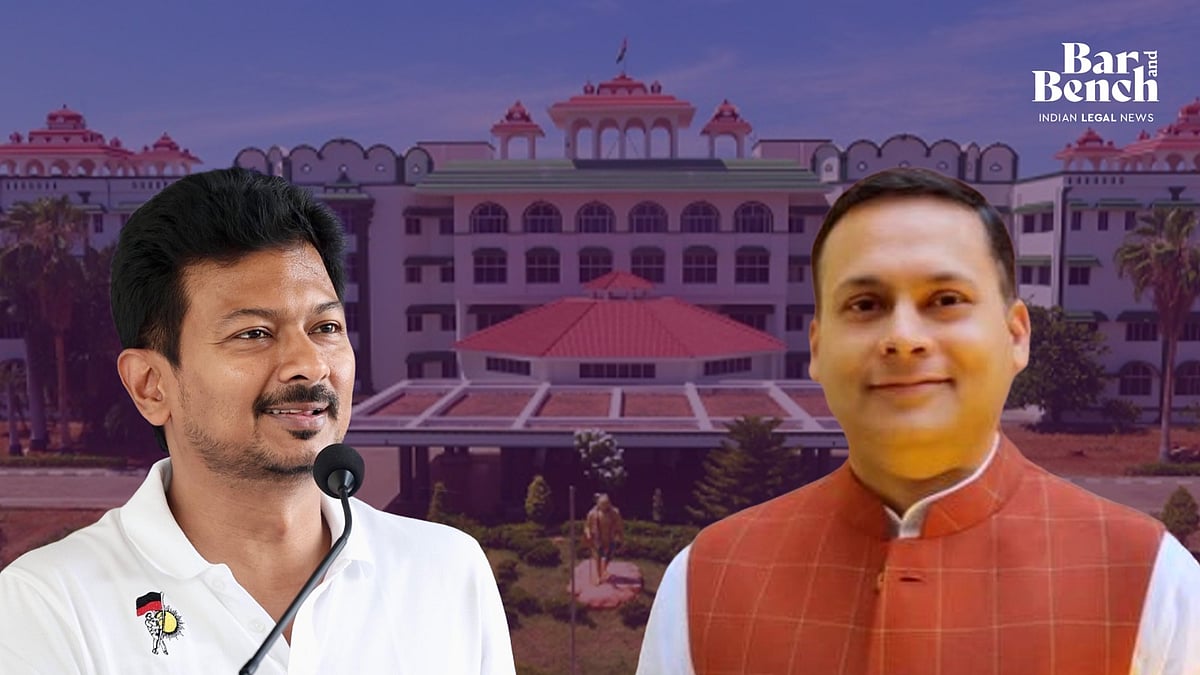
Madras HC Quashes FIR Against Amit Malviya Over Udhayanidhi Stalin's 'Eradicate Sanathana' Speech
Bar and Bench
January 21, 2026•1 day ago
AI-Generated SummaryAuto-generated
The Madras High Court quashed an FIR against Amit Malviya for sharing a speech by Udhayanidhi Stalin. Stalin's speech, translated as "eradicate Sanathana Dharma," was interpreted by the court as implying genocide. Malviya's post questioning this implication was deemed not hate speech, as it was framed as a question and did not incite violence. The court criticized the prosecution's reliance on the word "eradicate" and the pattern of prosecuting reactors to hate speech.
in light of the same, Justice S Srimathy quashed the first information report (FIR) registered by Tamil Nadu Police against BJP IT Cell head Amit Malviya for sharing a video of Stalin's speech on X and questioning whether the statement amounted to a call for the “genocide of 80% of the population of Bharat” who follow Sanathana Dharma.
"If a group of people following Sanathana Dharma should not be there, then the appropriate word is “genocide”. If Sanathana Dharma is a religion then it is “Religicide”. It also means to eradicate the people by following any methods or various methods with diverse attacks on ecocide, factocide, culturicide (cultural genocide). Therefore, the Tamil phrase “Sanathana Ozhippu” would clearly mean genocide or culturicide," the Court said.
The case arose from a speech delivered by Udhayanidhi Stalin on September 2, 2023 at a conference titled “Sanathan Abolition Conference”, organised by the Tamil Nadu Progressive Writers Artists Association.
In his address, the Minister drew an analogy between Sanathana Dharma and diseases such as dengue, malaria and COVID-19, and said that certain things cannot merely be resisted but must be eradicated.
“Sanathana Dharma should not be resisted or opposed but it has to be abolished / eradicated,” he said in a speech delivered in Tamil.
He used the Tamil phrase “Sanathana Ozhippu” (eradication).
Amit Malviya shared a video of this speech on X and questioned whether the statement amounted to a call for the “genocide of 80% of the population of Bharat” who follow Sanathana Dharma.
A complaint was then lodged alleging that Malviya had distorted the Minister’s speech to provoke enmity between groups, leading to the registration of FIR against him for offences under Sections 153A (hate speech) and 505 (statements conducing public mischief) of the Indian Penal Code (IPC).
He then approached the Court to quash the same.
Justice Srimathy held that the prosecution rested entirely on the meaning of the word “Ozhippu" used by Stalin in his speech.
“The entire case is on the word ‘Ozhippu’ which is crucial,” the Court observed.
It noted that even according to the State, the word translates to “abolish.”
The Court examined the ordinary meaning of the word and its synonyms.
“The synonyms for the word ‘abolish’ are eradicate, eliminate, exterminate, destroy, annihilate, wipe out,” the judgment recorded.
Applying this meaning to a religion, the Court reasoned that such language necessarily extends beyond abstract ideas.
“If Sanathana Dharma should not be there, then the people following Sanathana Dharma should not be there,” the Court said.
In these circumstances, the Court held, Malviya’s post questioning the implications of the Minister’s speech could not be characterised as hate speech.
The Court emphasised that Malviya’s post was framed as a question and did not call for violence or agitation.
“The petitioner has not asked any people to start any agitation either against the minister or his party,” Justice Srimathy recorded.
It rejected the State’s contention that the post instigated the Hindu majority against other groups.
“If such an argument is accepted, then it would amount to stating that the minister is instigating the 20% population against the 80% population,” the Court said.
Justice Srimathy also rejected the State’s attempt to justify the Minister’s remarks by citing historical and spiritual figures allegedly critical of Sanathana Dharma, calling such reliance misinformed.
The Court noted that Mahatma Gandhi had repeatedly declared himself a Sanathani Hindu, had read the Bhagavad Gita, Ramayana, Mahabharata and Manusmriti, and identified ahimsa as his core virtue. Gandhi, the Court held, could not be portrayed as being against Sanathana Dharma.
K Kamaraj was a devout Hindu who sang bhajans of Lord Murugan, while Buddha critical of certain Vedic practices, pursued a spiritual path deeply rooted in Indian philosophical traditions and therefore, could not be described as opposing Sanathana Dharma.
The Court further held that Ramanujar, the proponent of Vishishtadvaita philosophy, was in fact a cornerstone of Sanathana Dharma, having openly propagated the mantra “Om Namo Narayanaya” for universal spiritual benefit.
Vallalar emphasised compassion for all living beings through arulperumjothi and opposed animal slaughter, values embedded within Sanathana thought.
“Except E.V. Ramasamy @ Periyar, none of them had uttered against Sanathana Dharma,” the Court concluded.
The Court also said that it was pained at the disturbing pattern where those who initiate hate speech are not proceeded against, while those who react face criminal action.
It also criticised the investigating officer for injecting political colour into the counter affidavit, observing that “the officials ought to be apolitical” and that “taking sides with political party is reprimandable.”
"This Court with pain records the prevailing situation that the person who initiates the hate speech are let scot-free, but the persons who reacted for the hate speech are facing the wrath of the law," the order noted.
Rate this article
Login to rate this article
Comments
Please login to comment
No comments yet. Be the first to comment!