
Politics
15 min read
Tanzania & US Forge Graphite Exploration Partnership
The Chanzo
January 21, 2026•1 day ago
AI-Generated SummaryAuto-generated
Tanzania and the U.S. discussed a graphite exploration partnership involving STAMICO and the U.S. Department of State. This collaboration aims to identify areas for major investment, potentially establishing new mines. The discussions occur amid Tanzania's efforts to diversify critical mineral supply chains and ease diplomatic pressure following election-related concerns.
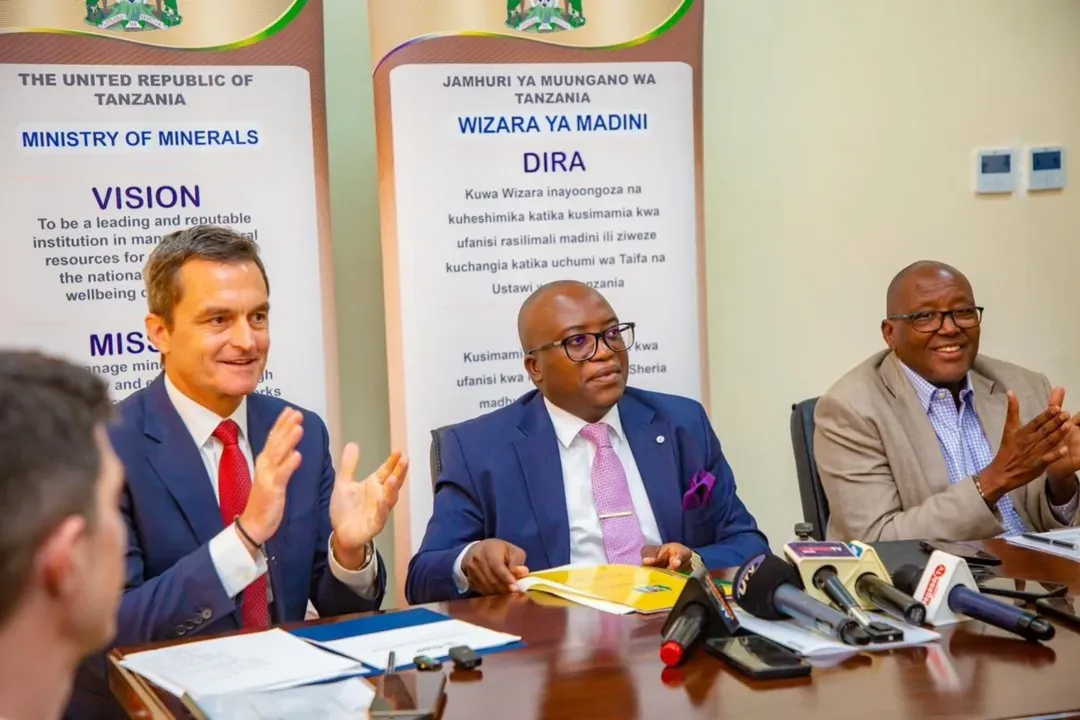
Tanzania’s Minister of Minerals, Antony Mavunde, on Wednesday, January 21, 2026, held discussions with U.S. Chargé d’Affaires Andrew Lentz on graphite exploration partnership involving the U.S. Department of State’s Energy and Mineral Governance Program. The proposed partnership is expected to involve Tanzania’s state-owned mining company, STAMICO, and the Geological Survey of Tanzania (GST).
“There are licenses that are owned by the State Mining Corporation, STAMICO, and under these licenses, we are going to conduct joint exploration with our counterparts through the U.S. Department of Minerals, to identify areas that will attract major investment,” Mavunde told reporters.
He continued: “Therefore, we expect that through this arrangement of working together and especially carrying out in-depth exploration, it will help identify areas where our country has been endowed with resources. Ultimately, this will lead to the establishment of another major mine, particularly in the regions of Mtwara and Lindi, where this exercise has taken place.”
The meeting comes as Tanzania has set a target to complete high-resolution airborne geophysical surveys covering 50 percent of its territory by 2030, up from the current coverage of 16 percent. On March 3, 2025, China dispatched experts to assess Tanzania’s needs for the exercise, and China is expected to be one of the major partners in the initiative.
Graphite is considered one of the most critical defense-related raw materials by NATO and is a key input for the global energy transition. Following China’s announcement of export controls on crucial minerals, including graphite, East African countries rich in the resource—among them Tanzania—are increasingly viewed as one of the alternative suppliers by Western nations seeking to reduce China’s dominance of the graphite supply chain. China remains the world’s largest producer and most influential player in the sector.
Speaking during the meeting, U.S. Chargé d’Affaires Andrew Lentz said the engagement demonstrated Tanzania’s commitment to partnership.
“As the United States of America continues to review the bilateral relationship between the United States and Tanzania, and to consider future opportunities to collaborate as we did in this example,” Lentz said.
“We are going to continue to look for clear examples of our partner Tanzania’s commitment to real partnering with the United States together in diversifying the global critical mineral supply chain,” he added.
On December 4, 2025, the U.S. Department of State announced that it was undertaking a comprehensive review of its relationship with the Government of Tanzania, citing: “Ongoing repression of religious freedom and free speech, the presence of persistent obstacles to U.S. investment, and disturbing violence against civilians in the days leading up to and following Tanzania’s October 29 elections.”
Tanzania’s Diplomatic Efforts
Following the announcement by the U.S. Department of State, Tanzania has intensified efforts to strategically engage the U.S. government. Among these efforts was a visit to Washington, D.C., by the Minister of Foreign Affairs, during which he engaged with some U.S. representatives, though he was unable to secure meetings with senior government officials.
READ: Tanzanian President Holds Talks With U.S. Chargé d’Affaires Amid Diplomatic Pressure Following October 29 Protests
Tanzania has also contracted the lobbying firm Ervin Graves Strategy Group under a 24-month agreement. The firm is expected to leverage Tanzania’s rare earth and critical minerals potential to develop an alignment strategy with U.S. government requirements for such resources. The lobbying effort is focused on engaging both members of Congress and officials in the Executive Branch, areas where the Tanzanian government has struggled to make progress following the killing of civilians during election day protests on October 29 and subsequent days.
Tanzania’s broader strategy to counter post-election diplomatic pressure appears to rest on several areas. These include expectations that public attention will gradually fade, reducing both domestic and international pressure, an outcome complicated by heightened political polarization and social divisions following the disputed election and subsequent crackdown.
The government is also seeking to leverage the country’s natural resources to advance diplomatic engagement. Additionally, some government-aligned analysts believe that increasing global competition with China will eventually soften diplomatic pressure, as Western countries may avoid sustained diplomatic pressure to prevent expanding Beijing’s influence. Other analysts note that on the international stage, the events of October 29 have been overshadowed by other unfolding developments, particularly rising geopolitical tensions between Europe and the United States, as well as the structural erosion of multilateral institutions.
Rate this article
Login to rate this article
Comments
Please login to comment
No comments yet. Be the first to comment!