
Space & Astronomy
12 min read
Watch 3 Massive Solar Eruptions Captured in Stunning Time-Lapse
Live Science
January 21, 2026•1 day ago
AI-Generated SummaryAuto-generated
The European Space Agency's Proba-3 mission captured a time-lapse video of three massive solar prominences erupting. Using an "artificial eclipse," the mission obscurs the sun's bright center to study its faint corona. This footage, combined with data from NASA's Solar Dynamics Observatory, offers unprecedented detail on solar surface and corona interactions, potentially helping scientists understand the corona's extreme temperature, a major solar mystery.
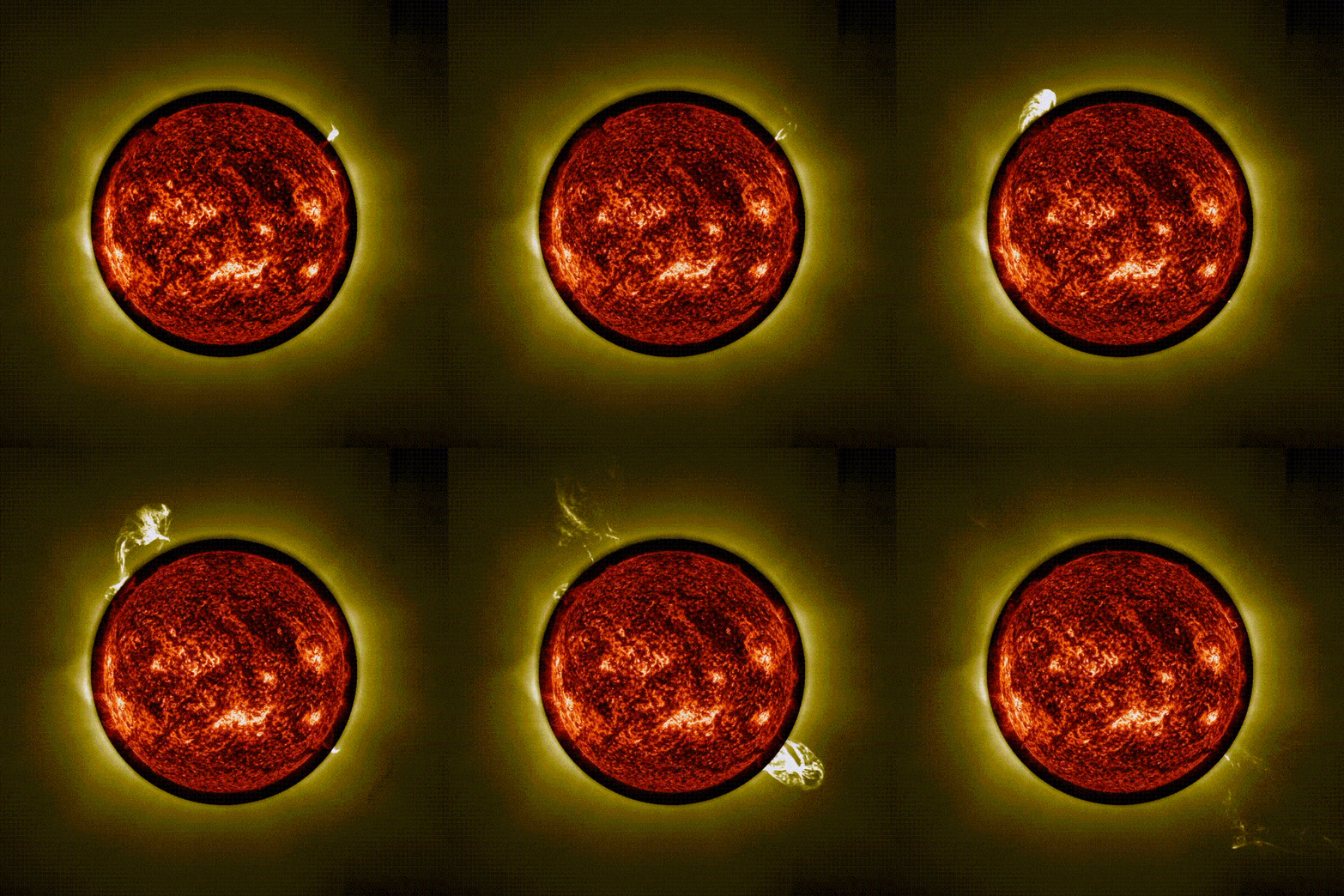
The European Space Agency (ESA) has released a stunning time-lapse of a trio of solar eruptions exploding into space from the sun during an "artificial eclipse." The unique footage, captured by the newly operational Proba-3 mission, could help scientists unravel one of the biggest mysteries surrounding our home star, researchers say.
The Proba-3 mission consists of two probes, dubbed the coronagraph and the occulter, which were launched into a highly elliptical orbit around Earth in December 2024. By perfectly aligning the coronograph behind the occulter, scientists can view the sun with its bright center fully obscured, just like we see from the planet's surface during a solar eclipse — but more frequently and over longer periods of time. This allows researchers to study the hidden subtleties of the sun's faint atmosphere, or corona, like never before.
The new video, released by ESA on Jan. 19, shows footage from a five-hour "eclipse" on Sept. 2, 2025, sped up into a four-second clip. The yellow light surrounding the sun is the corona, viewed by Proba-3's coronograph with a helium filter. In the center, scientists have superimposed footage of the solar surface captured concurrently by NASA's Solar Dynamics Observatory. With data from both spacecraft combined, researchers can see how the sun's surface and corona interact in unprecedented detail.
Three major plasma plumes shoot out of the sun during the video. At first glance, these look like solar flares — the massive explosions that can hurl solar storms toward Earth. However, when you look closely at the solar disk, there are no bright flashes, which are the telltale signs of a flare. Instead, what we are seeing are what researchers refer to as prominences, which are towering loops of plasma on the sun's surface that overextend and snap, flinging their ionized gas into space.
While they are less powerful than flares, prominences are equally valuable to researchers because they are usually harder to spot, Andrei Zhukov, a researcher at the Royal Observatory of Belgium and principal investigator of Proba-3's coronograph, explained in a statement. "Seeing so many prominence eruptions in such a short timeframe is rare, so I'm very happy we managed to capture them so clearly during our observation window."
The bright light emitted by the prominence eruptions suggests they are significantly hotter than the surrounding corona. But in reality, their plasma is much cooler — only "around 10,000 degrees" compared to the million-degree corona, Zhokov said.
The extremely high temperature of the corona, which is "around 200 times hotter than the sun's surface," is one of the sun's biggest remaining mysteries, Zhukov said. To date, scientists have struggled to explain why the corona is so much hotter than the rest of the sun, and footage like this could be the key to figuring it out, he added.
All eyes on the sun
Proba-3 has now observed at least 50 different artificial eclipses since beginning operations around seven months ago, and will hopefully collect hundreds more in the coming years, according to ESA. But it is not the only new technology that is making waves in the solar physics community.
For example, in June 2025, NASA's CODEX telescope, affixed to the exterior of the International Space Station, collected its first images of the sun, revealing never-before-seen perturbations in the corona linked to solar wind.
Last year, the Daniel K. Inouye Solar Telescope in Hawaii and ESA's Solar Orbiter — both of which came online in 2021 — also captured the most detailed photo of the sun's surface and the first-ever image of the sun's south pole, respectively.
NASA's Parker Solar Probe, which has been repeatedly swooping closer to the sun than any spacecraft before it, has also captured some stunning photos of our home star that could help unravel multiple solar secrets.
Rate this article
Login to rate this article
Comments
Please login to comment
No comments yet. Be the first to comment!