
Space & Astronomy
12 min read
SPHEREx Satellite Mission: A New Era in Near-Infrared Astronomy
astrobiology.com
January 20, 2026•2 days ago
AI-Generated SummaryAuto-generated
NASA's SPHEREx satellite, launched March 2025, is conducting the first all-sky near-infrared spectral survey. It aims to create a large galaxy redshift survey to constrain inflationary non-Gaussianity and map the abundance of water and biogenic ices in the interstellar medium. Data, including spectral images, are rapidly released to the public.
SPHEREx, a NASA explorer satellite launched on 11 March 2025, is carrying out the first all-sky near-infrared spectral survey. The satellite observes in 102 spectral bands from 0.75 to 5.0 um with a resolving power ranging from 35 to 130 in 6.2 arcsecond pixels.
The observatory obtains a 5-sigma depth of 19.5 – 19.9 AB mag for 0.75 to 3.8 um and 17.8 – 18.8 AB mag for 3.8 to 5.0 um after mapping the full sky four times over two years. Scientifically, SPHEREx will produce a large galaxy redshift survey over the full sky, intended to constrain the amplitude of inflationary non-Gaussianity.
The observations will produce two deep spectral maps near the ecliptic poles that will use intensity mapping to probe the evolution of galaxies over cosmic history.
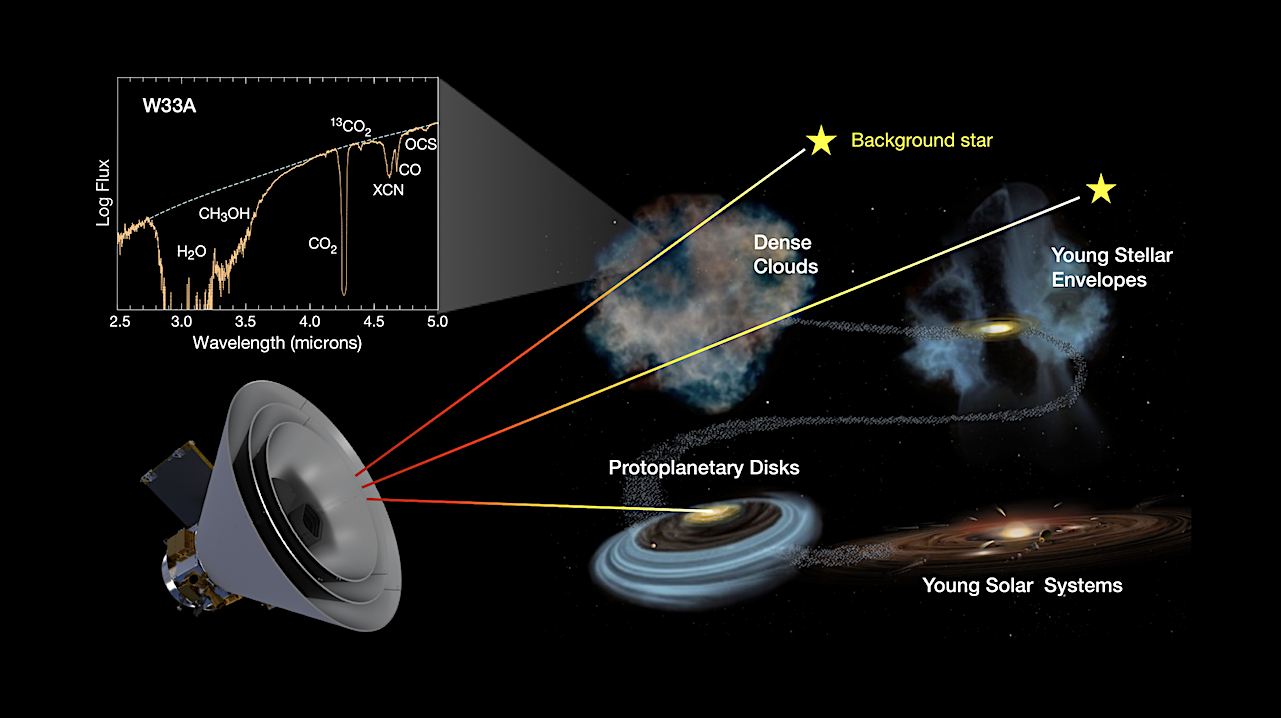
By mapping the depth of infrared absorption features over the Galactic plane, SPHEREx will comprehensively survey the abundance and composition of water and other biogenic ice species in the interstellar medium.
The initial data are rapidly released in the form of spectral images to the public. The project will release specialized data products over the life of the mission as the surveys proceed.
The science team will also produce specialized spectral catalogs on planet-bearing and low-mass stars, solar system objects, and galaxy clusters 3 years after launch.
We describe the design of the instrument and spacecraft, which flow from the core science requirements. Finally, we present an initial evaluation of the in-flight performance and key characteristics.
James J. Bock, Asad M. Aboobaker, Joseph Adamo, Rachel Akeson, John M. Alred, Farah Alibay, Matthew L. N. Ashby, Yoonsoo P. Bach, Lindsey E. Bleem, Douglas Bolton, David F. Braun, Sean Bruton, Sean A. Bryan, Tzu-Ching Chang, Shuang-Shuang Chen, Yun-Ting Cheng, James R. Cheshire IV, Yi-Kuan Chiang, Jean Choppin de Janvry, Samuel Condon, Walter R. Cook, Asantha Cooray, Brendan P. Crill, Ari J. Cukierman, Olivier Dore, C. Darren Dowell, Gregory P. Dubois-Felsmann, Tim Eifler, Spencer Everett, Beth E. Fabinsky, Andreas L. Faisst, James L. Fanson, Allen H. Farrington, Tamim Fatahi, Candice M. Fazar, Richard M. Feder, Eric H. Frater, Henry S. Grasshorn Gebhardt, Utkarsh Giri, Tatiana Goldina, Varoujan Gorjian, Salman Habib, William G. Hart, Chen Heinrich, Joseph L. Hora, Zhaoyu Huai, Howard Hui, Young-Soo Jo, Woong-Seob Jeong, Jae Hwan Kang, Miju Kang, Branislav Kecman, Chul-Hwan Kim, Jaeyeong Kim, Minjin Kim, Young-Jun Kim, Yongjung Kim, J. Davy Kirkpatrick, Yosuke Kobayashi, Phil M. Korngut, Elisabeth Krause, Bomee Lee, Ho-Gyu Lee, Jae-Joon Lee, Jeong-Eun Lee, Carey M. Lisse, Giacomo Mariani, Daniel C. Masters, Philip D. Mauskopf, Gary J. Melnick, Mary H. Minasyan, Jordan Mirocha, Hiromasa Miyasaka, Anne Moore, Bradley D. Moore, Giulia Murgia, Bret J. Naylor, Christina Nelson, Chi H. Nguyen, Hien T. Nguyen, Jinyoung K. Noh, Stephen Padin, Roberta Paladini, Sung-Joon Park, Konstantin I. Penanen, Dustin S. Putnam, Jeonghyun Pyo, Nesar Ramachandra, Keshav Ramanathan, Zafar Rustamkulov, Daniel J. Reiley, Eric B. Rice, Jennifer M. Rocca, Ji Yeon Seok, Roger Smith, Jeremy Stober, Sara Susca, Harry I. Teplitz, Michael P. Thelen, Volker Tolls et al. (14 additional authors not shown)
Comments: 30 pages, 21 figures. Accepted by Astrophysical Journal on 9 December 2025
Subjects: Instrumentation and Methods for Astrophysics (astro-ph.IM); Cosmology and Nongalactic Astrophysics (astro-ph.CO); Astrophysics of Galaxies (astro-ph.GA); Solar and Stellar Astrophysics (astro-ph.SR)
Cite as: arXiv:2511.02985 [astro-ph.IM] (or arXiv:2511.02985v2 [astro-ph.IM] for this version)
https://doi.org/10.48550/arXiv.2511.02985
Focus to learn more
Related DOI:
https://doi.org/10.3847/1538-4357/ae2be2
Focus to learn more
Submission history
From: James Bock
[v1] Tue, 4 Nov 2025 20:43:51 UTC (16,075 KB)
[v2] Mon, 15 Dec 2025 18:00:22 UTC (17,434 KB)
https://arxiv.org/abs/2511.02985
Astrobiology, Astrochemistry,
Rate this article
Login to rate this article
Comments
Please login to comment
No comments yet. Be the first to comment!