
Space & Astronomy
15 min read
ESA's Smart Space Gym: Keeping Astronauts Fit for Mars Missions
Earth.com
January 21, 2026•1 day ago
AI-Generated SummaryAuto-generated
The European Space Agency has developed the E4D, a compact exercise device for astronauts on long missions. It combines four exercise types, supports high resistance, and features a self-monitoring system with motion capture for real-time posture correction. This innovation aims to preserve muscle and bone health in microgravity, reduce reliance on ground control, and prepare astronauts for future deep-space exploration.
Keeping astronauts healthy in space is not easy. Gravity almost disappears, which makes muscles weaker, bones thinner, and the heart weaker over time.
On long missions to the Moon or Mars, astronauts must land and start working right away. Good health is not optional. It is essential for safety and mission success.
To address the challenge, the European Space Agency (ESA) has created a new exercise machine for space. The device is called the European Enhanced Exploration Exercise Device, or E4D.
This compact system helps astronauts stay strong while living and working in microgravity.
Why exercise matters in space
On Earth, gravity keeps muscles and bones active every day. In space, the body does not need to work as hard.
Without exercise, muscle and bone loss happen quickly. The heart and circulatory system also weaken. For deep-space missions, this risk becomes even more serious.
ESA designed E4D to help ensure astronauts stay physically ready. The device allows regular training that prepares the body for returning to Earth or stepping onto another planetary surface.
What makes E4D different
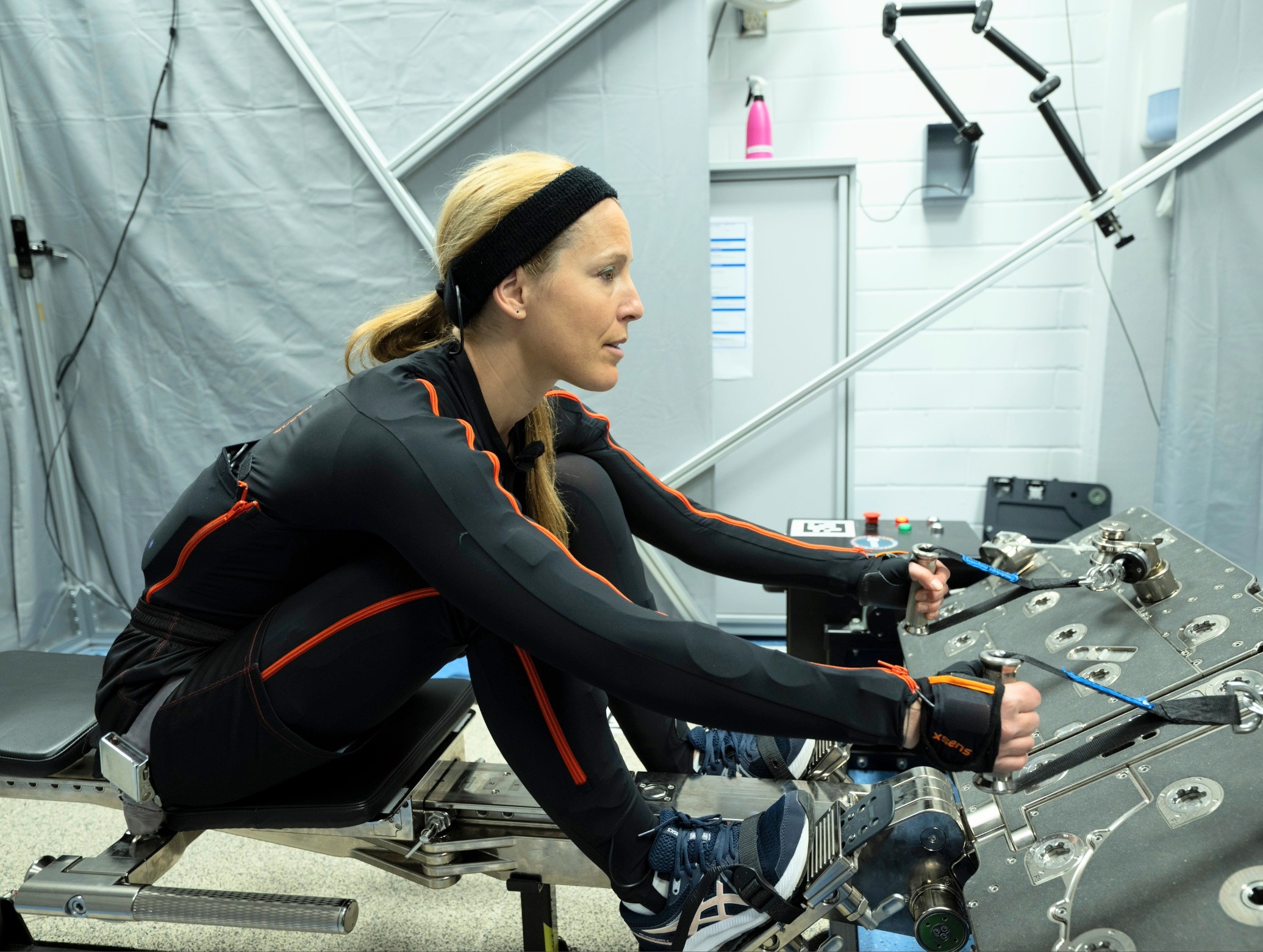
E4D combines four types of exercise in one system. Astronauts can perform resistance training, cycling, rowing, and rope pulling. This variety keeps workouts effective and engaging. New exercises can also be added later.
“E4D is a game-changer for astronaut health,” said Tobias Weber, ESA’s E4D principal investigator.
“By enabling a broader and more adaptable range of resistance exercises, it supports the preservation of muscle mass and bone integrity in microgravity, which are two of the biggest physiological challenges during long missions.”
The device supports loads up to 270 kilograms (about 595 pounds). It can change resistance during lifting or lowering movements, allowing better control and safer training in space.
Training without ground support
Space missions beyond Earth orbit face communication delays. Astronauts cannot depend on constant guidance from Earth. E4D includes a smart self-monitoring system to address this challenge.
“Just as important is E4D’s self-monitoring capability,” said Jennifer Struble, ESA’s Operations Team Lead for E4D.
“Using an integrated camera-based motion capture system, it allows astronauts to track their performance, evaluate their movement execution, and self-correct posture in real time.”
“This reduces reliance on ground supervision and helps ensure that every training session remains safe, precise, and effective, even in the demanding environment of orbit.”
Four cameras track body movements during exercise. The system creates a digital avatar that appears on a tablet. Astronauts can correct posture instantly, lowering the risk of injury.
An astronaut’s view on E4D
ESA astronaut Sophie Adenot is preparing for the εpsilon mission. She has already started training with E4D on Earth.
“E4D is a system I’m really looking forward to using during the εpsilon mission,” said astronaut Sophie Adenot.
“I really enjoy exercising for both physical and mental well-being and since it’s especially important to protect our bones and muscles in microgravity.”
Exercise also supports mental health. Long missions can feel stressful and isolated. Physical activity helps reduce stress and improve focus.
A gym and a science lab
E4D works as more than a fitness machine. Scientists also use it as a research tool. By comparing space exercise data with Earth-based tests, researchers learn how microgravity changes strength, movement, and recovery.
The motion capture system sends real time-data to Earth. Future upgrades may include machine learning and virtual reality.
Exercise experts could guide astronauts through virtual spaces, even when separated by thousands of miles.
Designed for future missions
Future space stations like the lunar Gateway will have less room than the International Space Station. Current exercise machines are too large and heavy. E4D offers a smaller, more efficient solution.
The current version serves as a technology demonstrator. ESA plans to develop even more compact systems based on test results.
E4D will arrive at the International Space Station in April 2026 during Sophie Adenot’s εpsilon mission. Crew members will test up to 100 exercise variations.
The European Columbus module will host the system, making E4D ESA’s largest payload by operational responsibility.
Commissioned by ESA, developed by the Danish Aerospace Company, and supported by motion capture technology from Qinematic in Sweden, E4D represents a major step forward in astronaut health.
As space missions move farther from Earth, strong bodies and smart technology become vital. E4D shows how Europe is preparing astronauts for the future of human space exploration.
Image credit: ESA – S. Corvaja
—–
Like what you read? Subscribe to our newsletter for engaging articles, exclusive content, and the latest updates.
Check us out on EarthSnap, a free app brought to you by Eric Ralls and Earth.com.
—–
Rate this article
Login to rate this article
Comments
Please login to comment
No comments yet. Be the first to comment!