
Space & Astronomy
8 min read
Earth Braces for Impact: X-Class Solar Flare and CME Arrive
NewsBytes
January 19, 2026•3 days ago
AI-Generated SummaryAuto-generated
The Sun has released an X-class solar flare and a fast coronal mass ejection (CME) directed at Earth. The CME is predicted to arrive within 24 hours, potentially causing strong geomagnetic storms. This could lead to visible auroras in lower latitudes, such as Northern California and Alabama. The storm's intensity depends on the CME's magnetic orientation.
By Mudit Dube
Jan 19, 2026 05:15 pm
What's the story
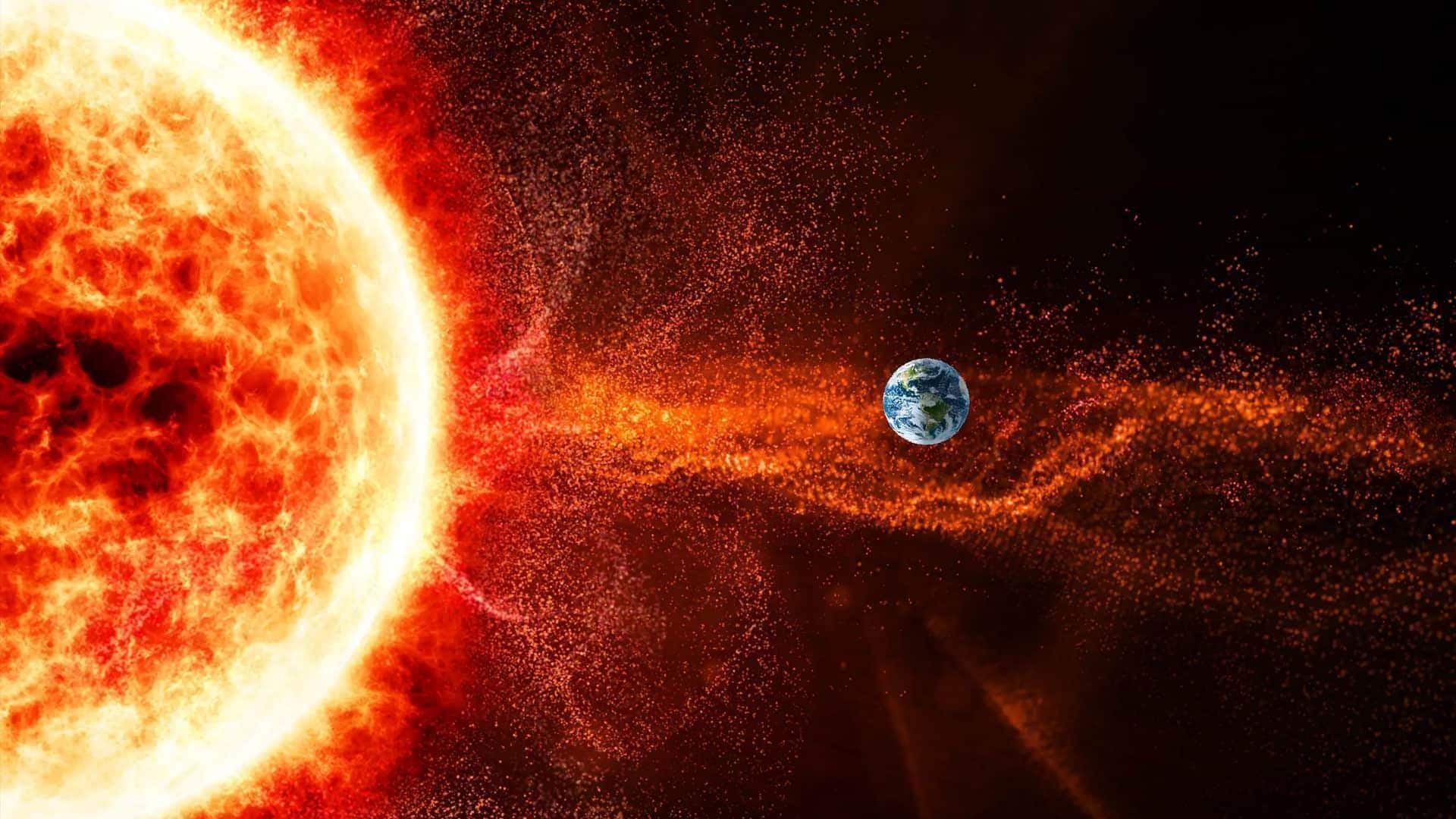
The Sun has unleashed a powerful X-class solar flare, along with a fast-moving coronal mass ejection (CME) headed straight for Earth. The CME is expected to hit our planet within the next 24 hours, possibly triggering strong geomagnetic storm conditions. If the predictions hold true, we could see stunning northern lights as far south as Northern California and Alabama.
Magnetic influence
CME's impact on Earth depends on its magnetic orientation
The impact of a CME on Earth is determined by its speed, direction, and most importantly, its magnetic orientation. If the CME's magnetic field is oriented southward (a component called Bz), it can easily connect with Earth's northward-pointing magnetic field. This allows energy to flow into our planet's magnetosphere and trigger geomagnetic storm conditions. However, if the Bz is oriented northward, Earth's magnetic field largely deflects incoming energy.
Solar strength
X-class solar flares: The strongest eruptions
Solar flares are classified from A, B, C, and M to X, with each letter representing a tenfold increase in intensity. X-class flares are the most powerful eruptions and the number that follows indicates how intense the event is. Today's flare was rated at X1.9, placing it among the strongest solar outbursts. The powerful flare from sunspot region AR4341 peaked at 1:09pm EST, according to NOAA's Space Weather Prediction Center.
Advertisement
CME impact
What is a CME and its potential effects on Earth?
A CME is a huge burst of plasma from the Sun, complete with a magnetic field. If it collides with Earth's magnetosphere (the protective magnetic "bubble" created by our planet), it can cause a geomagnetic storm. These storms vary in intensity and are rated from minor (G1) to extreme (G5). The UK Met Office's latest forecast indicates that the incoming CME could create strong (G3) to severe (G4) geomagnetic storm conditions.
Advertisement
Storm effects
Potential disruptions and enhanced auroras from geomagnetic storms
Geomagnetic storms can disrupt satellite operations, degrade GPS navigation, and increase atmospheric drag on spacecraft. They can also supercharge auroral activity, potentially bringing the northern lights far beyond their typical high-latitude regions. The impending CME could cause strong to severe geomagnetic storm conditions, making it a major event for space weather forecasters and aurora enthusiasts alike.
Rate this article
Login to rate this article
Comments
Please login to comment
No comments yet. Be the first to comment!