
Politics
6 min read
Nanta: Smart Lanes Significantly Reduce Road Accidents
The Star
January 21, 2026•1 day ago
AI-Generated SummaryAuto-generated
Works Minister Datuk Seri Alexander Nanta Linggi stated that smart lanes significantly reduce accident rates, citing a 22% drop on one stretch and 74% on another. He attributed most smart lane accidents to human error, such as speeding or improper lane changes. The government employs patrols, signage, CCTV monitoring, and inter-agency collaboration to ensure safety, emphasizing that travel time reduction does not compromise road safety standards.
KUALA LUMPUR: Accident rates in smart lane zones on highways are extremely low when compared to the number of vehicles that use the lane, says Datuk Seri Alexander Nanta Linggi.
The Works Minister said an analysis on various smart lane locations also revealed a sharp reduction in the number of accidents in comparison to the period prior to smart lane activation.
Citing the smart lane from Putra Mahkota to Southville, he said there was a 22% reduction in accidents.
The smart lane from R&R Rawang to the Rawang junction meanwhile recorded a 74% drop in accidents.
Nanta said the majority of accidents in smart lanes are not due to road design but human error.
“This includes speeding in smart lanes, changing lanes dangerously without providing any signal indicator and using the smart lane outside of its operation hours,” he told the Dewan Rakyat on Wednesday (Jan 21).
He was responding to a question by Manndzri Nasib (BN-Tenggara) who asked about measures being taken to curb the risk of accidents in smart lanes.
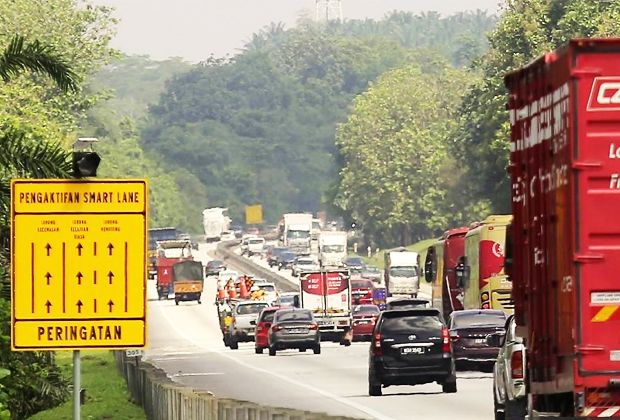
Smart lanes refer to the activation of emergency lanes to ease traffic congestion during peak travel periods.
According to Nanta, safety patrols are carried out by highway concessionaire and Malaysian Highway Authority (LLM) personnel prior to smart lane activation, ensuring there are no disruptions there.
Notice boards are also stationed 1km and 500m prior to smart lane activation, with closed-circuit television systems used to monitor traffic conditions in real-time.
Among other measures include the use of portable variable messaging systems to inform users on smart lane activation hours.
“LLM and highway concessionaires also work closely with the police and road transport department to ensure heavy vehicles do not use smart lanes,” he said.
Nanta assured that safety audits are carried out periodically at all smart lane locations.
He said that while smart lanes reduce travel time, there is no compromise on road safety standards.
Rate this article
Login to rate this article
Comments
Please login to comment
No comments yet. Be the first to comment!