
Geopolitics
30 min read
Senegal Revokes Oranto Petroleum License Amid Liberia Deal Fallout
FrontPageAfrica
January 19, 2026•3 days ago
AI-Generated SummaryAuto-generated
Senegal revoked Oranto Petroleum's offshore license due to failure to provide financial guarantees, prompting concerns in Liberia. Liberia recently ratified oil exploration deals with Oranto Petroleum and TotalEnergies. Critics question Oranto's past performance and the transparency of the Liberian deal, citing concerns about national benefit and contractual terms. The situation highlights ongoing debates about resource management and transparency in Liberia.
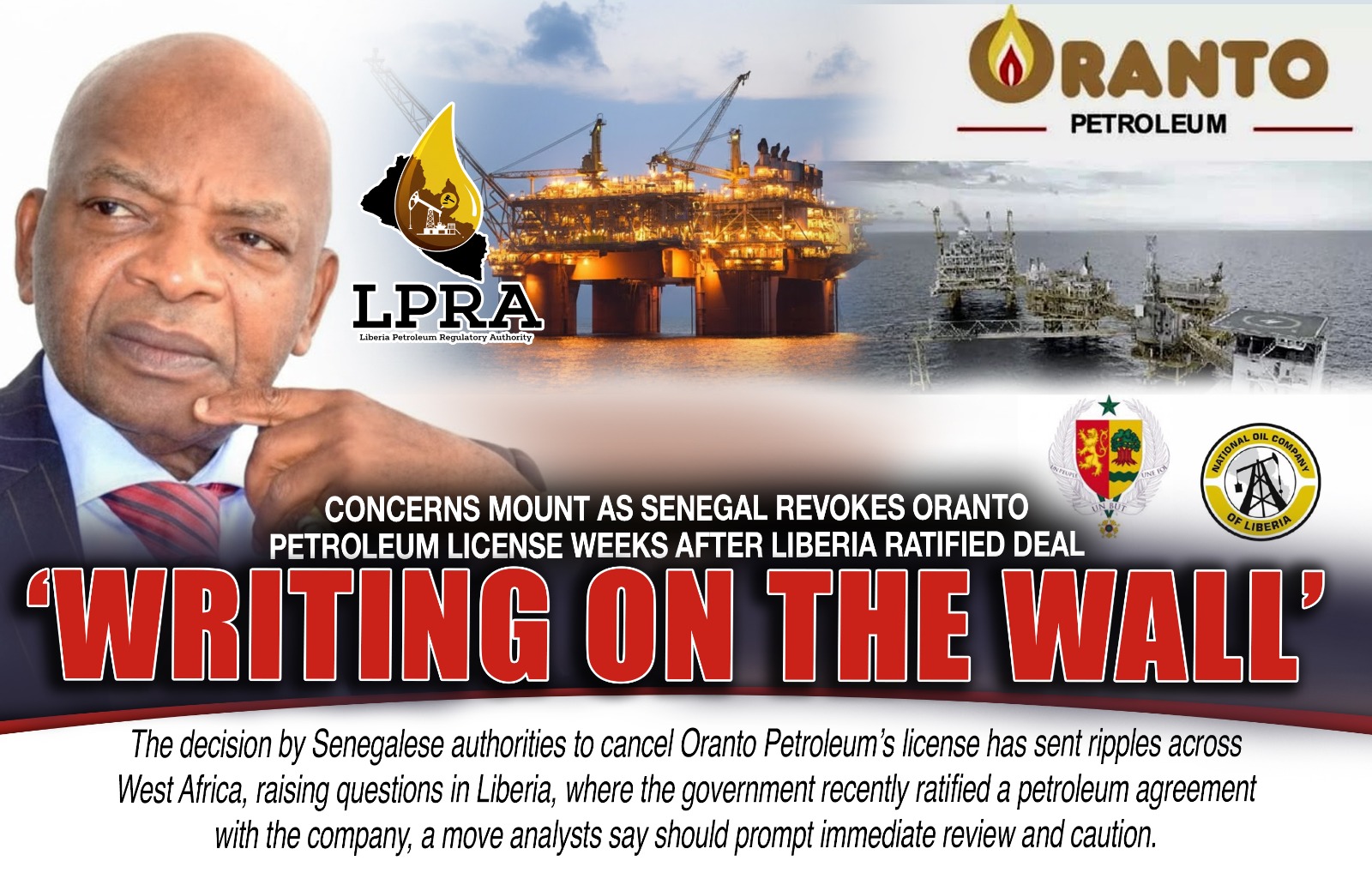
MONROVIA – Concerns are rising across the West African sub-region following the decision by the Government of Senegal to revoke an offshore petroleum license held by Nigerian oil firm Oranto Petroleum.
By Selma Lomax, selma.lomaxfrontpageafricaonline.com
The African Energy Chamber announced on January 13 that Senegal’s Ministry of Energy and Petroleum had withdrawn Oranto Petroleum’s license for the Cayar Offshore Shallow block and assumed full state control of the asset. According to information released by the Chamber, the decision came after repeated formal demands by Senegal’s Minister of Energy, Birame Soulèye Diop, for Oranto to submit adequate financial guarantees to back its agreed work programme under the contract.
Senegalese authorities said the company failed to meet those requirements within the stipulated timeframe, prompting the State to act in line with national petroleum legislation and contractual provisions.
Government officials in Dakar explained that the revocation followed a comprehensive legal, technical and regulatory review conducted by relevant authorities. The review assessed Oranto’s compliance with its contractual obligations, including its financial capacity, execution of exploration commitments and adherence to agreed timelines.
Under Senegal’s upstream petroleum governance framework, officials said the failure to provide financial guarantees constituted sufficient grounds for the license to revert to the State.
The African Energy Chamber said the action demonstrated Senegal’s firm stance on contractual discipline and regulatory enforcement, emphasizing that financial guarantees are essential to ensure that license holders have the capacity to carry out exploration and appraisal activities effectively.
The Chamber noted that the Senegalese government views strict enforcement as necessary to protect national interests, avoid prolonged inactivity in licensed blocks and maintain investor confidence in the sector.
Oranto Petroleum is a privately owned Nigerian oil and gas exploration and production company with operations and licenses across several African countries. The company generally focuses on early-stage exploration and technical work, often relying on partnerships to finance drilling and development. In Senegal, Oranto was awarded the Cayar Offshore Shallow block in 2008 but did not drill any wells over more than a decade and reportedly invested only limited funds in exploration activities. Industry sources indicate that the company faced difficulties attracting partners willing to co-invest in advancing the block.
The Cayar Offshore Shallow block is located north of the Dakar peninsula and forms part of Senegal’s shallow-water exploration portfolio.
It contains 13 identified leads and is considered oil-prone, with some prospects believed to hold several hundred million barrels of oil in place. Compared to Senegal’s deepwater acreage, the area has remained relatively underexplored, allowing the State to reconsider its potential and decide whether to re-license the block or include it in future licensing rounds.
The African Energy Chamber stressed that the license withdrawal should not be interpreted as a signal of reduced openness to private sector participation, stating that Senegal remains committed to working with international and indigenous oil and gas companies that demonstrate strong technical expertise, financial capacity and long-term commitment aligned with national priorities and international best practices.
The development has drawn particular attention in Liberia, where the House of Representatives recently approved two major oil exploration agreements involving TotalEnergies and Oranto Petroleum following a divisive and highly charged legislative process.
The agreements were passed by majority vote, despite objections from opposition lawmakers, former officials and civil society actors who raised concerns about transparency, legality and long-term national benefit.
Under the TotalEnergies agreements, the French energy company signed four Production Sharing Contracts for offshore blocks LB-6, LB-11, LB-17 and LB-29 in the Liberian Basin under the 2024 Direct Negotiation Licensing Round. Government officials have described the TotalEnergies deal as a significant step toward reviving exploration in Liberia’s deepwater basins through seismic surveys and possible drilling, marking the first major international upstream engagement in the country in more than a decade.
Alongside the TotalEnergies contracts, Atlas Oranto Petroleum Liberia Limited, a subsidiary of the Oranto Petroleum group, signed Production Sharing Contracts for offshore blocks LB-15, LB-16, LB-22 and LB-24.
The Oranto agreement includes signature bonuses and exploration commitments but has faced intense scrutiny due to the company’s past record in Liberia and other African jurisdictions.
Debate over the Oranto deal dominated proceedings in the House of Representatives, with reports of heated arguments, walkouts and accusations of procedural irregularities. Critics reminded lawmakers that Oranto previously held oil blocks in Liberia in 2007 under the administration of former President Ellen Johnson Sirleaf but failed to drill any wells. Those blocks were later transferred to Chevron, a move critics say allowed Oranto to benefit financially while Liberia gained little in return.
Former Finance Minister and current Gbarpolu County Senator Amara Konneh emerged as one of the strongest critics of the agreement. In public statements and social media posts, Konneh warned that Oranto’s operational history across Africa showed a recurring pattern of acquiring licenses, delaying activity for years and ultimately losing or transferring concessions when governments became frustrated.
Senator Konneh cited Oranto’s experiences in Senegal, Uganda and Equatorial Guinea as cautionary examples and argued that Liberia risked repeating past mistakes if it failed to carry out thorough and independent due diligence.
While expressing support for credible investors such as TotalEnergies, Konneh insisted that Oranto’s record warranted heightened scrutiny. He also emphasized that the Government of Liberia should independently fund and manage the due diligence process to safeguard national interests, warning against complacency and the recycling of failed approaches.
Former Speaker of the House, Cllr. J. Fonati Koffa, also voiced strong opposition, describing the Oranto agreement as illegal and exploitative. Koffa argued that the deal violated provisions of the 2019 Petroleum Law that guarantee a 5 percent ownership stake for Liberians and a separate 10 percent stake for the National Oil Company of Liberia. According to him, the agreement merged both interests into a single 15 percent stake controlled by NOCAL, effectively eliminating the direct ownership rights of the Liberian people.
Representative Koffa further criticized the signature bonus of about 1.2 million United States dollars, comparing it to higher bonuses paid by investors in neighboring countries such as Ghana. He warned that clauses in the agreement could allow Oranto to take over NOCAL’s shares if the national oil company failed to meet its financial obligations within 180 days of an oil discovery. Representative Koffa called for full publication of the contract and threatened legal action if the deal proceeded without amendments.
Supporters of the agreement rejected those criticisms, arguing that opponents were misrepresenting the law and undermining investor confidence. Cllr. Kanio Bai Gbala, an assistant professor of law at the Louis Arthur Grimes School of Law, defended the deal in a public commentary, stating that the interest assigned to NOCAL represented a national share held on behalf of all Liberians.
He argued that Liberia’s petroleum laws allow flexibility in negotiations, particularly given the high-risk and unexplored nature of the country’s offshore blocks.
Gbala dismissed comparisons with Ghana as economically misleading and accused critics of politicizing the issue. He warned that sustained public attacks on legally approved agreements could damage Liberia’s credibility and discourage future investment at a time when the country is seeking economic recovery.
His defense, however, was sharply criticized by Jefferson Chesson of the opposition Coalition for Democratic Change, who accused supporters of the deal of attempting to sell Liberia’s future at a discount. Chesson argued that Liberia’s unexplored resources should be treated as leverage rather than weakness and insisted that the 5 percent Liberian ownership stake must remain separate from NOCAL’s share.
Analysts say the controversy surrounding the Oranto deal reflects deeper structural challenges in Liberia, including weak negotiation capacity, fragile institutional oversight and a long history of failing to translate natural resource wealth into broad-based development. From iron ore and rubber to forestry and gold, Liberia’s resource sector has often been characterized by large concessions with limited benefits for ordinary citizens.
Recent economic assessments indicate that while Liberia’s macroeconomic conditions have stabilized, growth remains slow and insufficiently job-rich. Economists argue that oil could be transformative if managed transparently and responsibly, but warn that poorly structured agreements could reinforce dependency and elite capture.
With the agreements now ratified, attention is shifting to implementation, oversight and the government’s willingness to address transparency and accountability concerns, a process many observers say will determine whether Liberia’s oil ambitions become a source of shared prosperity or another missed opportunity.
Rate this article
Login to rate this article
Comments
Please login to comment
No comments yet. Be the first to comment!