
Technology
15 min read
The Crucial Role of Rope Cover Technology in Modern Marine Rigging
Sailing World
January 19, 2026•3 days ago
AI-Generated SummaryAuto-generated
Rope cover technology is evolving, moving beyond core focus to enhance performance, longevity, and safety. Advanced triple-blend covers, incorporating materials like Vectran and Dyneema, offer improved grip, slippage control, and abrasion resistance. These developments benefit both large yachts and smaller dinghies, ensuring more precise control and extended rope lifespan.
For sailors, riggers and manufacturers, the focus of rope technology has long been on the core, rope covers a mere consideration. But today, far more sophisticated covers are being realized for better rope performance, longevity and safety. Chris Manson-Hing, an authority in marine rigging at Marlow Ropes, argues that cover construction is now the topic of conversation.
For the average sailor, cordage has not evolved much over the last 10 years,” Manson-Hing says. “We haven’t seen major changes with cover technology until now. That’s the interface that you are touching and that your hardware is touching. It’s the cover that’s protecting the core and this is what’s going to give you strength in the rope.”
For Manson-Hing and engineers at Marlow, technical cover development has been hand-in-hand with top riggers and grand prix programs that demand precision control of highly-loaded ropes that take beatings from aggressive winch drums, clutches and blocks. This has now enabled Marlow to bring advanced, tried and tested products to club racers and dinghy sailors.
“For the everyday performance cruiser or club racer with modern sails, hardware and mast technology there also needs to be a new standard of performance in their rope.” Manson-Hing says.
The majority of failures that he has seen point to the cover as the culprit. “That’s due to improper cover materials being used, and that’s where you’re putting the core at risk,” he says, “and that’s where the breakages happen.”
And that’s where Marlow’s development of “triple-blend” covers comes into the conversation. The workhorse raceboat blend for most cordage manufacturers is polyester and Technora, but Marlow goes beyond with one blend of polyester, Technora and Vectran, a combination that’s ideal for runner tails, spinnaker sheets and jib sheets.
“With anything that’s being eased and trimmed continuously, especially around a winch drum, we need to consider heat and having a good balance of grip and slippage,” Manson-Hing says. The rope’s Technora and polyester elements provide grip when trimming the sail or runner tail and adding Vectran as a third fiber adds strength and abrasion resistance, while allowing slippage for smoother and more controlled eases on a winch drum.
“It’s going to give you more finite control and prevent that jumping motion you feel when you ease any line,” Manson-
Hing says, “so you’re going to be more active with trimming, experimenting and making smaller adjustments.”
A second new triple-blend uses Technora, Dyneema and polyester. While Dyneema lacks heat resistance, it is lighter and delivers chafe resistance and durability in more static applications—think tack lines and halyards on cabin-top winches. For a controlled ease of a loaded halyard for example, this blend allows for multiple wraps. “Because it’s a bit more slippery, you’re going to have more control of a drop or ease with more wraps,” Manson-Hing says. “Being able to have a controlled ease, without having to push the rope around the drum, is a gain for any situation.”
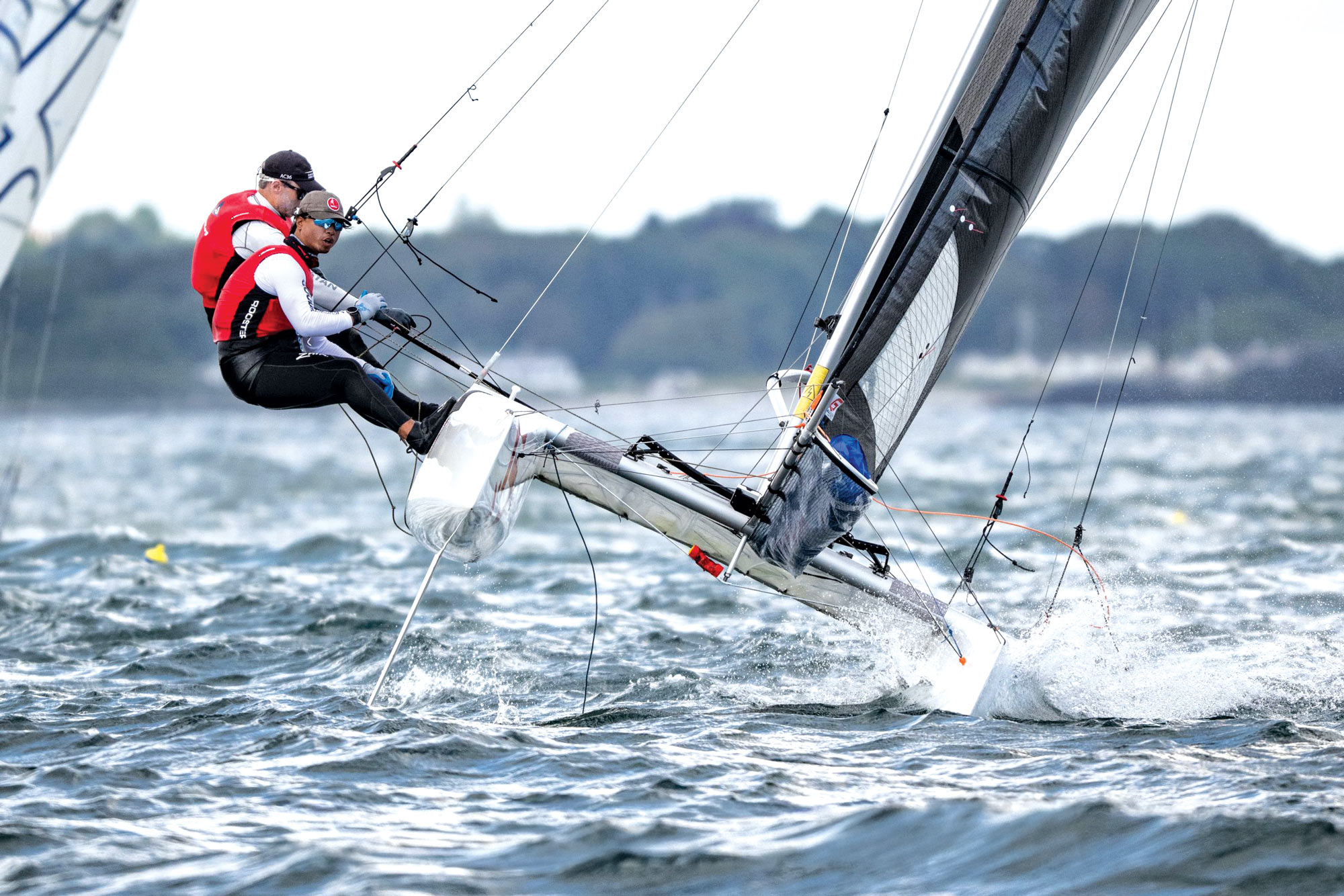
The benefits of these blended covers go beyond big boats with winches. Manson-Hing is an avid Formula 18 catamaran sailor, who enjoys the fruits of Marlow’s recent developments in its high-performance, small-boat range. Whereas winches eat lines on the big boats, more aggressive ratchet-block sheaves on dinghies and sportboats are cover munchers too.
“The trend in the dinghy market is to go to smaller diameters, but there is a limit to that,” Manson-Hing says. “What we really need is something that can give millimeter precision control but also grip when the puff hits and you need to ease sheet. And we need it to last.”
Marlow’s solution is to right-size lines for modern sheaves while reaping the benefits of a triple-blend approach. As the key technical fibers, Dyneema in the cover ensures durability and slip for sheet while Technora delivers grip in the sheave and hand when the load is static.
“Having more contact space with the ratchet, you’re giving yourself the same exact feeling of adding more wraps to the winch,” Manson‑Hing says, “and you’re now giving yourself the opportunity to ease in a controlled manner.”
As validation, he says, he finds himself using the mainsheet cam cleat less and less as the line runs so well and is easy to adjust downwind, also he’s now getting three times the life out of a set of sheets.
Manson-Hing emphasizes that high-quality rope is never going to be inexpensive, but it will last longer. What is expensive is replacing rope often or losing a sail overboard.
“I’ve found that we’ve been getting so much more time out of the same equipment,” he says, “and investing in the right rope that lasts through multiple seasons then allows you to invest in the hardware as well.”
Rate this article
Login to rate this article
Comments
Please login to comment
No comments yet. Be the first to comment!