
Sports
12 min read
Padma Chorol: Leading the Charge for Indian Women's Ice Hockey
olympics.com
January 21, 2026•1 day ago
AI-Generated SummaryAuto-generated
Padma Chorol, a pioneer in Indian women's ice hockey, began her journey in Ladakh. Overcoming limited opportunities and facilities, she trained with boys due to the absence of female teams. Chorol became a founding member of the national team in 2016, which achieved a historic bronze medal in the 2019 IIHF Women's Challenge Cup of Asia. The team later secured another bronze in 2025, marking significant progress despite persistent challenges.
Before becoming a well-known name in Indian women’s ice hockey, Padma Chorol’s sporting journey began on the speed skating tracks of Ladakh.
In a region where opportunities for girls were limited and facilities almost non-existent, Padma became a trailblazer in the course of her decade-old career on ice.
Sport ran in the family. Padma’s brothers - Nawang Stupdan and Tainang Dorge - played a decisive role in her journey, which began when she was just 10 years old.
Their constant encouragement pushed Padma towards competitive ice hockey at a time when girls were rarely seen on such a surface.
“They always motivated me to come into ice hockey,” Padma told SAI Media. “They persuaded me to train more, to compete, and to believe in myself. They wanted me to make a name for myself in this sport.”
Padma Chorol started with speed skating, which helped her develop balance, endurance and control. Every winter, when Ladakh’s lakes froze, she gradually moved towards ice hockey.
At the time, there were very few girls playing the sport. Due to the absence of women’s teams, she trained and competed alongside the boys.
“That is when my game truly improved,” she said. “Playing with boys made me faster, stronger and mentally tougher. What began as a compulsion became my greatest strength.”
In 2016, when the Indian women’s national ice hockey team was formed, Padma was among its first members. The selection was a moment of pride, but also filled with uncertainty.
“We didn’t really know what international ice hockey demanded,” she recalled. “Just being selected for the national team felt like a huge achievement.”
The challenges were immediate and structural. Training windows were limited to two or three months a year, dictated entirely by the availability of natural ice. There were no indoor rinks, little competitive exposure and a shortage of equipment, with players often sharing skates and sticks that were ill-fitting.
Those gaps became particularly evident at international tournaments, where matches were played on artificial ice in indoor arenas.
“The ice was much faster and far more slippery,” Padma said. “Even controlling the puck became a challenge.”
Despite the odds, progress followed. In 2019, India’s women’s team claimed a bronze medal at the IIHF Women’s Challenge Cup of Asia Division I - the country’s first major breakthrough at the continental level.
Momentum was halted by the COVID-19 pandemic, which kept the team away from international competition for nearly three years.
“It was a very difficult time mentally, but we never lost belief,” Padma says.
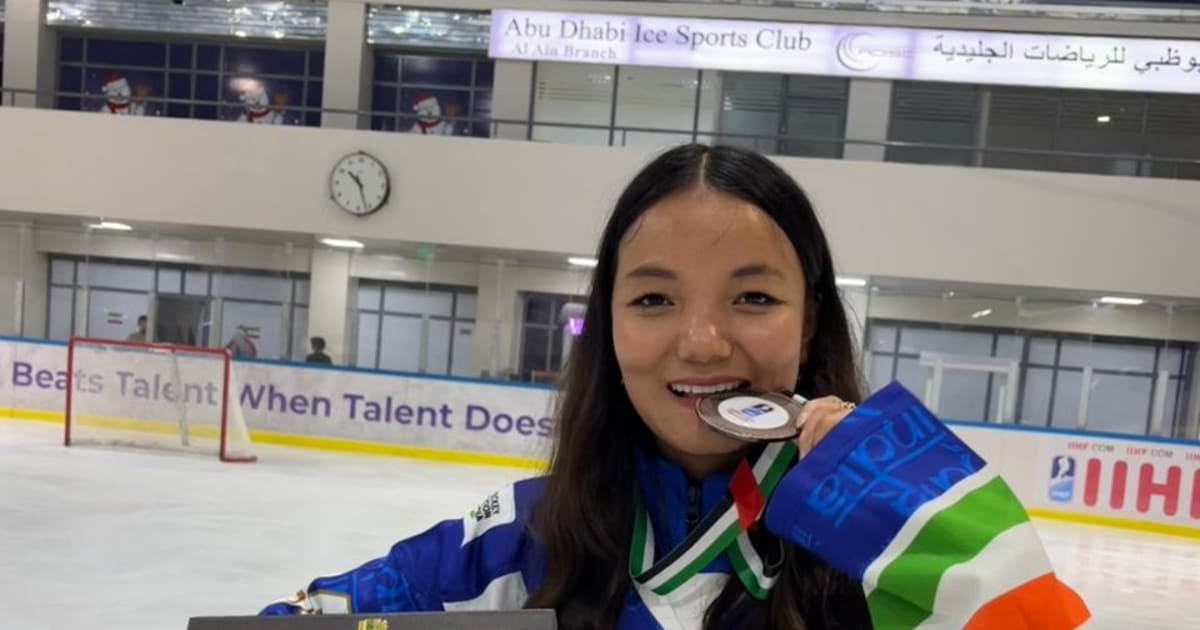
That belief bore fruit in 2025, when India returned to the international stage at the IIHF Women’s Asia Cup in the United Arab Emirates. Despite numerous challenges, the team secured a historic bronze medal - India’s second Asian podium finish.
“That medal was extremely emotional,” Padma said. “It made us realise where we started from - frozen lakes and borrowed equipment - and where we had reached.”
Beyond results, Padma has also witnessed a shift in the domestic landscape. Artificial ice rinks now exist in Ladakh, Dehradun and Pune, while structured competitions have provided players with regular match exposure. For her, this has transformed both participation and perception.
“Earlier, ice hockey was seen as only Ladakh’s sport,” she said. “Now players from other states are gaining exposure, experience and confidence.”
As a senior player, Padma is now mentoring younger athletes who have access to opportunities she never did. With domestic leagues in place and clearer pathways emerging, ambitions have grown accordingly.
“With domestic leagues finally in place, the goal is clear. We are looking at the qualification for the World Championships in 2027. And I believe it is achievable,” she concluded, looking ahead.
Rate this article
Login to rate this article
Comments
Please login to comment
No comments yet. Be the first to comment!