
Technology
21 min read
NOVARAD Study Data Heralds New Era in Radiation Protection
NeuroNews International
January 21, 2026•1 day ago
AI-Generated SummaryAuto-generated
The NOVARAD clinical study reported positive results for Cathpax's Nova-X radiation protection system. The study found Nova-X significantly reduced X-ray exposure for interventional neuroradiology staff, particularly in the head, arms, and feet. These findings suggest a potential new era for radiation protection in the field, improving staff safety and working conditions.
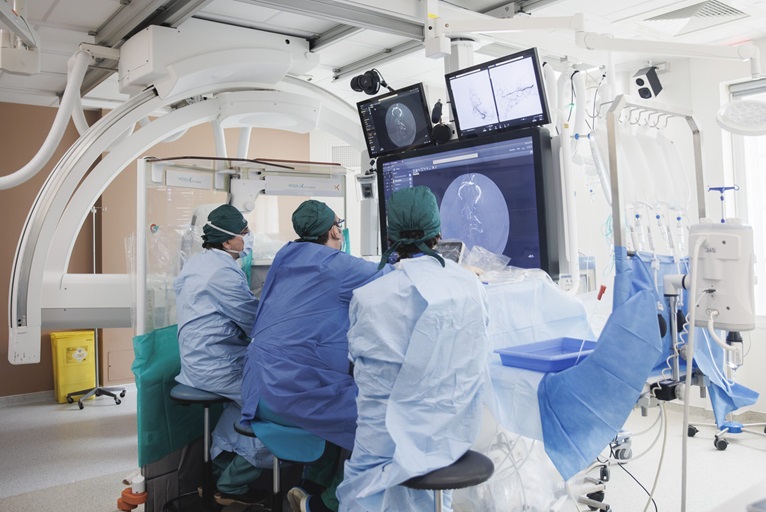
Cathpax—a spinoff of the Lemer Pax group that designs, develops and commercialises team-wide, full-body radiation protection systems for interventional medicine practitioners—has today announced positive results from the NOVARAD clinical study. This study is described by the company as the “first ever” to evaluate exposure to X-rays in interventional neuroradiology, with the aim of assessing the effectiveness of Nova-X in protecting the entire staff team in cath labs “from head to toe” during interventional procedures.
“The results of this study are extremely positive for our whole profession,” said Alessandra Biondi (Besançon University Hospital, Besançon, France). “They shine a light on the difficult working conditions that currently deter many young graduates—particularly women who are unwilling to take any risks during pregnancy. I am delighted to have taken part in this study which opens up a new era for radiation protection in our field.”
“The operator’s work ergonomics have an impact on the quality of patient care,” added Laurent Spelle (Bicêtre University Hospital, Paris, France). “Working while better and more comprehensively protected will necessarily change our approach, and enable us to concentrate entirely on our actions. Furthermore, this system does not change our work habits, which is essential to maximising the adoption of a new technology in the cath lab.”
A press release from Cathpax notes that cath lab healthcare professionals currently work with “restrictive and ineffective” personal protective equipment made from lead, which only offers them partial protection as it fails to shield areas like the head and extremities. Thus, they have a higher risk of developing radiation-induced pathologies including cancers and musculoskeletal disorders in the medium and long term.
Cathpax highlights the fact that, as a result, 17% of operators now limit their hours due to working conditions, compared to only 7% a decade ago, according to surveys led by the Society for Cardiovascular Angiography and Interventions (SCAI). This is prevalent despite the reliance on these interventional procedures having continued to grow in recent years owing to increased recognition of patient benefits, the company also says.
NOVARAD study
NOVARAD is a multicentre, two-arm prospective study analysing the X-ray doses received by three operators in seven distinct anatomical areas, with state-of-the-art operational dosimeters providing “extremely precise measurements”, as per a minimum detection threshold of 0.1µSv. In total, 178 procedures at four French centres—the university hospitals of Besançon, Bicêtre, Nantes and Toulouse—were included. Some 88 of these procedures were performed with Nova-X compared to 90 without.
The dose received with Nova-X was found to be 11 times lower for the head, 11 times lower for the arms, and 38 times lower for the feet, compared to the conventional approach, according to Cathpax’s recent release.
In the NOVARAD study, ‘Operator 1’ presented an average dose reduction of 91% across their entire body, with an average value of 1µSv per Nova-X procedure compared to 11.1µSv without Nova-X. The dose for ‘Operator 2’ went from 4.8µSv on average per procedure to 0.8µSv through the use of Nova-X, while ‘Operator 3’ received an average overall dose of 0.4µSv with Nova-X versus 1.1µSv without.
As per attempts to assess the stochastic risk within these data, effective dose was found to be 1.33 without Nova-X and 1.24 with Nova-X in staff members who were not wearing a lead apron. According to Cathpax, obtaining these results alongside deterministic risk findings demonstrating exposure reduction factors greater than 90% over the unprotected anatomical areas validates the possibility of working without a lead apron. Cathpax also claims that lead aprons are responsible for the “significant growth” in musculoskeletal disorders over the past 10 years, with SCAI survey results indicating an uptick from 49% in 2014 to 66% in 2023.
“It is now feasible to work in complete safety with total, homogeneous protection for the whole body, and for all staff working in the lab,” commented Christophe Cognard (Toulouse University Hospital, Toulouse, France. “This represents major progress for our profession, because it makes it possible to work without a lead apron.”
“The results of this study are extremely positive and support what we had already implemented at our institution a few months ago for one of our colleagues, who was unable to continue working due to a lumbar disc pathology caused by wearing a lead apron every day,” added Hubert Desal (Nantes University Hospital, Nantes, France). “This study constitutes a real revolution in our profession and strengthens our empirical knowledge on radiation issues—the subject at the centre of the transformation of our future hospital complex in Nantes.”
Next steps for Nova-X
In Cathpax’s recent release, the company’s strategic director Pascal Guy notes that the commercial rollout of Nova-X is now imminent and will initially focus on the European market.
“The extremely positive results of this study as well as the feedback received from the initial users confirm our system’s relevance, and its benefits,” Guy stated. “Furthermore, one of the main conclusions of this study is that the X-ray exposure environment is not homogeneous; it exposes interventional teams to very different doses depending on the anatomical segments. However, for 30 years, we have continued to extrapolate the dose to the whole body by measuring it with a single operational dosimeter placed on the chest under the lead apron. In light of these results, we will continue to actively work with the scientific community to ensure that all interventional physicians receive comprehensive radiation protection and appropriate dose monitoring.”
“Nova-X offers an ergonomic, safe working environment to one of society’s essential professions, whose working conditions have unfortunately improved very little over the past 20 years despite the volume of their work increasing and becoming more complex,” said Cathpax chief executive officer (CEO) Valérie Chevreul. “This profession no longer attracts young graduate physicians due to the risks to which they are exposed, which are increasingly documented in literature, fuelling the growing exodus of medical professionals.”
“These results are consistent with our expectations and confirm that Nova-X, in itself, and thanks to its radioprotective capacity—currently unmatched on the market—will allow a growing number of physicians to work with complete confidence while benefitting from clearly superior protection,” added Cathpax president Pierre-Marie Lemer.
Rate this article
Login to rate this article
Comments
Please login to comment
No comments yet. Be the first to comment!