
Space & Astronomy
9 min read
Northern Lights in Ireland: Your Guide to the Aurora Watch
The Journal
January 19, 2026•3 days ago
AI-Generated SummaryAuto-generated
A significant coronal mass ejection (CME) launched from the Sun is expected to impact Earth, potentially causing a geomagnetic storm. This could lead to visible Northern Lights displays in Ireland. However, widespread cloud cover and uncertain arrival times may hinder visibility, with North America potentially having better viewing conditions.
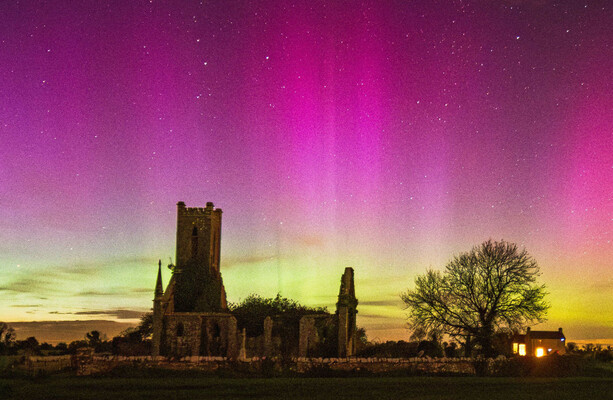
THE NORTHERN LIGHTS could be widely visible in the coming days, although some uncertainty over the forecast remains.
Early indicators suggest that the timing of conditions could favour North America rather than Europe.
Widespread cloud cover in Ireland over the coming days is also likely to hinder visibility.
A strong solar flare on Sunday was followed by the launch of a large, fast cloud of plasma – known as a coronal mass ejection (CME) – almost directly at Earth.
Plasma clouds like this can disturb Earth’s magnetic field, sending charged particles into the upper atmosphere. This makes gases like oxygen and nitrogen glow, producing the vibrant colours associated with auroral displays.
The UK Met Office predicts that a strong geomagnetic storm will likely follow, with ‘a chance’ it will reach severe G4 levels at times.
Although, on paper, this is equivalent to the G-scale strength of displays seen by many across Ireland and other parts of the world in October 2024, January 2025, and November 2025, it might be more fleeting than those events.
The CME could reach Earth as early as 1am or as late as 11.30am Irish time on Tuesday, though these arrival times remains hugely uncertain.
Conditions can change rapidly, and it can sometimes take several hours for activity to build enough for the northern lights to be seen at lower latitudes.
Advertisement
European countries could miss the best of the display if it arrives early, but if activity remains strong into the evening, the aurora could be visible from nightfall on Tuesday, particularly with a later arrival.
The northern lights can generally only be seen in Ireland during storms like this on camera, but sometimes a faint glow is visible to the naked eye.
There are myriad factors that dictate how the storm will develop.
Although the CME will likely hit Earth, it can sometimes miss, or the exact makeup of the plasma cloud might not lend itself to “charging up” the atmosphere in the right way.
Experts advise finding a dark location, free of light pollution, with a clear view of the northern horizon to be in with the best chance of snapping it.
Sightings of the northern lights have become more frequent in recent years as the Sun reached the peak of a roughly 11-year activity cycle.
Access to real-time space weather data and aurora forecasts is now widely available, making it easier for people to time their attempts.
Smartphone cameras have also improved significantly, so many more people can capture aurora displays that would once have required professional equipment.
Minor storms caused by CMEs or coronal holes are not uncommon, but the ensuing aurora is usually not widely visible except by more dedicated aurora chasers.
Rate this article
Login to rate this article
Comments
Please login to comment
No comments yet. Be the first to comment!