
Geopolitics
66 min read
Denmark Proposes NATO Surveillance Mission in Greenland
dw.com
January 19, 2026•2 days ago
AI-Generated SummaryAuto-generated
Denmark and Greenland have proposed a NATO surveillance mission on the island to NATO chief Mark Rutte. This initiative comes amid US President Donald Trump's recent push to acquire Greenland and his threats of tariffs against European nations opposing his ambition. European leaders are meeting to coordinate a response to these economic threats.
Rana Taha | Karl Sexton with AFP, Reuters, AP, dpa
Published 01/19/2026Published January 19, 2026
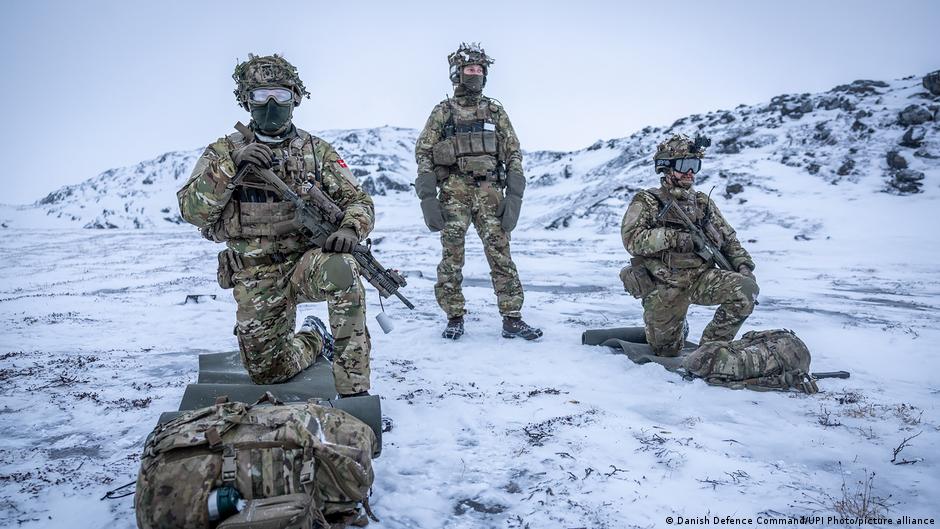
Denmark's defense minister said he and Greenland's defense minister raised the possibility of a NATO surveillance mission in Greenland in a meeting with the NATO chief Mark Rutte.
https://p.dw.com/p/572LA
Advertisement
Skip next section What you need to know
What you need to know
Danish defense minister said he raised the idea of a NATO mission in Greenland
Germany finance minister said Europe won't be 'blackmailed' into ceding control of Greenland earlier in the day
EU leaders to meet on Thursday to discuss Trump's latest tariff threat over Greenland
One option is a package of tariffs on €93 billion ($108 billion) of US imports
France reportedly pushing option to get the EU to activate its 'Anti-Coercion Instrument,' known as the 'trade bazooka'
Trump tells Norway's PM that he's no longer only thinking of 'peace' after he didn't win the Nobel prize
Follow below for the latest headlines, analyses, backgrounders and reactions to the escalating row over the future of Greenland on Monday, January 19, 2026:
Skip next section US 'has not prioritized' Greenland in terms of military investment, former Danish foreign minister says
01/20/2026January 20, 2026
US 'has not prioritized' Greenland in terms of military investment, former Danish foreign minister says
Despite Trump's louder calls to take control of Greenland, the US has not prioritized the Arctic island in terms of military investment in recent years, argued Jeppe Kofod, who served as Denmark's foreign minister between 2019 and 2022 and worked with the former Trump administration on the Greenland file.
Speaking to DW on Monday, Kofod looked back on how he worked with the first Trump administration, with Mike Pompeo as US Secretary of State, to appease Trump the first time he floated the idea of buying Greenland during his first term in office.
He remembered the initial idea as "a shock."
Kofod went over the efforts he exerted to give the US an alternative deal at the time. This involved reopening a US consulate in Nuuk in 2020 as well as an economic cooperation agreement between the US and Greenland.
"So something that started as a conflict ended as closer cooperation, which we all were very happy about," Kofod said.
How can Trump's Greenland ambitions be tamed?
To view this video please enable JavaScript, and consider upgrading to a web browser that supports HTML5 video
The former foreign minister, who is now CEO of consulting company Kofod Global, noted the Danish investment in Greenland in recent years, contrasting it against what he said was a US scale back of investment.
"Denmark has [in] recent years put more troops in Greenland, more military assets. And alongside other NATO countries, we are, as we speak, deploying much more assets to the High North and Greenland," he noted.
Meanwhile, he argued, the US "in the last decades has really, really scaled back."
"I mean, when there was most troops and soldiers, military staff from the US, this was around 10,000 in the high days of the Cold War, maybe 15 to 17 bases in Greenland, US bases. Now they're down to one military base, space base and only 150 troops. So [the] US has not prioritized to put more troops in Greenland," Kofod said.
Kofod reiterated warnings that the NATO alliance would come to an end should Trump deliver on his threat.
He said if the US were to take Greenland against the will of fellow NATO member Denmark, "that will be the end of NATO and it will lead to open conflict over the Atlantic between all of Europe and [the] United States and also [the] United States and most of the rest of the world."
https://p.dw.com/p/575ms
Skip next section US-Canadian aircraft arriving soon in Greenland space base in 'routine' activity
01/19/2026January 19, 2026
US-Canadian aircraft arriving soon in Greenland space base in 'routine' activity
The North American Aerospace Defense Command (NORAD) said aircraft from the joint US-Canada military organization for aerospace monitoring and defense will be arriving in Greenland.
The aircraft, due to arrive in the US' Pituffik Space Base, are meant to "support various long-planned NORAD activities, building on the enduring defense cooperation between the United States and Canada, as well as the Kingdom of Denmark," NORAD said in a statement on X.
The organization said the activity was coordinated with Denmark, adding that Greenland has been informed.
"NORAD routinely conducts sustained, dispersed operations in the defense of North America, through one or all three NORAD regions (Alaska, Canada, and the continental US)," NORAD said.
The activity comes amid an increasingly tense time for the transatlantic relationship, as European nations join Denmark and Greenland in attempting to ward off Donald Trump's advances on the Arctic island.
https://p.dw.com/p/575oZ
Skip next section EU weighs response to US 'blackmail' tariffs over Greenland
01/19/2026January 19, 2026
EU weighs response to US 'blackmail' tariffs over Greenland
European leaders have three main options for responding to the Trump administration’s economic threats.
If they don’t get it right, Trump may be emboldened to take over Greenland.
EU heads of state and government will meet for a summit on Thursday — a dinner cobbled together in haste to coordinate which of those options the bloc will use in response to Trump’s threats.
DW breaks down Europe's options and what each of those options would mean.
https://p.dw.com/p/575kd
Skip next section EU chief reiterates need to 'unequivocally respect' Greenland's sovereignty in Davos
01/19/2026January 19, 2026
EU chief reiterates need to 'unequivocally respect' Greenland's sovereignty in Davos
On the sidelines of the World Economic Forum in Davos, European Commission President Ursula von der Leyen "addressed the need to unequivocally respect the sovereignty of Greenland and of the Kingdom of Denmark" in a meeting with a bipartisan US congressional delegation.
"This is of utmost importance to our transatlantic relationship," she said on X, stressing that the EU is ready "to continue working closely with the United States, NATO, and other allies, in close cooperation with Denmark, to advance our shared security interests."
Von der Leyen said "transatlantic trade and investment" were also among the topics discussed, describing them as "a major asset" for both EU and US economies.
"Tariffs run counter to these shared interests," she added, appearing to refer to Trump's threats of imposing a 10% tariff on eight European countries as he ramps up his bid to acquire Greenland.
https://p.dw.com/p/575mT
Skip next section NATO chief says alliance to continue working with Denmark, Greenland on Arctic security
01/19/2026January 19, 2026
NATO chief says alliance to continue working with Denmark, Greenland on Arctic security
The NATO military alliance will continue working with Denmark and Greenland on important issues such as collective security in the Arctic region, NATO Secretary General Mark Rutte said on Monday.
His statements followed a meeting with the Denmak's defence minister and Greenland's foreign affairs minister.
"We discussed how important the Arctic - including Greenland - is to our collective security and how Denmark is stepping up investments in key capabilities," Rutte said on X.
https://p.dw.com/p/575iT
Skip next section Denmark, Greenland float joint NATO mission on the island
01/19/2026January 19, 2026
Denmark, Greenland float joint NATO mission on the island
Denmark's Defense Minister Troels Lund Poulsen has said Denmark and Greenland raised the idea of a NATO mission in Greenland in talks in Brussels with Greenlandic Foreign Minister Vivian Motzfeldt and NATO Secretary General Mark Rutte.
"We have proposed this. The NATO Secretary General has also taken note of this,a and I believe we can now hopefully establish a framework for how this can be achieved," Poulsen said. "This is also in line with what we have discussed with the Greenlandic government."
He was speaking amid US President Donald Trump's latest push for the US to control Greenland, arguing that the US needs the territory for national security purposes.
NATO's Rutte, meanwhile, said that the trio had discussed "how important that Arctic — including Greenland — is to our collective security and how Denmark is stepping up investments in key capabilities."
"We'll continue to work together as allies on these important issues," Rutte said.
The US once had dozens of military bases on Greenland and has wide-reaching deals granting its troops access. However, it shut the bases and currently stations only a few hundred soldiers on the vast island, not the thousands present at the height of the Cold War, when it was seen as a key site for missile interception and naval security in the North Atlantic if conflict with the Soviets flared up.
European members including Germany sent a small reconnaisance and fact-finding mission to the island in recent days amid the spat, but a NATO mission would represent a new development.
https://p.dw.com/p/575aI
Skip next section Europe has a 'slate of tools' to protect interests, EU's foreign policy chief says
01/19/2026January 19, 2026
Europe has a 'slate of tools' to protect interests, EU's foreign policy chief says
EU foreign policy chief Kaja Kallas stressed once again that "Denmark and Greenland are not alone" and vowed a strong response to Trump's tariff threats.
In a post on X, Kallas said that "Arctic security is a shared transatlantic interest" that can be discussed with US allies. "But tariff threats are not the way to go about this. Sovereignty is not for trade," Kallas said.
"We have no interest to pick a fight, but we will hold our ground. Europe has a slate of tools to protect its interests."
https://p.dw.com/p/575Ow
Skip next section France, Germany seek coordinated response to tariff threat
01/19/2026January 19, 2026
France, Germany seek coordinated response to tariff threat
German Chancellor Friedrich Merz said on Monday that he'd seek a unified line with France on potential responses to Trump's latest tariff threats.
He said that even though France's government and president might "want to react a little more harshly than we do," both sides were trying to compromise on a shared position to take to the next EU leaders' summit.
Ultimately, any response will be decided at the EU level rather than nationally because it is trade policy, but France and Germany have very considerable influence in Brussels as the two most populous countries in the bloc with the largest economies.
Merz's Finance Minister Lars Klingbeil, of the center-left Social Democrats rather than Merz's Christian Democrats, struck a slightly tougher tone in a meeting with his French counterpart Roland Lescure.
"Germany and France are agreed that we will not allow ourself to be blackmailed," Klinbeil said. "We as Europeans must make it clear: the limit has been reached."
Lescure meanwhile told French reporters that "we are ruling nothing out" while considering how to respond.
Merz also said that on the most fundamental level, the EU was already united on the matter.
"Among Europeans there is great unanimity that further tariff threats weaken transatlantic relations and do not strengthen them," Merz said. He also said he believed most people in America were also aware of the risks.
Merz noted that in the past 12 months Trump had often repeatedly and loudly threatened large tariffs, only to partially or even completely roll them back before they even came into force.
Merz: 'We don't want a trade dispute with the US'
To view this video please enable JavaScript, and consider upgrading to a web browser that supports HTML5 video
https://p.dw.com/p/575ML
Skip next section Here's what to know if you're only joining us now:
01/19/2026January 19, 2026
Here's what to know if you're only joining us now:
European nations are preparing countermeasures to Trump's 'blackmail,' Germany's Finance Minister Lars Klingbeil said, in reference to the US president's tariff threats
EU leaders are meeting in Brussels on Thursday to discuss the bloc's response
Germany's Chancellor Merz stressed Europe must stand firm in the face of Trump's threats over Greenland
French President Emmanuel Macron is reportedly pushing to activate the bloc's "Anti-Coercion Instrument" which allows the EU to impose measures such as restrictions on imports and exports, and retaliatory tariffs
US Treasury Secretary Scott Bessent warned European nations against imposing retaliatory tariffs on the US
https://p.dw.com/p/575MA
Skip next section Retaliatory EU tariffs would be 'very unwise,' US Treasury boss says
01/19/2026January 19, 2026
Retaliatory EU tariffs would be 'very unwise,' US Treasury boss says
The US Treasury Secretary, Scott Bessent, has warned European nations not to impose retaliatory tariffs on the US.
The EU is considering the tariffs in response to Donald Trump's threats to impose levies on eight countries that have opposed the US president's aim of taking control of Greenland.
Speaking to reporters in the Swiss mountain resort of Davos on the first day of the World Economic Forum, Bessent said, "I think it would be very unwise" when asked about the possibility of EU tariffs.
Bessent repeated Trump's stance that the US wants the semiautonomous, Danish-owned territory because it is a "strategic asset" that is fundamental to US national security.
"We are not going to outsource our hemispheric security to anyone else," Bessent said.
"I think everyone should take the president at his word," the treasury secretary added.
https://p.dw.com/p/575CT
Skip next section Europe must stand its ground over Greenland — Merz
01/19/2026January 19, 2026
Europe must stand its ground over Greenland — Merz
Germany's Chancellor Friedrich Merz has said Europe must hold firm in the face of US President Donald Trump's threat to slap tariffs on nations that block him over Greenland.
"It is clear that we want to stand our ground, as a country and as a continent," Merz said. "It is up to us, and in Germany we want to accept the realities, take responsibility and lead the way for Germany."
Merz said European leaders broadly agreed that tariffs would only undermine transatlantic ties and lead to an escalating trade war.
"We want to avoid any escalation in this dispute if at all possible," the chancellor said.
Trump has said he will slap 10% tariffs on eight European countries, including Germany, for opposing him and his desire to acquire Greenland.
The German leader said that tariffs would primarily hurt American consumers, while admitting that Germany's and Europe's economies would also suffer.
"Customs duties are usually paid by those in whose country the imports go," Merz said. "In this case, US consumers would pay the customs duties, but they would of course also damage our economy, the European economy and the German economy in particular, which is why we want to find a solution here."
While he said the aim is to resolve transatlantic differences "together," he said Washington "knows we could also retaliate" with its own tariffs.
"I don't want to, but if necessary, we will of course protect our European interests as well as our German national interests," he said.
https://p.dw.com/p/574Ud
Skip next section EU leaders to meet Thursday to discuss Trump tariff threat
01/19/2026January 19, 2026
EU leaders to meet Thursday to discuss Trump tariff threat
European Union leaders will meet in Brussels on Thursday to discuss the bloc's response to Donald Trump's tariff threat against European nations that oppose his desired acquisition of Greenland.
Trump has threatened six EU members, as well as Norway and the United Kingdom, with tariffs that could rise to 25% for opposing his aim of buying the Arctic territory, which Denmark has controlled for about 300 years.
In preparation for the emergency summit on Thursday, an EU spokesman told reporters that "intensive consultations" were ongoing among EU leaders.
"The priority here is to engage, not escalate, and avoid the imposition of tariffs," EU trade spokesman Olof Gill said.
"Sometimes the most responsible form of leadership is restraint," Gill added.
He also said talks with US officials "at all levels" were ongoing.
"We are trying to be calm, to be firm, to be serious, to be responsible, because that's what, in our view, leadership looks like," Gill said.
But, he warned, the bloc is "prepared to respond" with the tools at its disposal, which include the never-before-used anti-coercion instrument, also known as the EU's "trade bazooka."
https://p.dw.com/p/574Re
Skip next section Trade war in 'no one's interest,' Starmer says
01/19/2026January 19, 2026
Trade war in 'no one's interest,' Starmer says
The United Kingdom's Prime Minister Keir Starmer has pushed back against US President Donald Trump's threat to impose tariffs on European nations over Greenland.
At a press conference on Monday, Starmer reiterated that the UK stands by the people of Greenland and Denmark in the face of Washington's increasingly aggressive posturing over the Arctic territory.
He also pointed out that Denmark is a "close ally" of both the UK and the US. "Alliances endure because they are built on respect and partnership, not pressure," Starmer said.
"That is why I say the use of tariffs against allies is completely wrong. It is not the right way to resolve differences within an alliance," the UK leader said. "A trade war is in no one's interest," said Starmer.
"The right way to approach an issue of this seriousness is through calm discussion between allies," the British leader said.
He added that he had spoken with Trump on Sunday, as well as European leaders and NATO chief Mark Rutte to "find a solution rooted in partnership, facts and mutual respect."
https://p.dw.com/p/574JZ
Skip next section What is the EU's 'trade bazooka'?
01/19/2026January 19, 2026
What is the EU's 'trade bazooka'?
Roshni Majumdar Editor
Donald Trump's threat of 10% tariffs against eight European nations — including six members of the EU — has triggered growing calls in the bloc to use its "anti-coercion" trade tool to counter the US president's "blackmail."
Trump has said imports to the US from Denmark, Norway, Sweden, Finland, France, Germany, the United Kingdom, and the Netherlands will face tariffs of 10% from February 1 unless the US acquires Greenland. Trump also threatened to raise those tariffs to 25% by the summer if a deal hasn't been reached.
The instrument was created in 2023 as a countermeasure to Chinese trade practices, after Lithuania accused Beijing of blocking its exports because Vilnius had allowed a Taiwanese diplomatic mission to be opened in Lithuania two years earlier.
While it has never been used before, French President Emmanuel Macron is pushing to activate the "Anti-Coercion Instrument" (ACI), sources in his office said this weekend.
What is the EU's so-called 'trade bazooka' and what does it do?
Also known as the EU's 'nuclear' option, the instrument allows the European Commission to use a range of measures to respond to 'economic coercion'
The bloc considered using the tool last year after Trump's 'big, beautiful tariffs' announcement before a trade deal was reached
It allows the EU to impose measures such as restrictions on imports and exports and retaliatory tariffs
It also allows the bloc to restrict intellectual property and investments and block US companies' access to public procurement contracts in Europe
What does EU consider to be 'economic coercion'?
According to the European Commission, 'economic coercion' is when a third country applies or threatens to apply 'measures affecting trade or investment'
Economic coercion refers to practices that 'unduly interfere with the legitimate sovereign choices' of the EU and its 27 member states
What retaliatory tariffs could the EU impose?
Before the US and EU signed a trade deal last year, the bloc had been preparing a package of retaliatory tariffs worth €93 billion ($108 bln).
The tariffs, which were suspended once the deal was signed, are again being considered as a countermeasure to Trump's threats over Greenland.
What could the EU's retaliatory package include?
25% levies on American-made airplanes, meaning US aerospace giant Boeing would be badly affected by a potential trade dispute, according to the Financial Times
Tariffs on cars, whisky and soybeans
Machinery, medical devices, chemicals and plastics, and electrical equipment would also be affected
Will the EU go 'all in' against Trump's Greenland threats?
To view this video please enable JavaScript, and consider upgrading to a web browser that supports HTML5 video
https://p.dw.com/p/572mt
Skip next section How could the EU respond to Trump's tariffs threat?
01/19/2026January 19, 2026
How could the EU respond to Trump's tariffs threat?
Donald Trump has threatened to slap tariffs on eight European nations for opposing his bid to acquire Greenland.
Germany's Vice Chancellor Lars Klingbeil said Monday that Europe was weighing countermeasures in response.
What can the EU do?
The EU's first option could be to put the current trade deal with the US on hold, Klingbeil said
The deal set a baseline 15% tariff on European exports to the US
The agreement was criticized by many as being too favorable to Washington
European leaders said it was needed to restore 'stability' and 'predictability' to transatlantic trade after months of trade tensions
The EU's second option could be to impose tariffs on imports from the US
A third option, Klingbeil said, could be to use the Anti-Coercion Instrument (ACI) — better known as the EU's so-called 'trade bazooka'
https://p.dw.com/p/572l5
Show more posts
Rate this article
Login to rate this article
Comments
Please login to comment
No comments yet. Be the first to comment!