
Space & Astronomy
9 min read
Was Mars Once Blue? New Evidence Reveals Ancient Ocean
Space
January 19, 2026•3 days ago
AI-Generated SummaryAuto-generated
New evidence suggests Mars once hosted an ocean comparable in size to Earth's Arctic Ocean. Analyzing probe images of geological formations within Valles Marineris, scientists identified fan delta-like structures indicating ancient shorelines. This implies Mars may have sustained stable surface water across its northern hemisphere for extended periods around 3.37 billion years ago, forming vast connected systems.
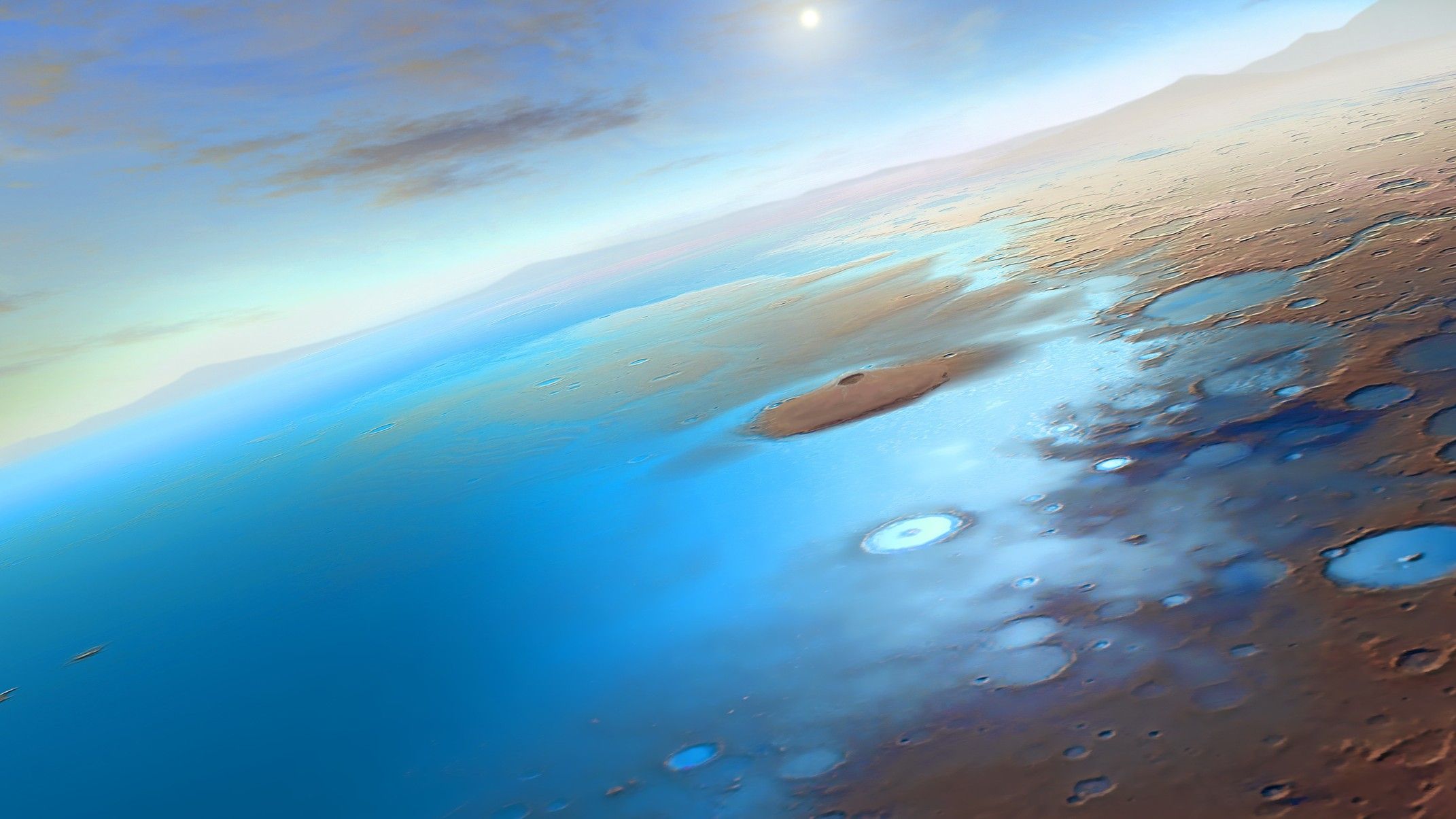
Mars may have once possessed an ocean at least as large as Earth's Arctic Ocean, a new study suggests.
Previous research suggested rivers and seas once existed on Mars, raising the question of whether it might have once been capable of supporting life. However, much remains uncertain about how blue the Red Planet once was.
In the new study, researchers analyzed high-resolution images from various cameras on Mars probes, including the European Space Agency (ESA)'s ExoMars Trace Gas Orbiter, ESA's Mars Express, and NASA's Mars Reconnaissance Orbiter.
"Together, these instruments act like a geological time machine, helping us reconstruct the planet's past condition," study lead author Ignatius Argadestya, a planetary geologist at the University of Bern in Switzerland, told Space.com.
The scientists investigated the southeast part of a 620-mile (1,000-kilometer) canyon known as Coprates Chasma. This gorge makes up part of the Valles Marineris, the largest canyon system on Mars, which stretches more than 2,485 miles (4,000 km) long along the Red Planet's equator.
Specifically, the researchers focused on geological formations known as scarp-faced deposits at the lower end of Coprates Chasma. These resembled fan deltas on Earth — fan-shaped cones of debris and sand that form where rivers pour into oceans. Although wind-sculpted dunes currently cover these former delta structures on Mars, their original shape is still recognizable.
All the scarp-faced deposits the scientists identified occurred at the same range of elevations — a depth of 11,975 to 12,300 feet (3,650 to 3,750 meters) in the Valles Marineris and the northern lowlands. In addition, they all formed about 3.37 billion years ago.
The researchers suggested these scarp-faced deposits are evidence of an ancient shore. All in all, they estimated Mars once possessed an ocean across its northern hemisphere that was at least as large as the Arctic Ocean on Earth.
"The most important implication is that Mars may have sustained stable surface water on a planetary scale for longer periods than previously thought," Argadestya said. "Water on Mars may once have formed connected systems across vast distances, rather than existing only in isolated lakes."
The scientists noted they are not the first to speculate about the existence and size of any ocean on Mars. "What our study contributes is a new line of geological evidence that helps constrain where the shoreline may have been and how high the water once reached," Argadestya said.
In the future, the scientists plan to investigate the composition of ancient Martian soils. These could help shed light on what kind of erosion Mars experienced from water, Argadestya noted.
Rate this article
Login to rate this article
Comments
Please login to comment
No comments yet. Be the first to comment!