
Geopolitics
18 min read
Macron: Europe Won't Yield to Bullies or Trump's Intimidation Tactics
SBS Australia
January 21, 2026•1 day ago
AI-Generated SummaryAuto-generated
French President Emmanuel Macron criticized Donald Trump's threats of tariffs and sharing private messages, stating Europe will not yield to bullies. Macron emphasized the importance of the rule of law and territorial sovereignty, warning against a "world without rules." This stance signals potential EU trade sanctions in response to US actions.
Emmanuel Macron said France preferred "respect to bullies" and rejected "unacceptable" tariffs.
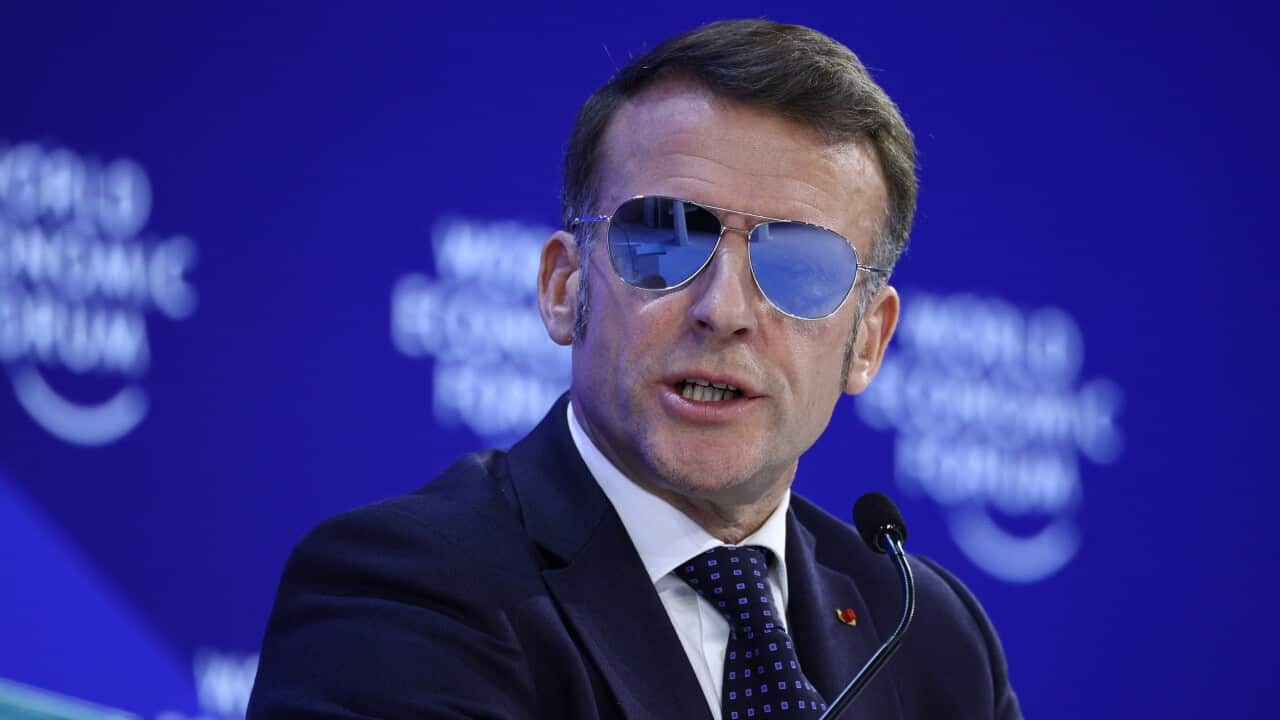
Emmanuel Macron wore aviator sunglasses during his speech, which French officials said was to protect his eyes because of a burst blood vessel. Source: PA / Lafargue Raphael
French President Emmanuel Macron says Europe will not give in to bullies or be intimidated, in a scathing criticism of US President Donald Trump's threat to impose steep tariffs if Europe does not let him take over Greenland.
While other European leaders have tried to keep a measured tone to prevent the trans-Atlantic dispute from escalating, Macron came out swinging.
France, and Europe, will not "passively accept the law of the strongest," Macron said at the World Economic Forum in Davos overnight, adding that doing otherwise would lead to their "vassalisation".
Instead, he said, Europe will continue to stand up for territorial sovereignty and the rule of law, despite what he called a shift towards a world without rules. That could include the EU responding with its own steep trade sanctions.
READ MORE
$1.5 billion for a seat: Is Trump's new Board of Peace an 'irreparable' threat?
'Prefer respect to bullies'
"We do prefer respect to bullies," Macron said. "And we do prefer rule of law to brutality."
He delivered the speech after Trump threatened huge tariffs against French wine and champagne and posted private messages from Macron, an unusual breach of diplomatic discretion.
Trump had already vowed on Saturday to implement a wave of increasing tariffs from 1 February on several European allies, including France, until the US is allowed to acquire Greenland, a step major EU states decried as blackmail.
Washington's "endless accumulation" of new tariffs is "fundamentally unacceptable," Macron said in Davos, "even more so when they are used as leverage against territorial sovereignty".
What will Europe do?
EU leaders decided over the weekend to convene in Brussels on Thursday evening for an emergency summit on Greenland.
Tariffs on €93 billion ($162 billion) worth of US goods, which the EU set aside when Trump agreed a trade deal with the bloc last summer, could snap into place on 6 February.
Macron has pushed for the EU also to consider the first use of its Anti-Coercion Instrument, informally known as the "trade bazooka", which could limit US access to public tenders or restrict trade in services such as tech platforms. Macron said it was "crazy" it had gone that far.
READ MORE
'Should take it seriously': Warning for Australia as Trump faces EU trade backlash
200 per cent tariff on wines and champagnes
The US president's relationship with Europe as a whole has deeply soured over his push to wrest sovereignty over the Arctic island from fellow NATO member Denmark, rattling European industry and sending shockwaves through financial markets.
Trump has also taken offence at France's reluctance to join a proposed Board of Peace, a new international organisation that he would lead. Paris has voiced concern over its impact on the role of the United Nations.
When asked about Macron's stance on the Board of Peace, Trump said late on Monday: "I'll put a 200 per cent tariff on his wines and champagnes, and he'll join, but he doesn't have to join."
Trump publishes private messages
A few hours later, Trump published on his Truth Social account a screenshot of an exchange with Macron.
In the exchange, which a source close to Macron said was authentic, Macron told Trump: "I do not understand what you are doing on Greenland" and offered to host a G7 meeting, inviting Russia and others. Neither Trump nor the French source disclosed the date of the messages.
Trump also unveiled a private text message from NATO secretary general Mark Rutte, in which he thanked the former Dutch prime minister.
Rutte, who famously referred to Trump as "Daddy" at a NATO summit last year, said in the message that he was "committed to finding a way forward on Greenland".
"Can't wait to see you," the NATO chief added.
No Trump-Macron meeting planned in Davos
Macron confirmed he had no plans to extend his stay in Davos to Wednesday, when Trump arrives in the Swiss mountain resort town.
"I don't have to change my schedule," he said, adding that it had long been planned that he would leave in the evening.
Macron, who will leave office in mid-2027, has been France's president since 2017. His relationship with Trump has had ups and downs since Trump's first term, with Macron alternating between flattery and tougher rhetoric.
World order in 'midst of a rupture', Carney says
Canadian Prime Minister Mark Carney said that the US‑led global system of governance is enduring "a rupture," defined by great power competition and a "fading" rules‑based order.
Carney delivered his stirring speech to political and financial elites at the World Economic Forum, a day before Trump was set to address the gathering in Davos.
Since entering Canadian politics last year, Carney has repeatedly warned that the world was not going to return to a pre‑Trump normal.
He re‑affirmed that message on Tuesday (local time), in a speech that did not name Trump but offered an analysis of the president's impact on global affairs.
"We are in the midst of a rupture, not a transition," Carney said.
He noted that Canada had benefited from the old "rules‑based international order," including from "American hegemony" that "helped provide public goods: open sea lanes, a stable financial system, collective security, and support for frameworks for resolving disputes."
A new reality has set in, Carney said.
"Call it what it is: a system of intensifying great power rivalry where the most powerful pursue their interests using economic integration as coercion."
For the latest from SBS News, download our appand subscribe to our newsletter.
Rate this article
Login to rate this article
Comments
Please login to comment
No comments yet. Be the first to comment!