
Geopolitics
17 min read
Lee Jae-myung: Navigating South Korea's Domestic & Diplomatic Challenges
East Asia Forum
January 18, 2026•4 days ago
AI-Generated SummaryAuto-generated
South Korean President Lee Jae-myung has navigated domestic political divisions and international challenges since taking office. He is adeptly balancing relations with the US and China amid escalating rivalry, and managing ties with Japan. Lee has also shown pragmatism in addressing North Korea's human rights issues while seeking diplomatic engagement. Early signs suggest his administration is becoming a stabilizing force in the region.
Since he assumed office in June 2025, South Korean President Lee Jae-myung has faced political turbulence on both domestic and international fronts. He came to power in the middle of the national turmoil instigated by his predecessor’s declaration of martial law and consequent impeachment.
Only six months before Lee took office, Donald Trump had begun his second term as US president, upending the international and regional economic order with the imposition of a suite of punitive tariffs on goods entering the United States.
The most urgent task facing Lee after his inauguration, as Sangin Park writes in the first of this week’s lead articles, was successfully ‘concluding tariff negotiations with the United States’.
While still early days in his presidential tenure, South Korea’s new president has displayed impressive statecraft in navigating this turbulence through the initial tests of diplomatic summitry and domestic upheaval.
Daniel Sneider argues in our second lead article that Lee ‘has proven himself to be not only a consummate pragmatist, as some predicted, but even more surprisingly a deft diplomat as well’.
The early indications are that the Lee administration will successfully hedge between the United States and China amid their intensifying rivalry, and also balance interests with China and Japan amid the spiral downwards in their relations. He is also making at least some headway in bridging the polarisation of the South Korean electorate.
On the home front, Lee has been walking a political tightrope between ideologically divided camps. As Sneider describes it, ‘the South Korean right is increasingly at odds with itself, pitting former president Yoon Suk-yeol’s hardline followers, who have adopted the rhetoric and imagery of Trump’s Make America Great Again movement, against the conservatives who crucially broke with Yoon’s martial law bid. On the left, the Lee administration is dominated for now by advocates of pragmatism, not only in the realm of foreign policy but also in fostering the support of chaebols [Korea’s conglomerates]. There is, though, a tribe of ideological leftists within its ranks and in the membership of the party’s National Assembly bloc’.
Lee’s progressive Democratic Party of Korea is often viewed by conservatives as being ‘too soft’ on North Korea, but in November 2025 he cosponsored the UN General Assembly’s resolution on North Korean human rights with Trump. This signals a departure from recent liberal administrations in South Korea, including that of Moon Jae-in, who refrained from co-sponsoring such a resolution to facilitate engagement with North Korea. For Lee, taking a stance on Pyongyang’s human rights abuses is not incompatible with his policy of reopening diplomatic channels with the North.
Lee’s pragmatism is also evident in his management of relations with Beijing and Tokyo and avoidance of being drawn into their deepening diplomatic row.
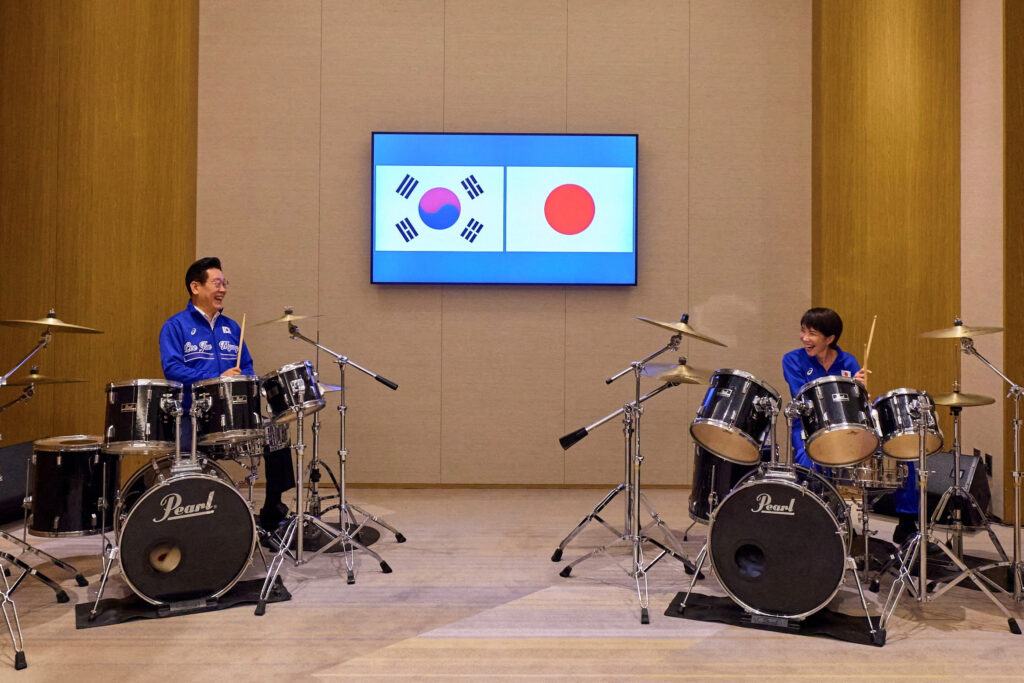
Following a successful summit with Beijing in January 2026, Lee was hosted by Japan’s new Prime Minister Sanae Takaichi in Nara, her hometown and constituency, for summit talks. In a show of camaraderie, the two leaders played the drums together to the tune of K-Pop songs. Lee reaffirmed Seoul’s intention to accede to the Comprehensive and Progressive Agreement for Trans-Pacific Partnership.
While Lee’s predecessor Yoon was cautious about downplaying bilateral ‘history problems’ in his bid to mend ties with Tokyo, Lee does not see these two policy issues as mutually exclusive. Earlier this month, Lee condemned vandalism attacks by far right South Korean activists on a ‘comfort women’ statue that stands opposite the Japanese embassy in Seoul, denouncing such actions as ‘mindless acts of defamation against the deceased’. The Japanese government has previously sought to have this statue removed.
Similarly, during his four-day visit to Beijing in early January, Lee waded into sensitive ‘history problems’ by visiting the historic site of Korea’s provisional government in Shanghai during Japan’s colonial rule of the peninsula. ‘The history of the Korean independence movement cannot be discussed without China. China was a key stage of our independence movement, with nearly half the historical sites of the independence movement located there’, Lee said during his trip to the site.
Sneider argues that Lee’s administration ‘seeks to use improved ties to China to open dialogue with the North Korean regime. But Pyongyang seems to prefer relying on its new alliance with Russia and waiting to see what Trump may offer them. Even if Trump’s visit to Beijing scheduled for April 2026 is able to help foster inter-Korean relations, there is no guarantee that North Korean Supreme Leader Kim Jong-un will have a dialogue with Seoul’.
These early signs of Lee’s ability to pursue diplomatic engagement with China, Japan, and North Korea while reaffirming the US–South Korea alliance, despite the volatilities of the Trump administration and domestic polarisation, look promising. They bode well for the continuation of US–Japan–South Korea trilateral security cooperation, and for the potential of Seoul to mediate growing tensions between Beijing and Tokyo.
The Lee administration’s South Korea is becoming a stabilising force in an uneasy region at a time of heightened uncertainty, potentially going beyond its traditional hedging role in the region.
The EAF Editorial Board is located in the Crawford School of Public Policy, College of Law, Policy and Governance, The Australian National University.
Rate this article
Login to rate this article
Comments
Please login to comment
No comments yet. Be the first to comment!