
Technology
11 min read
Japan's Pint-Sized Gullwing Sports Car Roars Back with Rotary Power
CarBuzz
January 18, 2026•4 days ago
AI-Generated SummaryAuto-generated
At the Tokyo Auto Salon, Goda Bankin unveiled a modified Mazda Autozam AZ-1 kei car. The tiny sports car now features a rear-mounted rotary engine, significantly increasing its power output. The build also includes extreme fender flares, upgraded suspension, and a six-speed manual transmission, transforming the compact vehicle into a miniature supercar.
The Tokyo Auto Salon is roughly Japan's equivalent of the SEMA Show in the United States. Both events allow automakers, aftermarket parts companies, and tuned-vehicle builders to showcase their modification components that the general driving public might not find very interesting. Some of the highlights this year included Italdesign's reimagined Acura NSX, a Toyota GR86 with pop-up headlights, and the surprise unveiling of a refreshed Nissan Z.
The Tokyo Auto Salon is a big event, so it's easy for cool builds to fall through the cracks. As a case in point, the company Goda Bankin premiered a wild take on the Mazda Autozam AZ-1 kei car by installing a rear-mounted rotary engine into the tiny machine. As if the engine upgrade isn't enough, the builder also adds some of the widest fender flares possible on such a diminutive machine.
The AZ1 Becomes A Tiny Supercar
As a brief refresher, the AZ-1 belongs to Japan's kei car class, a category of vehicles with a limited size and power output but cheaper to own. The AZ-1 arrived during a hot period for these models, when automakers introduced tiny sports models, such as the Honda Beat and Suzuki Cappuccino. This Autozam used a 657cc turbocharged inline-3, making 64 horsepower and 63 pound-feet of torque. Its gullwing doors and rear-mounted powerplant made this model look like a little racing prototype for the road. Its production only lasted from 1992 through 1995.
The Goda Bankin AZ-1 uses the venerable 13B rotary engine, which is famous for powering many Mazda RX-7s across several generations. It uses rotors from the RX-8, upgraded fuel injection, and a Link ECU. The transmission is a six-speed manual out of a Mazdaspeed3. The clutch and differential are special-order components from OS Giken.
The engine's power output isn't entirely clear, but it's certainly more than the AZ-1's original. With the powerplant at the back turning the rear wheels and the short wheelbase, this little machine should be a blast on a tight road or track. For a rough idea of the potential power, the naturally aspirated 13B in a 1992 RX-7 makes 160 hp and doesn't benefit from the internal upgrades that this one has.
The front suspension also comes from an RX-8. At the back, there's a Mazda3 suspension. The brakes come from the Japanese firm Endless.
At this point, the intake and exhaust openings are still covered in tape, so this machine isn't quite ready to hit the road yet. The transmission is in place, though, so the work appears to be at a fairly advanced state.
An Extreme Experience
When looking at Goda Bankin's Autozam, it's impossible not to notice the gargantuan fender flares. The pieces are fully functional, though. While the original AZ-1 uses 13-inch wheels, this tuned example packs pieces that are 18 inches in diameter, in addition to being 9 inches wide in front and 10.5 inches wide at the back. The builder doesn't list the size of the extensions, but they appear to be nearly twice the AZ-1's stock width.
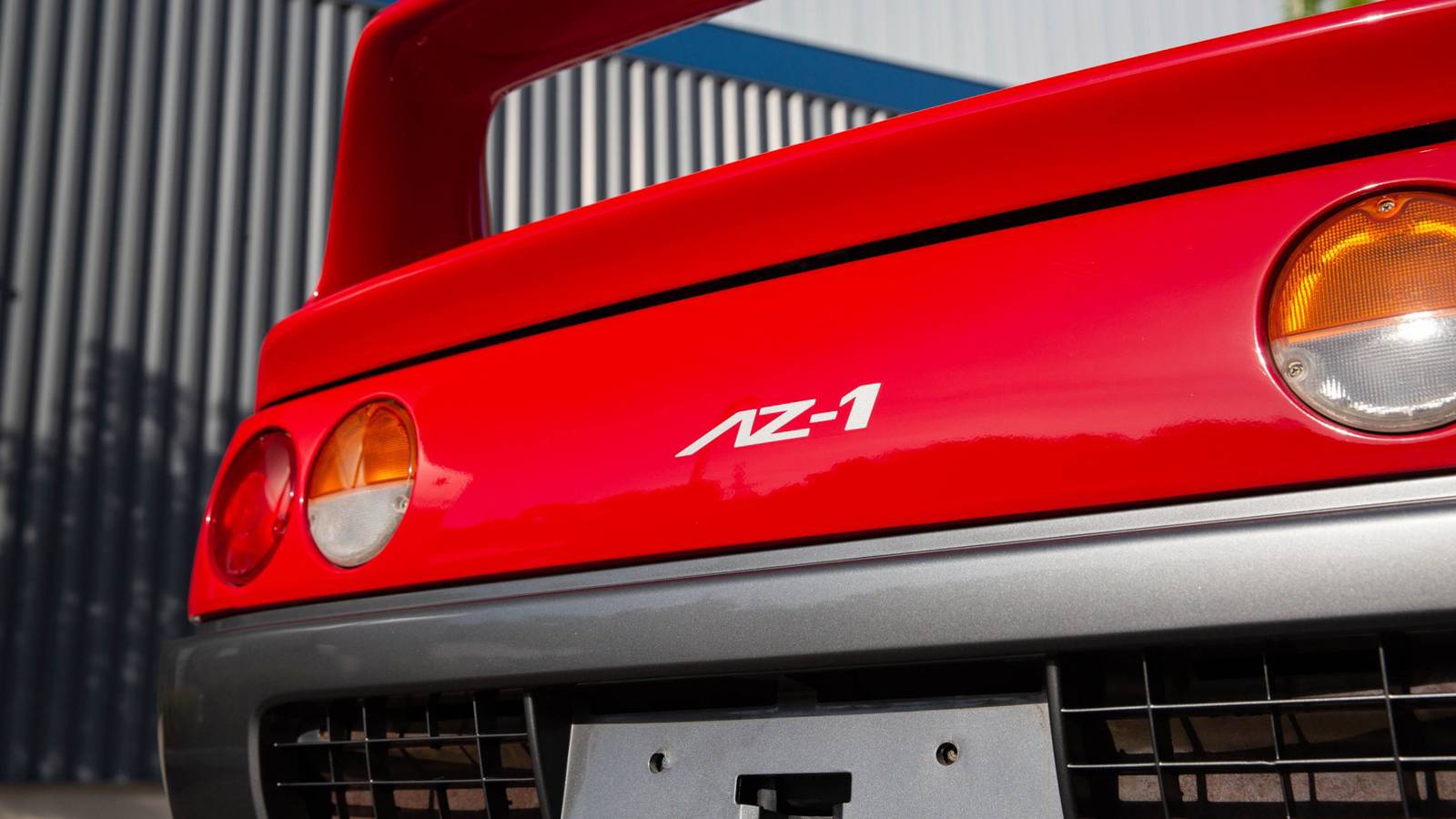
Aside from the huge fenders, this AZ-1 also has a revised front fascia. However, it looks like a placeholder piece for displaying the build at Tokyo Auto Salon because the part doesn't match the rest of the car's aesthetic. An ultra-wide rear wing attaches to the engine cover and is big enough to cover the blistered flares.
The interior is not the focus of this build, but it has a few tweaks. The cabin has Bride sport seats and a Nardi steering wheel. The instruments are from Defi. In stock form, the AZ-1 had a fairly simple layout with just a pair of seats, a simple instrument cluster, and a narrow center stack.
Rate this article
Login to rate this article
Comments
Please login to comment
No comments yet. Be the first to comment!