
Economy & Markets
69 min read
New Earthquake Early Warning System for Italy's High-Speed Rail
Copernicus.org
January 20, 2026•2 days ago
AI-Generated SummaryAuto-generated
Italy has deployed an Earthquake Early Warning (EEW) system for its high-speed railway network. This system, covering the Rome-Naples line, uses seismic monitoring to detect earthquakes and trigger automated train braking. Performance analysis shows the system can issue alerts within seconds, with high prediction accuracy, aiming to enhance safety and operational efficiency during seismic events by preventing trains from entering affected segments.
2.1 Seismic monitoring infrastructure development
A dedicated seismic monitoring infrastructure was first developed. It is operated by RFI, with real-time data acquisition and transmission capacity. The network consists of 20 stations installed in March 2020, within the RFI Technological Sites located along the train line, covering the route from the northern endpoint nearby Rome (Salone station) to the southern end-point nearby Naples (Afragola station) (Fig. 1). Each station is equipped with a 3-component accelerometer, installed in a small buried superficial vault (volume of about 1 m3), specifically conceived to ensure the optimal coupling between sensor and ground and to protect the sensor from high temperature variations. A triaxial accelerometer (model SARA SA-10 FBA) was employed, providing a sensor output voltage of 20 Vpp and a full-scale range of ±2 g (adjustable via the acquisition software). A borehole installation version of the sensor (model SARA SSBHV-SA10) was also used; although it features a different form factor, its performance specifications are equivalent. In 5 sites, an additional accelerometer is installed at the bottom of a 20 m-deep borehole, to improve the signal-to-noise ratio by reducing the contamination of shallow noise ground vibrations. The installation of permanent stations was preceded by a preliminary experimentation campaign aimed at the site characterization (in terms of quality of each recording site, periodic noise-sources identifications, optimal sensor positioning). Section S1 in the Supplement shows examples of preliminary analyses for the site characterization (see also Figs. S1 and S2).
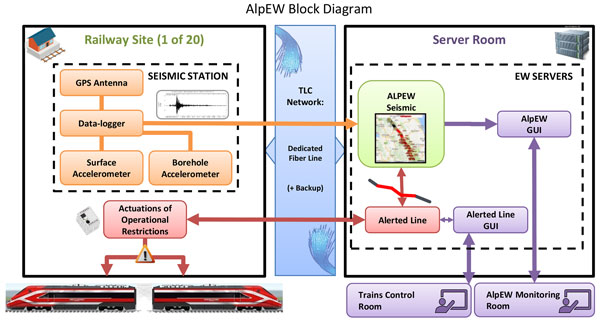
The ground motion data is acquired at a frequency of 125 Hz (with 30 bit-dynamic range data loggers), georeferenced and synchronized via GPS, and transmitted in real-time to a central server (located in Naples), through a dedicated, proprietary fiber optic telecommunication infrastructure managed by RFI. The servers for calculation, data acquisition and storage are installed at Naples Central Station. Data acquisition from the stations is done through the SeedLink protocol (http://ds.iris.edu/ds/nodes/dmc/services/seedlink/, last access: 4 December 2025), in the form of miniSeed packets with a fixed size of 512 bytes and a fixed time duration of 0.6 s, to minimize the latency in data transmission (Fig. 2). The EEW method is implemented in a modular software platform whose block diagram is shown in Fig. 2. The platform is named AlpEW (Array lineare per Early Warning) and the main steps of the methodology are synthetically described in the following paragraphs.
2.6 Integrated Earthquake Early warning and High-Speed Train Braking and Emergency Management System
The protocol for high-speed train braking system management follows the European Train Control System (ETCS) (Rados et al., 2010) that works as part of the broader European Rail Traffic Management System (ERTMS) (Laroche and Guihéry, 2013) to ensure safe and efficient operation of trains, including high-speed traffic. The European Train Control System (ETCS) manages train movements and braking through a combination of continuous communication, onboard computing, precise monitoring, and centralized control (Flammini, 2010). The system relies on GSM-R (Global System for Mobile Communications – Railways) for uninterrupted communication between the train and the control center, known as the Radio Block Center (RBC). The RBC centralizes information on train movements and headway (the safe distance between consecutive trains) and issues movement authorizations. Each train is equipped with an onboard European Vital Computer (EVC), which processes data such as train speed, position, and status, as well as inputs from the RBC, to calculate train behaviour, including movement and braking strategies.
To ensure accurate positional data, Eurobalise transponders placed along the tracks provide precise position and speed information to the train. When a train passes over a Eurobalise, updated data is transmitted to the EVC to enhance accuracy. Using this real-time information – such as train speed, headway, distance to the next target, and safety parameters – the system calculates the optimal braking strategy.
The braking actuator (or emergency closure device) is then triggered to ensure the train stops precisely before the designated stopping point. The RBC continuously monitors train positions and enforces movement limits to prevent collisions, enabling trains to brake intelligently and stop safely at target points like signals or platforms. The emergency closure devices along a railway line are designed to quickly interrupt train operations in response to safety-critical situations, such as accidents, infrastructure failures, or hazards on the track. They can be activated manually by authorized personnel, such as railway operators or staff at a control center, or automatically by connected systems detecting anomalies like derailments, track obstructions, or signalling failures.
For the Italian high-speed railways, specific emergency closure devices have been designed and built to be interfaced and remotely controlled by the seismic Early Warning system so to automatically activate the train stopping signal along the RM-NA railway. Once activated, the device sends an immediate signal to the railway signalling system, indicating that operational restrictions must be applied in the affected section of the track. This signal may also alert the centralized control center, allowing operators to coordinate further operational measures.
The electronic communications through GSM-R in ETCS-equipped railways transmit the emergency status directly to the onboard systems of trains, instructing them to stop. Approaching trains receive the emergency signal and initiate braking procedures; in automatic or semi-automatic systems, the train's braking system is triggered immediately without requiring driver intervention, ensuring all trains within or approaching the affected section come to a stop. Once the emergency closure is activated, the section of the railway line is marked as out of service in the control system, preventing further train movements until the issue is resolved. This process also triggers protocols for emergency response teams to assess and address the situation and inspect the line. After the issue is resolved, the emergency closure device must be reset manually or electronically by authorized personnel, and normal train operations can resume once the area has been inspected with a positive outcome. In our integrated Early Warning and train traffic system, the message of “end of earthquake emergency” is declared by the seismic Early Warning system that pilots the automatic or semi-automatic deactivation, of the along-line emergency closure devices.
3.1 Offline analysis of system performance
A quantitative evaluation of the performance of the EEW system is crucial for stakeholders and end-users (Le Guenan et al., 2016) to setup the operational system and properly configure the several configuration parameters, including, for instance, the PGAth threshold value and the minimum number of nodes at which the predicted PGA should exceed this value to declare the warning. Due to the absence of a massive catalogue of real earthquake waveforms recorded at the high-speed railway sites, the performance here is evaluated through a retrospective, off-line analysis of the system outputs, for a massive number of offline playbacks of earthquake records at the AlpEW system, as explained in the following paragraphs.
The database for performance evaluation includes both real earthquake waveforms (sorted from the waveform database of Italian earthquakes (Luzi et al., 2008) and train transit signals (effectively recorded at stations along the RM-NA line). We identified 2 linear arrays of stations from the Italian National Accelerometric Network (RAN) (Gorini et al., 2010). The arrays have been specifically selected to simulate at best the geometry, extension (total length about 200 km), orientation and spacing of the sensors, as compared to the RFI nodes, as well as their relative position with respect to the source area. The arrays were selected by the National Accelerometric Network (RAN) and are located in Central Italy, in the Apennine area, in a near-parallel and near-orthogonal orientation with respect to the Apennine chain itself. Figure S6 shows the networks used for the experiment, the relative stations and the epicentral positions of the earthquakes. A total of 56 seismic events and 975, 3-component records were selected (i.e., 325 records for each component). The complete earthquake database is composed as follows:
Apennine Array. 16 stations, 28 earthquakes with magnitudes between 3.5 and 6.5;
Anti-Apennine Array. 12 stations, 28 earthquakes with magnitudes between 3.5 and 6.5.
We also evaluated the impact of the train transits on the system performance by simulating the partial and total overlapping of their signals with the P wave recordings. We extracted random samples of train transits (acquired at the RFI nodes during an earlier phase of the project) and summed-up them to the earthquake records, simulating a partial or total overlap with the P wave. Figure S7 illustrates an example of signal obtained by adding the train passage record to a seismic event, before the arrival of the P wave, in acceleration, velocity and displacement (from top to bottom, respectively).
As for the simulation of different configuration parameters, here we explore three specific parameters which are: the PGAth, the EPL level and the DM configuration for the first alert release. We varied these parameters in reasonable ranges (suitable for the Italian railway applications) and, for each combination of the three parameters, we evaluated the response of the system. The complete list of the twenty-two explored combinations (denoted by C) is shown in Table S3. Considering the total number of available records (975) and the selected noise windows (7), a total of 6825 three-component recordings (2275 records per single component) were generated.
For each of the configurations explored, we used all the available records to evaluate the performance. Depending on the comparison between the predicted and the observed value of PGA (PGAobs), four different alert categories at each single node may occur:
SD (Successful Declaration of threshold exceedance):
(1a) PGA pred ≥ PGA th & PGA obs ≥ PGA th
SND (Successful No Declaration of threshold exceedance):
(1b) PGA pred < PGA th & PGA obs < PGA th
FD (False Declaration of threshold exceedance):
(1c) PGA pred ≥ PGA th & PGA obs < PGA th
MD (Missed Declaration of threshold exceedance):
(1d) PGA pred < PGA th & PGA obs ≥ PGA th
We then introduced a straightforward formulation for the performance assessment of the AlpEW system in terms of two indicators:
the Quickness Index QI(C), computed as:
(2) QI ( C ) = ∑ i = 1 N alerts TFD i C N alerts ;
This parameter is defined as the mean value of TFD for each specific configuration C and represents the rapidity of the system in providing first alerts. TFD is the time of the first declaration of threshold exceedance, measured in seconds since the first P wave detection at the network. The QI is computed only for the events belonging to the Nalerts subset;
the Impact Prediction Performance IPP(C,t), computed as:
(3) IPP ( C , t ) = ∑ j = 1 N nodes SD j C , t + SND j C , t N nodes ⋅ 100 .
This parameter represents the percentage of successful predictions of PGA (as the sum of NSD+NSND), at a given time t and for a specific configuration C and it is evaluated for all available nodes for which the P wave signal is available at the considered time. It represents the EEW system ability to correctly predict/not predict the ground shaking level at a single node.
In the above formula:
Nalerts is the number of earthquakes PGAobs ≥ PGAth at a variable number of nodes (depending on the configuration C); Nnodes is the total number of available nodes considering all networks and performed simulations (it is the same for each configuration C and is equal to 2275);
For each configuration of the three explored parameters (PGAth, DM, EPL), we computed the median values of QI and IPP as obtained from the playbacks. A useful way of representing the performance is provided by the IPP vs. QI diagram of Fig. 3. The proposed scheme allows positioning each configuration in the ideal space of the two indicators and provides an immediate and quick visualization of the system performance. The best performing configurations are those that maximize the IPP parameter while minimizing the QI value (top-left diagram corner). For clarity of representation, in Fig. 3, we did not associate each configuration with a different symbol, but we highlighted the behavior of the system depending on DM, PGAth and EPL values.
Download
The performance analysis is summarized in Fig. 3 for all events (panels a, c) and relevant earthquakes only (panels b, d), where a “relevant” earthquake is defined as an event for which the observed PGA has exceeded the user-set threshold at least in one node of the network. The performance is shown at the Time of the First Declaration of threshold exceedance (TFD) (panels a, b), and 5 s later (TFD+5) (panels c, d) for all events (panels a, c) and for relevant earthquakes only (panels b, d). For all the tested configurations, the first alert declaration (TFD) is typically released within a short time after the first P-detection at the network, in a range of 3 to 8 s for all earthquakes, and 3 to 10 s for relevant earthquakes. At these times, the IPP parameter ranges between 85 % and 97 % of successes (positive and negative successful alerts) for all events (Fig. 3a) and between 65 % and 85 % for relevant earthquakes (Fig. 3b). At later times, at TFD + 5 s, the performance in terms of IPP varies between 90 % and 100 % for all events (Fig. 3c) and between 80 % and 93 % for relevant earthquakes (Fig. 3d). For all configurations, the use of high EPL values (75 % or 90 %; empty symbols) generally requires longer times to issue the first alert declaration and does not provide significant performance improvements, as compared to the value EPL = 50 % (filled symbols).
Whichever configuration is used, an increase of the user-set PGAth generally results into a slightly higher impact prediction performance, when considering all the events. This is a widely understood behaviour of EEW systems and reflects the relative larger number of SND, with respect to the SD, when increasing the threshold level for warning declaration (Minson et al., 2019). Indeed, the same effect is less evident when considering the relevant earthquakes only, for which the number of SD remains rather constant between different configurations, and SND are partially reduced from the computation. The threshold-dependency of impact prediction performance becomes less evident at later times.
It is worth to mention that the percentages here refer to the individual node numbers that provide successful declarations (both SD and SND) vs. unsuccessful declarations (both MD and FD). This means that, in case of a missed/false declaration of threshold exceedance at a single node, there will be an underestimation/overestimation of the railway segment length affected by strong shaking, but anyway the alert for a potential damaging earthquake occurrence will be issued in most of the cases. The underestimation of the railway segment length affected by strong shaking is mitigated by considering a buffer zone at the beginning and at the end of the segment.
4.2 System performance evaluation
For a distributed target such as the railway line, the traditional concept of magnitude estimation accuracy and lead-time are, indeed, not applicable. The effectiveness of an EEW system should, therefore, be evaluated in a broader sense. Here, we first propose a compact and powerful diagram which transforms the classical approach to the performance evaluation and allows end-users to choose the optimal system configuration parameters. We then evaluate the impact of the system on the railway traffic of the whole line, accounting for the actual probability of occurrence of potentially relevant earthquakes.
The EEW system for high-speed railways in Italy is evolutionary in time, meaning that PGA predictions are updated as the P wave propagates across the network. However, the Decision Module (DM) is conceived in a way that once the declaration of threshold exceedance is given at any node, the step back is no longer possible during the seismic shock. Indeed, the definitions of SD (Successful Declaration), SND (Successful No Declaration), FD (False Declaration) and MD (Missed Declaration) are based on the comparison between predicted and observed PGA values. While the PGA prediction may evolve with time, as longer portions of P wave signals are analyzed, the a-posteriori observed value of PGA is fixed. Moreover, the expected PGA is continuously predicted from the initial P wave peak amplitude (Pd, Pv, Pa) which are computed as the absolute maximum amplitude in increasing P wave time windows, in displacement, velocity and acceleration, respectively. Therefore, the prediction can only increase or remain stable with time. In other words, once the predicted PGA has exceeded the threshold value, the warning declaration cannot be cancelled during the seismic shock. With this in mind, the prediction performance at any node may potentially evolve with time from SND to FD or from MD to SD. Other transitions between alert states are indeed not possible. Thus, a way to improve the quality of predictions and maximize the real-time performance is by reducing FD since the first alert, with more robust P-amplitude to PGA prediction models, accounting for a more comprehensive approach for all source, propagation, and site effects. Additionally, the experience of operational or under testing EEW systems worldwide teaches us that: (1) the performance of a system in terms of correct or wrong predictions of the PGA strongly depends on the threshold value for the alert declaration; (2) the declaration of correct alerts can be pushed to the limits, while the trade-off between missed and false alerts cannot be eliminated (Minson et al., 2019). Indeed, the lower the threshold is, the higher is the probability for the system of issuing false alerts, with a relatively small number of missed alerts. Conversely, if a high threshold is requested to release the warning, the chance of declaring false alerts decreases, but the incidence of missed alerts may increase.
4.3 Alerted Segment of the Railway (ASR) and Potential Benefits of the Early Warning System
Beyond the performance evaluation, a critical aspect of this study is the utilization and effectiveness of earthquake alerts in railway applications (Minson et al., 2021). Stopping a high-speed train completely requires a considerable amount of time, which may sometimes exceed the warning time provided by the system. Therefore, one of the primary advantages of the EEW system is its ability to prevent high-speed trains from entering the Alerted Segment of the Railway (ASR) while promptly initiating deceleration for trains already within the segment. This approach helps mitigate the potential impacts of seismic shocks. During an earthquake alert, operational restrictions would slow down and eventually stop trains within the ASR, while preventing entry for trains approaching the segment from either direction.
The proportion of trains inside or outside the ASR during an alert depends on train traffic density along the railway and the extent of the ASR, which is determined by the earthquake's magnitude (M) and its distance (R) from the railway line. We computed the expected ASR lengths for earthquakes with magnitudes between 4.5 and 7.0, occurring at distances of 10 to 100 km from the RM-NA railway line, using an empirical relation, similar to a standard GMPE, between the length of ASR, the earthquake magnitude (M) and the distance of the earthquake from the railway (R) (see Appendix C: Alerted Segment of the Railway computation). Figure 4 shows data used for the estimation of the ASR. Additionally, a two-month analysis of train traffic on the high-speed railway revealed two occupancy patterns: low-density periods (06:00–10:00 and 20:00–23:00) and high-density periods (10:00–20:00), during which rail occupancy remains relatively consistent across the line (Fig. 5a). Based on these occupancy trends and earthquake scenarios, we estimated the distribution of trains inside and outside the ASR, as shown in Fig. 5b. For most ASR lengths and time periods, the percentage of trains outside the ASR exceeds those within it, except for the case where ASR = 100 km, where the proportions are approximately equal. An ASR length of 100 km corresponds to a large earthquake occurring close to the railway line (M>6.5, R<20 km). This represents a rare scenario for the RM-NA railway, with an estimated return period of approximately 2000 years (Fig. 5c) (Appendix C: Alerted Segment of the Railway computation). More frequent cases, with return periods of 10–15 years, involve moderate earthquakes (M 4–5) occurring within 10–20 km of the railway, resulting in ASRs of about 10 km. In these instances, the vast majority of trains would likely receive sufficient warning to decelerate or stop before entering the ASR.
Download
Furthermore, while the current ASR estimates rely on theoretical PGA values, the ability of the EEW system to rapidly identify non-relevant earthquakes or adjust ASR parameters based on real-time data could significantly enhance the system's efficiency. This would enable faster resuming train operations, providing substantial benefits to the overall railway infrastructure.
Finally, to validate the trigger criteria, we simulated the criteria for the first alert release embedded in the SSR2 configuration of the DM and evaluated its performance on the largest historical earthquakes occurred nearby the railway line (see Appendix C: Alerted Segment of the Railway computation). We evaluated the expected shaking produced by these earthquakes along the route and whether they would or would not have triggered the activation of the EEW system. The results are explained in Sect. S2 and shown in Fig. S9. For all the selected scenarios, the earthquakes would have triggered the activation of the alert, resulting in the interruption of the train circulation within a portion of the line (ASR), ranging from 20 to 50 km, while keeping the circulation possible in the rest of the route.
Rate this article
Login to rate this article
Comments
Please login to comment
No comments yet. Be the first to comment!