
Politics
27 min read
Rights Group B'Tselem Warns of Severe Israeli Abuse of Palestinian Prisoners
dw.com
January 20, 2026•2 days ago
AI-Generated SummaryAuto-generated
A human rights group's report details alleged systemic torture and abuse of Palestinian prisoners by Israeli authorities. The report, featuring new testimonies, claims prisons have become "torture camps," with sexual assault and degrading treatment occurring. Israel's Prison Service denies these allegations, stating all inmates' rights are safeguarded. The report coincides with discussions in Israel's parliament to reintroduce the death penalty for "terrorists."
The memory of the sexual assault with a stick still haunts Tamer Qarmut from Beit Lahiya in the northern Gaza Strip, who was among many who spoke of their ordeals to the Israeli human rights organization B'Tselem. His full testimony is published in B'Tselem's "Living Hell" report,which went online on Tuesday.
The report, an update to the August 2024 "Welcome to Hell," contains 21 new testimonies by Palestinians about the conditions in various Israeli prisons and detention centers, following the earlier publication with 55 testimonies.
"Israeli prisons have turned into a network of torture camps," Yuli Novak, B'Tselem's executive director, told DW.
"Israel is continuing its systemic, institutionalized policy of torture and abuse of Palestinian prisoners, approved and backed by the political system, the judicial system, the media and, of course, the prison authorities themselves, which openly boast about the torturous conditions in which Palestinian inmates are held," the report says.
The Israel Prison Service, or IPS, that operates the country's 30 civilian prisons, has categorically rejected allegations described in the testimonials. "Claims of 'systematic violence' or abuse are false and unsupported," IPS told DW in a statement.
"All inmates are held pursuant to legal procedures, and their rights including access to food, medical care, and humane living conditions are safeguarded by trained professional staff," the spokesperson said.
According to its latest report from September 2025, IPS was holding 10,863 Palestinians classified by the Israeli regime as "security prisoners."
Among these, 3,521 are defined as "administrative detainees," which refers to Palestinians imprisoned without trial and without the opportunity to mount a defense against allegations. Another 2,623 are defined as "unlawful combatants," people who are held without an official prisoner of war status — according to the Geneva Conventions — which means that they have fewer protections, and 3,227 were defined as "security detainees", i.e. Palestinians against whom legal proceedings are underway but have not yet been sentenced. The remaining 1,492 are "security convicts" with prison sentences by a court.
During the large-scale prisoner swap on October 13, 2025, around 2,000 Palestinians — including 41-year-old Tamer Qarmut — were released. The swap also freed the 20 surviving Israeli hostages held by Hamas since the terror attacks on Israel on October 7, 2023, under a US-brokered ceasefire deal reached in early October, which halted almost two years of war in Gaza.
Still, the number of Palestinian prisoners remains higher than it was before October 7, 2023, B'Tselem notes: In September 2023, IPS had listed 4,935 Palestinian inmates.
Military detention
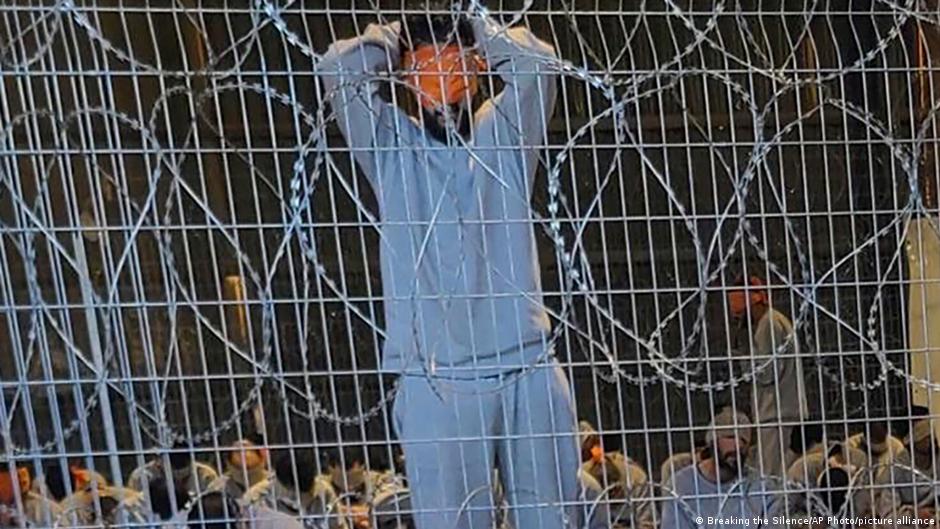
In addition to Israel's civilian prisons, the Israeli Defense Forces, or IDF, also operate four military detention camps across the country. In particular, Sde Teiman, a military detention facility in the Negev Desert, continues to be at the center of the allegations.
Two months after Hamas — an Islamist militant group which is categorized as terror organization by the Israel, US, EU and many other countries — attacked Israel on October 7, 2023, and killed around 1,200 mostly civilians and took more than 240 hostage, parts of this military base were converted into a large-scale detention camp.
Since then, Palestinians classified as "unlawful combatants" are detained there in line with Israel's "Unlawful Combatants Law." According to the law, the Israeli military is allowed to arrest suspected militants and hold them for 45 days without a formal detention order. Some people are detained for up to 90 days without access to a lawyer.
"At the Sde Teiman facility, I went through the hardest days of my life. I'm still suffering from severe trauma. They held me naked, and soldiers set dogs on me that attacked me. They beat me on the penis, tied it with a plastic cord and caused swelling and bleeding," a Palestinian, who asked for anonymity for fear of reprisal after he was released in October 2025, told B'Tselem.
Muhammad al-Mishwakhi, 45, added that in Sde Teiman "they hardly allowed us to shower, and when they did, it was only for two minutes. We didn't change out of those tracksuits for more than two months. Our clothes got so filthy, and we had to wash them and put them back on while still wet, even in the cold of winter."
When asked about several individual cases, the IDF told DW that they are unable to comment on these cases without knowing the full background. However, the IDF emphasized that their soldiers act in accordance with Israeli as well as international law, and that they protect the rights of individuals held in detention facilities under its responsibility.
"The IDF treats any such violations with the utmost seriousness, as they contradict its core values," the statement continued, adding that the IDF completely rejects allegations regarding the systematic abuse of detainees, including allegations of sexual abuse.
The IDF also noted that concrete complaints regarding misconduct or inadequate detention conditions are forwarded to relevant authorities, and in appropriate cases, disciplinary measures are taken against facility staff members.
However, according to an investigation by the NGO by Action on Armed Violence from August 2025, 88% of Israeli investigations into recent Gaza abuse allegations stalled or closed without findings, with just one leading to criminal sentencing.
'Dehumanization of Palestinians as strategy'
Jane Kinninmont, CEO at the United Nations Association UK, recognizes a pattern. "With prison abuse, it is often that the authorities first of all deny it and then say that it is a problem of a few junior officials who went rogue," she told DW, adding that in fact it is "all too often tolerated or even encouraged from the top and seen as a way to frighten and coerce a population seen as an enemy."
At the same time, she added that local people and rights organizations like B'Tselem and Breaking The Silence work bravely to change these dynamics. "But they are constantly under pressure from an Israeli government for whom the dehumanization is strategically useful, helping to justify the subjugation of another people and the destruction of foundations of Palestinian life in Gaza," she said.
Kinninmont believes that if Israel really wanted to address these abuses, leadership from the top would be needed.
Yet, Itamar Ben-Gvir, the far-right head of the National Security Ministry, which oversees the Israeli Prison Service, said in a Hebrew-language post on X in in July 2024 that one of his highest goals was "to worsen the conditions of the terrorists in the prisons, and to reduce their rights to the minimum required by law."
Knesset considering reintroduction of death penalty
On Monday, various human rights organizations raised alarm over a contentious bill that is currently being discussed by Israel's parliament. If enacted, the Penal Law (Amendment – Death Penalty for Terrorists), 2025, would end Israel's de facto abolition of the death penalty. In the context of escalating human rights violations since October 7, 2023, this would constitute a grave, racially targeted threat to Palestinian lives, they warned in a statement.
"Itamar Ben-Gvir tried to push the death penalty law in early 2023, but now it is gaining traction," said Milena Ansari, Israel and Palestine Assistant Researcher at Human Rights Watch.
Even before that, the UN and HRW had already warned about the abuse and alleged torture and the death of Palestinian prisoners. According to the recent B'Tselem report, at least 84 Palestinian prisoners and detainees, including one minor, have died in Israeli prisons and military detention centers since October 7, 2023. Some human rights organizations put the number even higher, at around 100.
"The testimonies documented by B'Tselem are horrifying, but they are entirely consistent with Human Rights Watch's own research," Ansari told DW. "These abuses do not appear to be isolated incidents but part of a broader pattern, especially since October 7, 2023," she said, adding that "we have documented similar patterns of torture, cruel and degrading treatment, sexual violence, and medical abuse, particularly against Palestinian health care workers detained from Gaza."
Ansari further warned that "what we are seeing likely represents only a partial picture, as independent monitoring has been blocked by Israeli authorities." This includes the main international organization with access to prisoners in conflict, the International Committee of the Red Cross.
Edited by: Jess Smee
Rate this article
Login to rate this article
Comments
Please login to comment
No comments yet. Be the first to comment!