
Technology
9 min read
iPhone 16 Pro Camera: Can AI & iPhone 16 Pro Outshine iPhone 17 Pro?
PRWeb
January 20, 2026•2 days ago
AI-Generated SummaryAuto-generated
Glass Imaging's research suggests AI processing can enhance camera performance beyond hardware upgrades. While the iPhone 17 Pro might feature a higher-resolution telephoto sensor, AI models that understand the entire imaging chain can reconstruct more detail from lower-resolution sensors. This approach, demonstrated on the iPhone 16 Pro, focuses on recovering existing detail rather than generating new textures, potentially surpassing purely hardware-driven improvements.
https://www.glass-imaging.com/journal/how-ai-and-iphone-16-pro-might-surpass-iphone-17-pros-camera-upgrade
Apple's iPhone 17 Pro introduces a 48-megapixel telephoto sensor, widely viewed as a major hardware upgrade. Glass Imaging's findings, however, illustrate that sensor resolution alone does not define delivered image quality. Instead, lens-aware, noise-aware neural reconstruction plays an increasingly decisive role in extracting usable detail at high zoom.
More pixels help, but they are not the whole story. If the pipeline cannot preserve fine structure, extra resolution just gives you a sharper version of blur. The goal is to recover real detail that the sensor actually captured," said Vishal Vinod, Machine Learning Engineer at Glass Imaging.
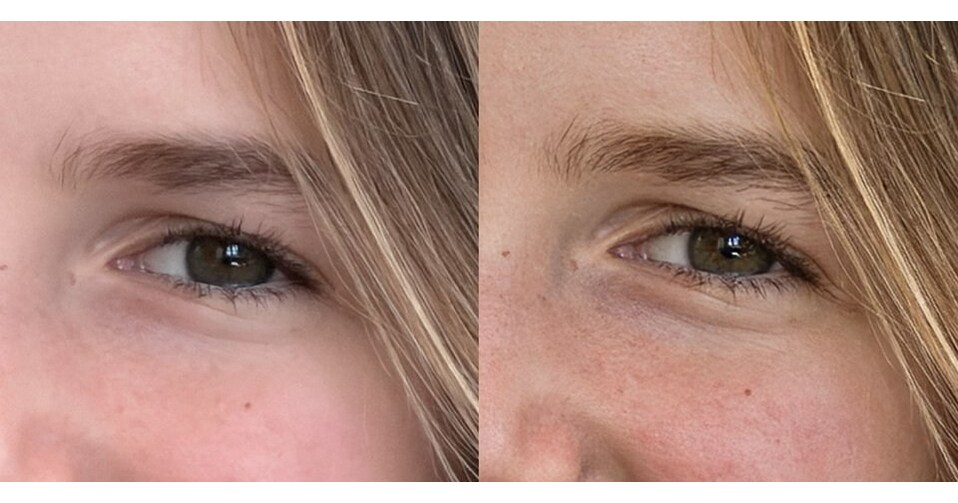
Unlike conventional super-resolution or sharpening approaches, Glass AI models the complete imaging chain — optics, sensor characteristics, and noise statistics — to reconstruct scene-consistent high-frequency information rather than hallucinated texture.
"We are not trying to generate any new texture. We train the model to model the lens, sensor, and noise behavior so the output maintains its fidelity to the scene. If the RAW evidence is non-existent, the network should not create it… When applied to the iPhone 16 Pro's 12MP telephoto output, Glass AI doesn't just make the image bigger; it analyzes the existing pixels and, based on its training, reconstructs plausible high-frequency details obscured by sensor noise and optical aberrations. This restores textures, sharpens edges, and extracts detail that would be lost using conventional processing," said Shivansh Rao, Machine Learning Engineer at Glass Imaging.
Technical implications highlighted in the analysis:
Diminishing Returns from Pure Hardware Scaling: Larger and higher-resolution sensors alone do not guarantee proportional perceptual gains.
Pipeline-Level Modeling Matters: Joint optimization of demosaicing, denoising, and super-resolution enables materially better detail recovery.
Software-Defined Camera Performance: AI increasingly defines the effective capabilities of a camera system across product generations.
The complete methodology and comparative results are available here:
https://www.glass-imaging.com/journal/how-ai-and-iphone-16-pro-might-surpass-iphone-17-pros-camera-upgrade
About Glass Imaging
Glass Imaging is a computational imaging company developing AI-first camera pipelines that replace traditional ISP architectures with neural reconstruction optimized per sensor and lens. The company enables OEMs to deliver materially higher image quality without changing camera hardware. Learn more at https://www.glass-imaging.com
Media Contact:
Glass Imaging Press Office
[email protected]
Media Contact
Ziv Attar, Glass Imaging Inc., 1 4086096138, [email protected], https://www.glass-imaging.com
SOURCE Glass Imaging Inc.
Rate this article
Login to rate this article
Comments
Please login to comment
No comments yet. Be the first to comment!