
Space & Astronomy
7 min read
New Infrared Detector Promises Breakthrough in Exoplanet Biosignature Detection
astrobiology.com
January 20, 2026•2 days ago
AI-Generated SummaryAuto-generated
Researchers developed a dual-polarization mid-infrared detector that mitigates multipath fading. Operating at 20 micrometers, this superconducting device achieves ultra-low noise by capturing signals in two orthogonal polarizations simultaneously. The innovation promises enhanced sensitivity for detecting biosignatures on exoplanets and for climate change observations, overcoming limitations of current detectors.
The mid-infrared (MIR) wavelength range, from 5 to 25 micrometers, is an important regime for astrophysics as it can be used to detect the biosignatures of life that may exist on distant planets.
These wavelengths are also useful making space-based observations of climate change on Earth since they can be used to make global maps of atmospheric temperature, humidity, and precipitation.
However, many current MIR detectors are limited by readout noise and dark current, which restricts their sensitivity. To overcome these issues, researchers have been developing superconducting pair-breaking detectors, called kinetic inductance detectors (KIDs), which have proven successful in improving sensitivity-limited optical, near-infrared and far-infrared observations.
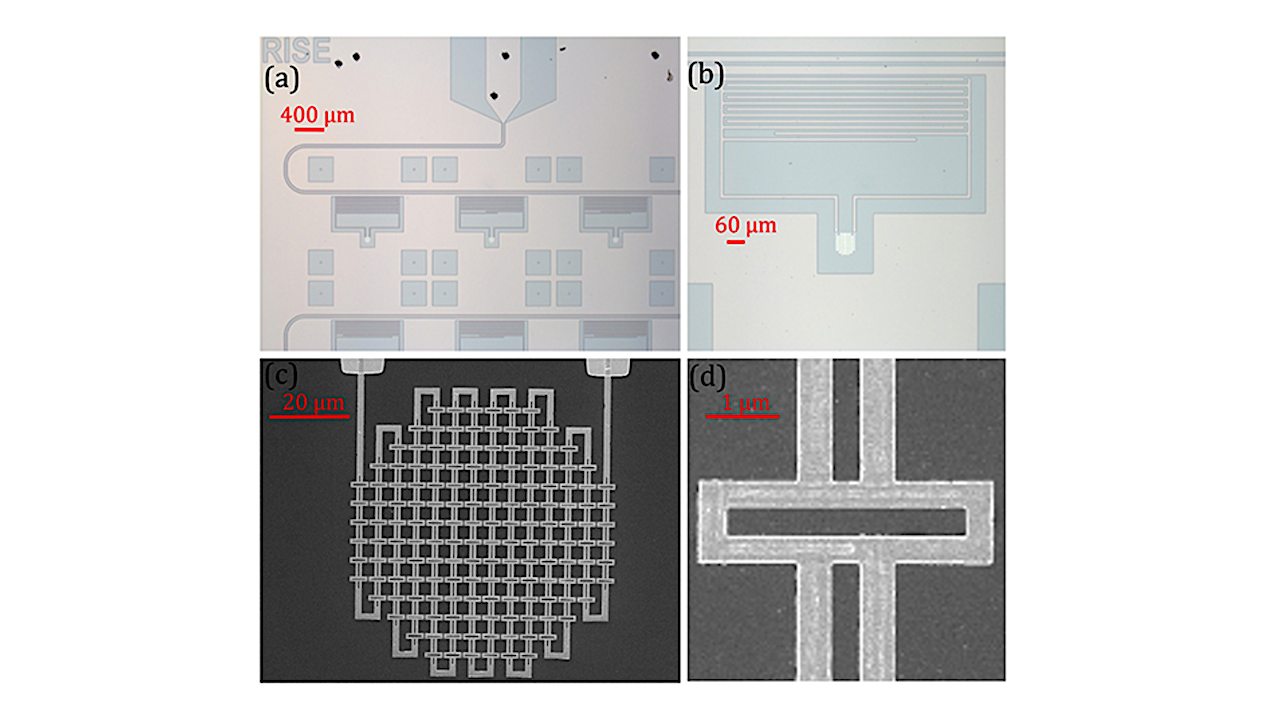
Further improving KIDs, Su et al. developed a dual-polarization version operating at 20 micrometers that mitigates multipath fading to enhance the signal-to-noise ratio. The device simultaneously functions as an absorber to capture signals in two orthogonal linear polarizations. This allows the detector to achieve ultra-low noise in scenarios where their targets interact with radiation in both polarization states.
“The superconducting kinetic inductance detector we designed, which is fabricated with relatively simple processes and can be easily implemented into a large array, is a competitive candidate for ultra-sensitive MIR detection for imaging applications,” Chen said. “As a result, it can be used as an ultra-sensitive MIR camera for cold astrophysical sources in the universe.”
The device is a promising detector for space and balloon-based observatories, which can rise above the bulk of Earth’s atmosphere, where water vapor readily absorbs the 20 micrometer wavelength. It may even prove useful in observatories in Antarctica, where water vapor is limited.
Ultra-low noise mid-infrared detector could help detect biosignatures on exoplanets, AIP
Source: “A dual-polarization mid-infrared kinetic inductance detector with photon-noise-limited performance,” by Runfeng Su, Rui Tan, Junhua Chen, Yuwei Zhu, Tianyuan Chi, Siming Zang, Jingbo Wu, Xuecou Tu, Kai Zheng, Jian Chen, and Peiheng Wu, Applied Physics Letters (2025). The article can be accessed at https://doi.org/10.1063/5.0300553 .
Astrobiology, Astrochemistry,
Rate this article
Login to rate this article
Comments
Please login to comment
No comments yet. Be the first to comment!