
Space & Astronomy
16 min read
Giant Iceberg A-23A Turns Blue as It Melts
Earth.com
January 18, 2026•4 days ago
AI-Generated SummaryAuto-generated
Giant iceberg A-23A, after nearly four decades, is showing signs of significant melting. NASA images reveal blue meltwater pools on its surface, indicating sustained thawing. Scientists explain these melt features, like hydrofracture and rampart-moats, are weakening the iceberg. It is currently drifting in the South Atlantic and expected to break apart during the austral summer.
After nearly four decades at sea, a giant Antarctic iceberg named A-23A is soaking itself from the top down, stained blue by its own meltwater.
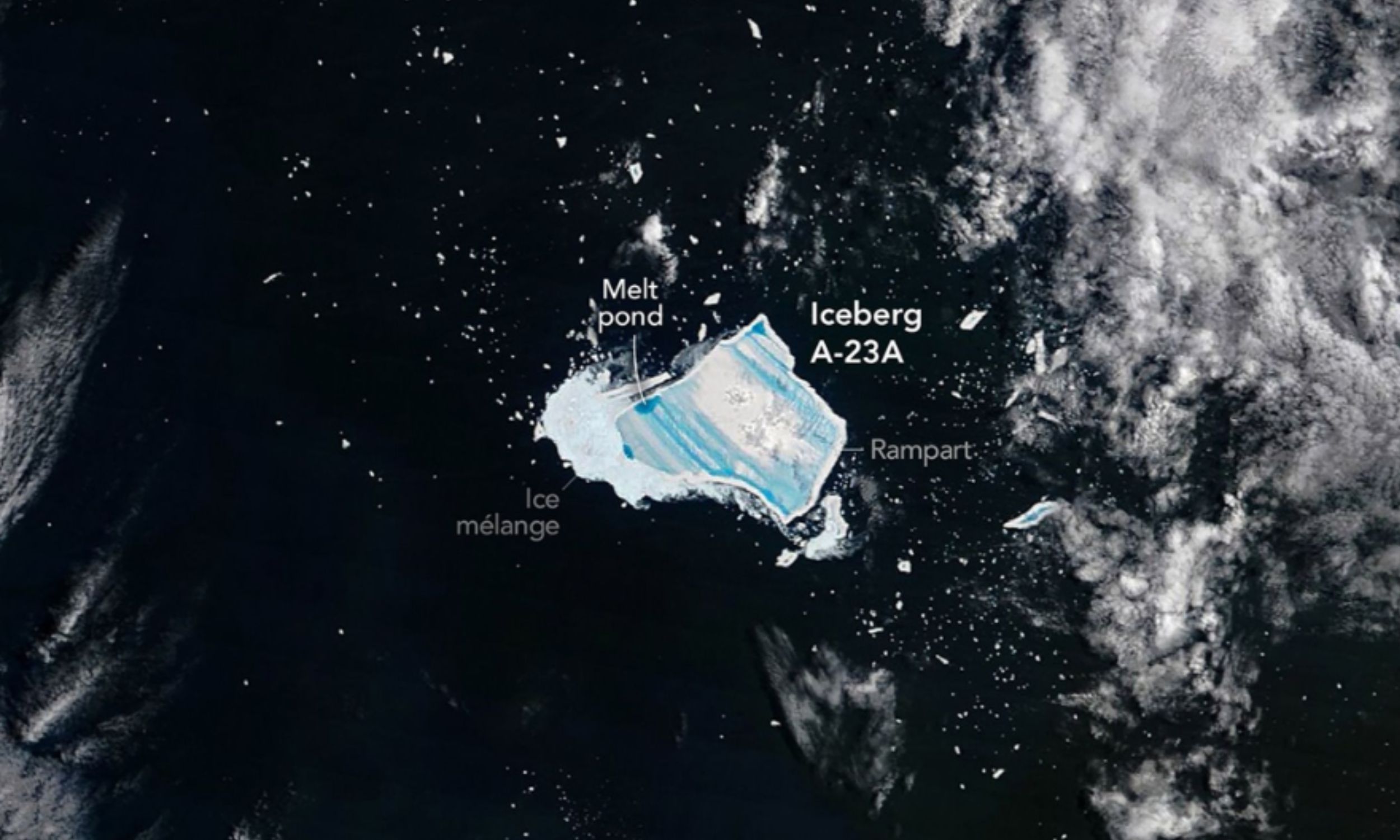
New NASA images show it drifting through the South Atlantic in late December 2025, still larger than New York City but visibly failing.
A CBS News report described melt pools on A-23A on December 26, 2025, followed by an astronaut photo 1 day later.
At the University of Maryland, Baltimore County (UMBC), Dr. Christopher A. Shuman coordinates long-term iceberg tracking with NASA partners.
His research ties satellite patterns to on-ice processes, so surface water becomes evidence of cracks spreading through the berg.
Because the iceberg is far from shore, consistent remote observations help researchers separate temporary surface change from real structural failure.
Blue meltwater around A-23A
Sunlight traveling through pooled water loses more red wavelengths, and the light that returns to orbit looks blue.
Clear water also smooths the ice surface, reducing scattering from air bubbles and making darker layers show through.
As the surface thins, shallow basins connect, and meltwater follows subtle slopes that were carved long before the iceberg calved.
Blue patches do not prove the iceberg will vanish on schedule, but they signal sustained melting rather than brief thaw.
Water pressure breaks the plate
Once ponds deepen, the water forces cracks open by hydrofracture, water-driven cracking that pries ice apart from within.
Because liquid water is denser than ice, it adds pressure that can drive a crack downward toward seawater.
When a fracture reaches the bottom, the pond can drain fast, and the sudden change can stress nearby weak spots.
Repeated drainage events can steadily weaken the ice, leaving the remaining plate more likely to split during storms.
Along some edges, thin melt at the waterline can bend the floating ice upward and form a raised rim.
Scientists call this a rampart-moat, a raised lip with a shallow depression just behind it.
The rim can hold water on the surface longer, increasing the time that ponds can grow heavy and deepen.
If the rim breaks or the ice flexes, trapped water can spill into cracks, raising stress at the edges.
When the ice springs leaks
Some pooled water can escape through a weak spot, and the outflow can whiten nearby sea surface in satellite views.
The spill can create a freshwater discharge plume, a buoyant flow of fresh water that spreads outward.
By rising to the surface, meltwater can carry nutrients from the iceberg and stimulate algae growth tens of miles away.
Cloudy skies often hide these streaks, so satellites can miss short-lived plumes even when the discharge is strong.
Old grooves steer the flow
Long lines across A-23A likely trace striations, shallow grooves carved by moving ice sliding over bedrock.
Those ridges and valleys can steer meltwater into narrow channels, which explains the sharp blue-and-white bands seen from orbit.
Snowfall can soften the surface, but the underlying relief still guides where water collects and where it drains.
As melting grows more widespread, these inherited grooves can concentrate water into fewer cracks, raising the chance of sudden failure.
Currents push A-23A north
Warm surface currents have carried the iceberg toward the zone near South Georgia where many Antarctic bergs break apart.
After calving in 1986, A-23A shrank from about 1,544 square miles to 456 square miles as it entered warmer seas.
More sunlight and wave action attack the edges, while meltwater keeps forming on top during the Southern Hemisphere summer.
“I certainly don’t expect A-23A to last through the austral summer,” said Shuman, pointing to fast melt in this region.
Seafloor traps and spins
For more than 30 years, the iceberg sat grounded in the Weddell Sea, pinned by shallow seafloor highs.
After it broke free, a Taylor column, a spinning water column tied to seafloor bumps, kept it turning for months.
Rotating in tight circles slows travel, but it also exposes the same edges to waves and warm water again and again.
Unusual detours like this make some bergs last longer, yet they also leave them fragile when they finally escape.
Lessons from iceberg A-23A
Multiple NASA and partner satellites map iceberg size and motion, letting scientists follow changes even when storms and darkness block ships.
Instruments measure reflected light and surface height, which helps teams estimate how much ice has been lost since the last pass.
At UMBC, Shuman and colleagues compare these maps with sea and weather data, looking for the conditions that trigger breakups.
When A-23A disintegrates, the record will still guide forecasts for future megabergs that leave Antarctica’s ice shelves.
Blue ponds, trapped rims, and leaking plumes all point to a single story, meltwater is now reshaping A-23A from the top down.
Better satellite tracking and field studies at UMBC could reveal which bergs fail quickly, and which ones linger long enough to matter.
—–
Like what you read? Subscribe to our newsletter for engaging articles, exclusive content, and the latest updates.
Check us out on EarthSnap, a free app brought to you by Eric Ralls and Earth.com.
—–
Rate this article
Login to rate this article
Comments
Please login to comment
No comments yet. Be the first to comment!