
Entertainment
14 min read
Henry V: Shakespeare's War Play and Its Relevance in Global Chaos
The Guardian
January 21, 2026•1 day ago
AI-Generated SummaryAuto-generated
Shakespeare's *Henry V* is a historically relevant play that reflects current global chaos and the threat of war. Its meaning shifts with each production, adapting to contemporary political and cultural winds. Past interpretations have varied from wartime propaganda to critiques of conflict, highlighting the play's enduring ambiguity and its capacity to mirror societal anxieties. A new RSC production is anticipated to continue this tradition.
I have long argued that Shakespeare’s history plays have more urgent relevance today than his tragedies. The issues they raise – such as the nature of good governance and the difficulty of deposing a tyrant – are precisely those that still haunt us. Henry V, shortly to be given a new RSC production directed by Tamara Harvey, seems especially timely as we are living in a world where the threat of war is painfully real.
It is also a play that constantly changes its meaning. James Shapiro wrote in the Guardian in 2008: “There’s no better way to know which way the cultural and political winds are blowing than by going to see a performance of Henry V.” He reminded us that in 1599, when the play was first performed, playgoers anxiously waited to hear whether an Irish uprising had been suppressed.
Two major film versions have a wildly different emphasis. Laurence Olivier’s 1944 movie was dedicated “To the Commandos of England” and seen as a major contribution to the war effort. Kenneth Branagh’s 1989 film, in contrast, was haunted by the spectre of Vietnam and substituted grey and muddy brown for Olivier’s heightened colours.
Henry V, in short, is a slippery, ambiguous work that has a chameleon-like quality. Looking back over past productions, I also notice how it subtly changes depending on whether it is played in isolation or presented as part of a sequence. One of the first versions I saw was at Stratford in 1964 when, directed by Peter Hall and John Barton, it was part of an eight-play Shakespeare history cycle: much of the fascination lay in watching Ian Holm’s transition from a coldly calculating Prince Hal to a more sympathetic Henry. Even through the mists of time, I recall how that production struck a balance between rhetoric and reality. Eric Porter’s Chorus was a wholly Elizabethan figure putting a romantic spin on history; Holm’s Henry was a dogged scrapper who after Agincourt joined his rain-drenched troops in pushing a war-wagon offstage while exhaustedly singing a Te Deum.
Michael Boyd went even further in his 2007 production to bring out the play’s ambivalence. His Henry, Geoffrey Streatfeild, was a figure of puzzling contradictions: a pensive solitary who forced himself to become a military leader, a punitive warrior capable of unexpected tenderness. Having graphically threatened the citizens of Harfleur with unspeakable horrors (“Your naked infants spitted upon pikes”) he then turned to his uncle, Exeter, and quietly said “use mercy to them all”. Even when the king acted like a war criminal with the notorious injunction “then every soldier kill his prisoners” you felt that Streatfeild was driven by the heat of battle to issue a totally impractical order.
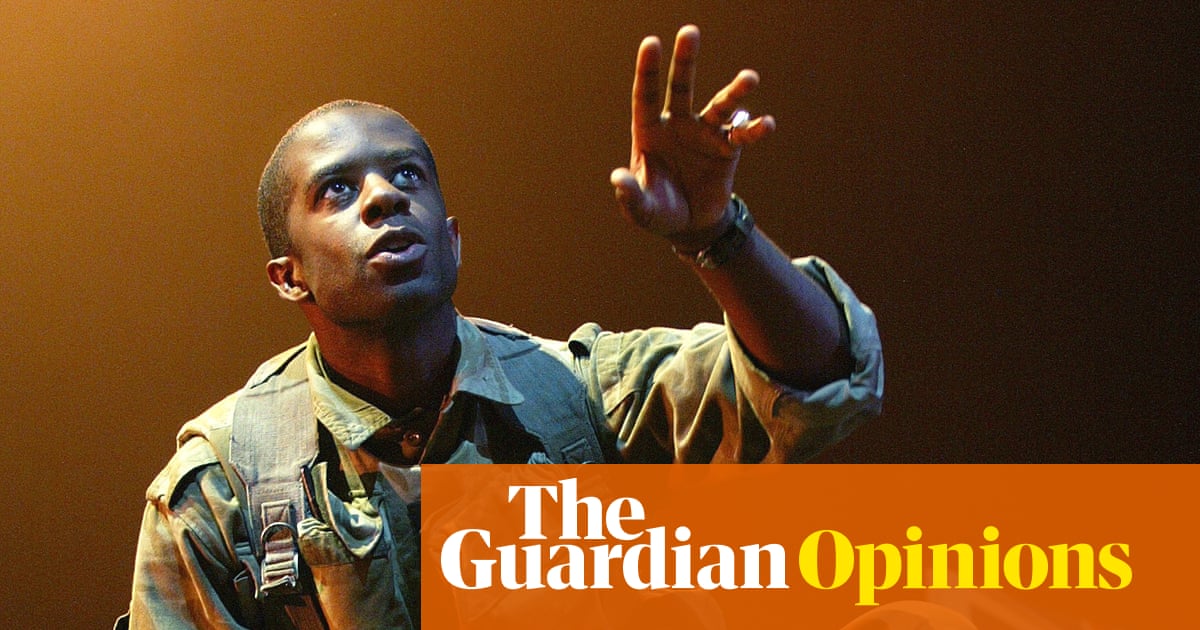
Surveying a mix of solo productions, I am struck by their constant desire to deglamorise war and to sharpen the play’s modern relevance. From Adrian Noble’s 1984 production, where a young Branagh first essayed the role of Henry, I recall the image of workaday English soldiers huddling together in the rain. Ron Daniels’s 1997 version, with Michael Sheen as the king, began and ended at the Cenotaph in a potent reminder of the consequences of war. Edward Hall’s 2000 production, with its references to Dad’s Army and ’Allo ’Allo, suggested that patriotism itself was confused, self-contradictory and circumstantial. Famously, Nicholas Hytner’s 2003 production for the National Theatre, with Adrian Lester as the king, was shadowed by Iraq and was, in Hytner’s own words, the story of “a charismatic young English leader who commits his troops to a dangerous foreign invasion for which he has to struggle to find justification in international law”.
So, if Henry V often acts as a barometer of the times, what can we expect from the new Stratford version? Tamara Harvey is the first woman to direct the play for the RSC and will have a company made up of 11 men and eight women, with Alfred Enoch playing the king. The key question will be how current events are refracted through the play. We are living in a world of chaos, instability and fractured alliances. Burgundy’s climactic speech about the devastating impact of war – where even the survivors “grow like savages – as soldiers will / That nothing do but meditate on blood” – has acquired new potency. For the first time in generations we are contemplating the possibility of a global war. Yet, as you look around the world at existing military conflicts and not least in Ukraine, you see acts of individual and collective courage. For all these reasons, this may be a good moment to revive this richly ambivalent play with its strange Shakespearean mixture of the heroic and the ironic.
Rate this article
Login to rate this article
Comments
Please login to comment
No comments yet. Be the first to comment!