
Economy & Markets
30 min read
Hawaiian Airlines Finally Introduces Premium Economy Class
Simple Flying
January 19, 2026•3 days ago
AI-Generated SummaryAuto-generated
Hawaiian Airlines will introduce premium economy cabins as part of a fleet-wide interior overhaul starting in 2028. This move aligns with the airline joining the oneworld alliance and the growing popularity of premium economy for monetizing long flights. The new cabin aims to capture travelers seeking more comfort than economy without the cost of business class.
Hawaiian Airlines has long been an outlier among full-service carriers in the United States. The airline has a brand built on hospitality and long overwater flying to Hawaii, but it has yet to offer a premium economy cabin that sits cleanly between its economy and business-class offerings. For years, the carrier leaned on Economy Comfort (extra-legroom) seats as a middle option, with older Airbus A330s equipped with only an older premium layout. This strategy was not irrational in a Hawaii-oriented network that skewed heavily towards leisure travelers. Many flights would not have been able to actually fill a premium cabin on Hawaii routes, meaning that there was simply no need to add this unique cabin.
What has changed for the airline, however, is its incentive set. The Alaska Air Group has now outlined a broad investment program that includes a full interior overhaul of Hawaiian's Airbus A330 fleet starting in 2028, adding new seats up front. The carrier is going to be adding an international-style premium economy cabin. At the same time, Hawaiian is scheduled to join the oneworld alliance on April 22, 2026, stepping into a global ecosystem where premium economy is becoming increasingly popular. This cabin is slowly becoming a lucrative way to monetize long flights without needing more lie-flat seats. The airline's move is motivated by an ownership change, an alliance milestone, and a fleet retrofit window to make premium economy a relevant component.
Economy Comfort Seats Were Increasingly Used As A Placeholder
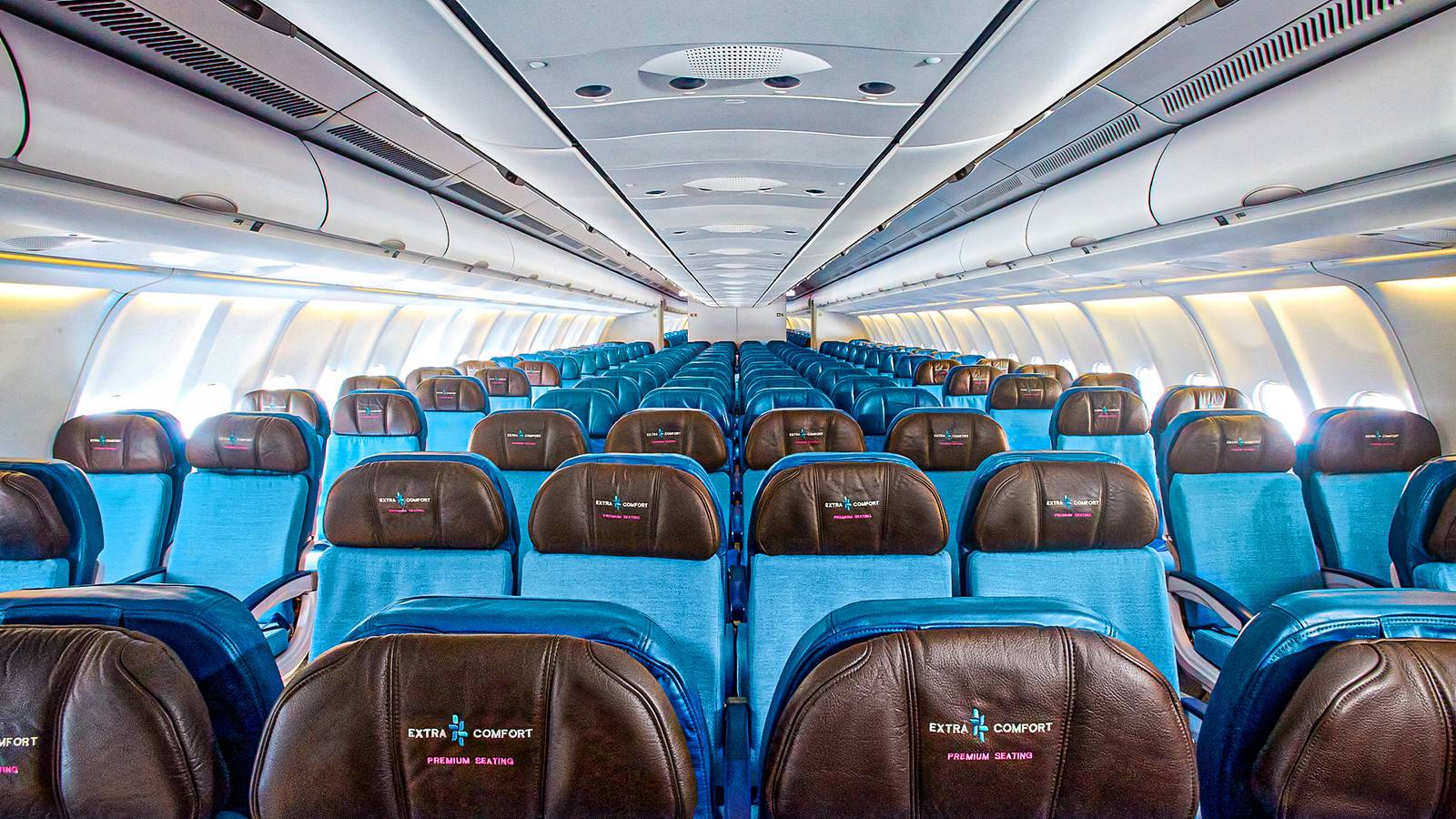
Hawaiian Airlines did not ignore comfort in its product setup, but rather elected to sell comfort differently. On its flagship Airbus A330s, the airline elected to carve out 88 Economy Comfort seats, which were still labeled as economy seats, but in an economy plus segment with additional legroom and AC power that was made available. These seats were priced as a straightforward add-on rather than a distinct cabin altogether.
The same philosophy shows up in the Boeing 787-9's design. Extra Comfort is essentially the standard economy seat with more space, and reviewers have been very clear that this seat is not a premium economy cabin in any kind of international sense. Seat specifications also underline this point. The following table highlights the differences in some of these specifications, according to the carrier:
Extra Comfort seats and standard economy seats offer essentially the same pitch, while seatback screens are the same size. However, this cabin was not the kind of premium economy that the airline could properly upsell. Even in the world of modern and dynamic premium cabins, the Boeing 787-9's Extra Comfort seats don't stand out all that much from the standard product. These seats are mixed right into the main cabin, and they are not positioned like any kind of premium mini-cabin. As a result, one can fairly clearly tell that the airline needs a capable and dedicated premium economy cabin if it wants to fully develop its premium portfolio.
What Will Hawaiian's New Premium Economy Cabin Offer?
Hawaiian Airlines' planned move is a major category shift, as it expects to replace today's Economy Comfort with four rows of premium economy recliner seats that are explicitly wider, more comfortable seats paired with a higher level of upgraded in-flight dining. This service and hardware combination is ultimately what separates premium economy from the extra-comfort economy section. These seats will not just offer additional legroom, but a different seat that offers a more intentional onboard experience.
Hawaiian Airlines has not published the exact seat manufacturer yet, so it is difficult to identify what kind of specifications these seats will offer. What we can expect, however, is that these seat specifications will fall roughly in line with industry norms for international premium economy seats. The seat setup will likely be a 2-3-2 nine-abreast configuration. These seats are set to offer meaningfully more pitch than economy, as well as a noticeably wider seat with deeper recline.
Then, the airline will add amenities that airlines typically bundle into a premium economy package. Passengers will likely be able to enjoy more charging options, better separation, and a service flow that feels calmer and more premium. Hawaiian Airlines is not simply upgrading a seat but rather building a new rung on a product ladder that will allow it to capture travelers who find business too expensive but want more comfort than economy.
What Is The Airline's Retrofit Timeline?
One of the major questions that has emerged from this analysis is why the carrier elected to add this cabin at this specific time. Hawaiian's premium economy is arriving as part of a capital-heavy reset. The Alaska Air Group's Hawaii investment plan includes a full interior upgrade of the airline's Honolulu-based Airbus A330 fleet starting in 2028, with new seats, lighting, and finishes. First-class suites, a premium economy cabin, Bluetooth-enabled high definition seatback screens, and fast, free Starlink Wi-Fi will also be added as part of the equation. Hawaiian has also indicated that it will be acquiring three Airbus A330s as part of a lease agreement that will support the fleet's future role across the Pacific Ocean.
This bundling matters because cabin overhauls are ultimately expensive and operationally painful. Aircraft that are out of service are not making money, and layouts need to be recertified. Crews also need to be trained on new models. Airlines rarely take on these costly and painful procedures unless they can tie them to a step-change in revenue. Hawaiian's current Airbus A330 premium lineup is also showing its age, with a business class cabin that features a 2-2-2 setup that lacks universal direct-aisle access.
As a result, premium economy is showing up as the airline's fleet has a defined modernization window. The airline does not have a massive fleet, so overhauls and modernization will need to be efficient. Every extra month that Hawaiian Airlines' aircraft sit on the ground means less revenue is generated, and renovations become more and more costly.
Route Economics Favor Mid-Cabin Upsells
Premium economy is the airline industry's rapidly growing revenue sweet spot, as it monetizes comfort without committing the space of a lie-flat business-class seat. Hawaiian's network is tailor-made for this exact kind of logic, as it offers long overwater segments where customers feel the discomfort gap grow. There is also a chunk of this demand that is a premium-oriented, price-sensitive demographic. A dedicated mid-cabin gives Hawaiian a clean way to segment this demand, with families and vacationers who will not buy the pointy end and can still be sold a noticeably better seat and overall experience.
This allows the carrier to reserve business-class inventory for the highest-yield travelers and those truly in search of upgrades. This is also where Hawaiian's old strategy has begun to cap out. Economy plus seats are easy to sell, but there is a hard ceiling on them. These seats are essentially just economy seats with a few more comforts, and thus, they are rarely dynamic enough to justify large increases in prices.
Reviewers have noted extensively that the Boeing 787-9's extra comfort product is only a marginal step-up, an upgrade that feels like a missed opportunity when the aircraft is used on flagship-style missions. A true premium economy cabin changes the upgrade ladder, too, as it offers loyalty programs and attractive corporate travel policies. Hawaiian Airlines is waiting until it can sell this middle cabin properly, and now is the best time to dive right into this kind of market.
Where Does The Airline Stand Amid The Competitive Landscape?
With the carrier joining oneworld on April 22, 2026, the bar has undeniably been raised for the airline's services. Hawaiian is stepping into an alliance where premium economy seating is an increasingly important part of long-haul revenue generation. Partner reciprocity (especially when it comes to status perks and upgrade narratives) makes this incredibly valuable. For carriers looking to win higher-value connecting passengers and corporate contracts, a missing cabin tier is somewhat of a hole.
Competition also matters on routes that are closer to home. Hawaiian Airlines has long competed with the United States legacy carriers on routes to Hawaii, onto which legacy carriers can funnel elites and corporate travelers. Premium travelers can already buy a recognized premium economy product on many of these international routes. Hawaiian's economy-plus workaround increasingly looks like a compromise rather than a cohesive strategy.
This retrofit plan further aligns with broader premium expectations across the board. Hawaiian Airlines' current Airbus A330 business class is evidently a dated product, differing from today's norm of suites and direct aisle access products. Hawaiian's own upgrade roadmap frames the new premium cabins as a material revenue driver over the course of the next few years.
What Is The Bottom Line When It Comes To This Product?
At the end of the day, Hawaiian Airlines is making a move where it adds an entirely new product to its lineup, one that provides it with the ability to generate more revenue than ever before. However, there is some risk associated with adding these new seats, namely that they require investment and significant downtime.
This move is part of the Alaska Air Group's broader strategy to continue increasing the airline's share of the overall premium market. A heavier premium mix on these routes will play an essential role in increasing unit revenues.
The challenge that emerges once these seats have been installed is consistently filling them. At first, premium economy cabins will need to be advertised through a standard set of influencer marketing and traditional channels. Filling them at a profitable price point is the test that will follow.
Rate this article
Login to rate this article
Comments
Please login to comment
No comments yet. Be the first to comment!