
Geopolitics
19 min read
African Union Peace Council Convenes to Discuss Guinea's Situation
Amani Africa
January 21, 2026•1 day ago
AI-Generated SummaryAuto-generated
The African Union Peace and Security Council will convene to discuss Guinea's situation. This follows the conclusion of Guinea's political transition after a 2021 military coup, culminating in a presidential election and the inauguration of General Mamadi Doumbouya. AU officials and an observation mission recommended lifting sanctions, citing peaceful elections and progress. The council is expected to lift Guinea's suspension, despite concerns over coup leaders participating in elections.
Tomorrow (22 January), the African Union (AU) Peace and Security Council (PSC) will convene a session to consider the situation in Guinea.
The session will commence with an opening statement by the Chairperson of the PSC for the month, Jean-Léon Ngandu Ilunga, Permanent Representative of the Democratic Republic of the Congo to the AU, followed by a statement from Bankole Adeoye, Commissioner for Political Affairs, Peace and Security (PAPS). Guinea’s representative may also deliver a statement following the closed session.
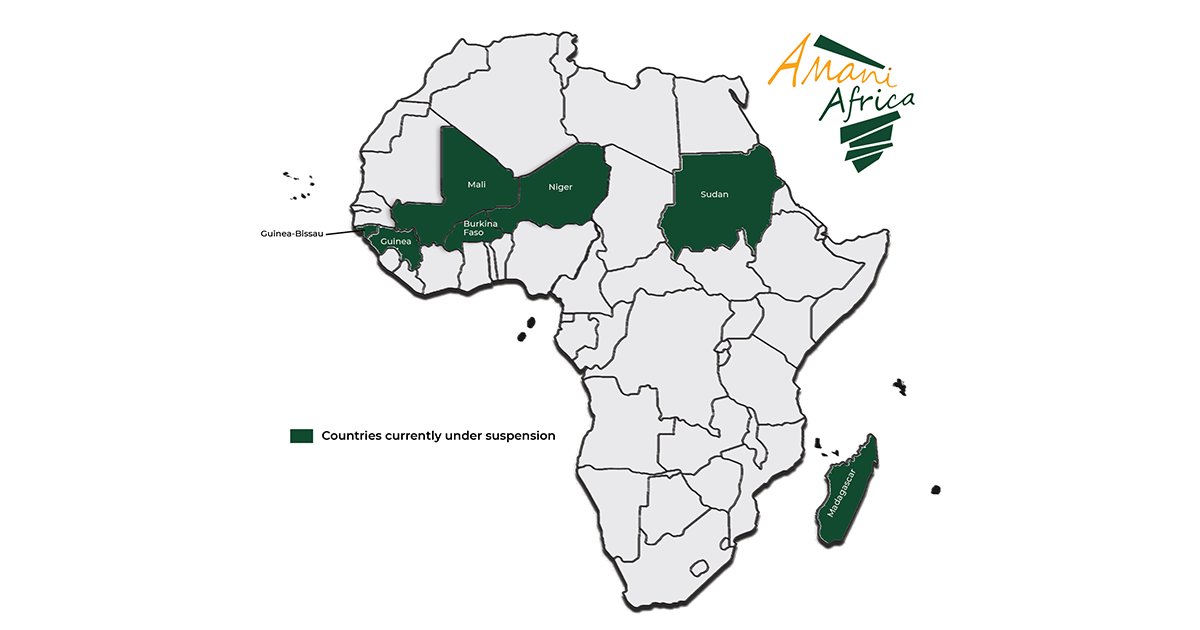
The session takes place against the backdrop of recent developments marking the formal conclusion of Guinea’s transition following the September 2021 military coup. These developments culminated in the presidential election held on 28 December 2025. The coup leader, General Mamadi Doumbouya, was declared the winner with 86.72 per cent of the vote following the proclamation of the final results by the Supreme Court on 4 January 2026, and was subsequently sworn in as President on 17 January.
In a communiqué released on 4 January, the Chairperson of the AU Commission, Mahamoud Ali Youssouf, extended his ‘warmest congratulations’ to the President-elect of Guinea. He commended the Guinean people for demonstrating political maturity through peaceful participation in the electoral process, and called on the AU and the international community to assess the situation in the country with a view to lifting the sanctions imposed on Guinea. He stated that such a step would reflect the progress achieved and help create favourable conditions for the implementation of the roadmap aimed at rebuilding and modernising the state for the well-being of the Guinean people.
A similar position was reflected in the Preliminary Statement of the AU Election Observation Mission, led by former President of Burundi and member of the AU Panel of the Wise, Domitien Ndayizeye. The Mission concluded that the election was conducted in a ‘peaceful, orderly and credible environment, consistent with relevant international standards and the national legal framework.’ On this basis, it recommended that the AU consider lifting the sanctions imposed on Guinea as a gesture of increased solidarity, to encourage the acceleration and successful completion of structural reforms, support national reconciliation, and create a conducive environment for forthcoming elections as drivers of social stabilisation and democratic consolidation.
Tomorrow’s session thus unfolds in the context of these calls by the Chairperson of the Commission and the AU Election Observation Mission for the lifting of the sanctions imposed by the PSC at its 1030th session of 10 September 2021, following the unconstitutional change of government in the country. Mirroring the approach taken in the case of Gabon—where suspension was lifted after a presidential election despite its inconsistency with the AU’s anti-coup norm barring coup perpetrators from contesting elections—the PSC is expected to lift the sanctions and bring Guinea back into the AU fold.
Guinea was suspended by the PSC on 10 September 2021 from participation in all AU activities following the military coup of 5 September 2021 led by the current President, General Mamadi Doumbouya. Since then, the political transition in the country experienced delays, notwithstanding the two-year transition period agreed between Guinea and the regional bloc, ECOWAS, in October 2022. However, in 2025, Guinea took steps to complete the political transition.
A constitutional referendum was held on 21 September 2025, laying the foundation for the entry into force of a new Constitution adopted by the people and promulgated on 26 September. The Constitution amended the legal framework to allow members of the ruling military authorities to stand as candidates and extended the presidential term to seven years, renewable once. A new Electoral Code was also adopted and promulgated on 27 September 2025. On 28 December, Guinea organised the presidential election, a key milestone in the political transition and a major step toward the restoration of constitutional order in the country.
The PSC conducted a field mission to Guinea on 30 and 31 May 2025, during the chairship of Sierra Leone, to encourage the authorities to complete the transition. During the mission, it is recalled that the Guinean authorities requested that the AU consider lifting sanctions following the constitutional referendum in September, in order to facilitate re-engagement with the international community and access to vital partnerships for socioeconomic development. However, both the report of the field mission and the communiqué adopting it alluded that the conduct of the presidential election in December—rather than the constitutional referendum—would mark the formal end of the transition and trigger the lifting of sanctions.
In the communiqué adopted at its 1284th session, the PSC requested the AU Commission to engage with the Guinean transition authorities to identify areas of support and provide the necessary technical and financial assistance, particularly for the constitutional referendum and the preparation of the general elections scheduled for December. In follow-up to this request, the Commission deployed a short-term Election Observation Mission to Guinea from 20 December 2025 to 1 January 2026, composed of 62 observers and led by Mr Domitien Ndayizeye.
As PSC members prepare to consider the lifting of Guinea’s suspension, they will be confronted with the question of how to reconcile such a decision with Article 25(4) of the African Charter on Democracy, Elections and Governance (ACDEG), which explicitly prohibits perpetrators of unconstitutional changes of government from participating in elections held to restore democratic order or from holding positions of responsibility in political institutions. This, however, is not the first time the PSC has faced this dilemma. At its 442nd session in June 2014, when lifting Egypt’s suspension, the PSC explicitly stated that the decision was taken with the ‘understanding that this does not constitute a precedent’ regarding compliance with Article 25(4) of the Charter.
Rate this article
Login to rate this article
Comments
Please login to comment
No comments yet. Be the first to comment!