
Economy & Markets
11 min read
Google's Innovative CO2 Batteries: Large-Scale Renewable Energy Storage
Utility Dive
January 20, 2026•2 days ago
AI-Generated SummaryAuto-generated
Google is investing in CO2 battery technology to provide long-duration, reliable backup power for its data centers. These batteries store excess renewable energy using compressed carbon dioxide, offering greater scalability and a longer lifespan than lithium-ion batteries. This aims to ensure continuous clean power, even during periods of low renewable generation.
This audio is auto-generated. Please let us know if you have feedback.
Google is commissioning construction of what are being called CO2 batteries to provide green, reliable backup power for its major data centers in the United States, Europe and in parts of Asia, the company announced.
“We’ve been scanning the globe seeking different solutions,” Ainhoa Anda, Google’s senior lead for energy strategy in Paris, said in an IEEE Spectrum report on the project.
CO2 batteries are intended to play a role similar to that of lithium-ion battery units to store excess renewable energy to help ensure data centers have clean, reliable power when needed. But they would have greater capacity and scalability than lithium-ion batteries, and can be easily standardized to be used anywhere.
“The challenge the tech giant has encountered is not only finding a long-duration storage option, but also one that works with the unique specs of every region,” the IEEE Spectrum report says.
“Standardization is … one of the aspects that we really like,” Anda told IEEE Spectrum.
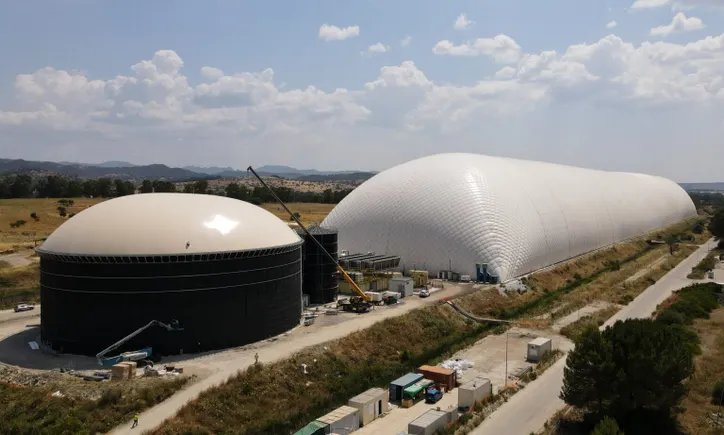
Google is working with a Milan-based company called Energy Dome, which has built a model facility in Ottana, Sardinia, Italy, that is storing 2,000 tons of carbon dioxide generated from a gas supplier. As part of the partnership, Google has made an equity investment in Energy Dome.
The facility stores the CO2 daily in an expandable dome. When energy is needed, it compresses and expands the CO2 to turn a turbine that generates 200 megawatt-hours of electricity, or 20 MW over 10 hours. Google is hoping to build similar units near its data centers to supply renewable power around the clock even when the sun isn’t shining or the wind isn’t blowing, according to IEEE Spectrum’s report.
Lithium-ion batteries mostly play this role for data centers now, but they typically can only cost effectively supply back-up power for 4-8 hours at a time — not long enough to power through a whole night, multiple cloudy and windless days or the hottest week of the year, when energy demand hits its peak.
“CO2 Batteries check a lot of boxes that other approaches don’t,” the report says. “Their expected lifetime stretches nearly three times as long as lithium-ion batteries. And adding size and storage capacity to them significantly decreases cost per kilowatt-hour. Energy Dome expects its [CO2 battery] to be 30% cheaper than lithium-ion.”
CO2 batteries also have advantages over other types of large-scale power storage units, like pumped-hydro, because they can be built relatively quickly and with comparatively small footprints, needing only about 5 acres of flat land.
The Sardinia facility took less than two years to construct and the expandable dome took less than half a day to inflate, according to the article. A pumped-hydro facility, which creates energy by pumping water between reservoirs at different elevations, can take a decade to build. It also needs a lot of land with a very specific type of topography.
Google can expect to face some pushback from neighbors. The expandable dome reaches a height comparable to that of a sports stadium, which could spur opposition. And if the dome is damaged, it could release CO2 into the air. But Energy Dome says the amount of gas that’s released won’t be much more than what’s released by airlines that make multiple flights across the Atlantic Ocean and is negligible compared to what’s released by coal plants, Energy Dome founder and CEO Claudio Spadacini told Spectrum IEEE.
Rate this article
Login to rate this article
Comments
Please login to comment
No comments yet. Be the first to comment!