
Technology
19 min read
Europe's New Rocket Engine: A Game-Changer for the Space Race
Earth.com
January 18, 2026•4 days ago
AI-Generated SummaryAuto-generated
Europe has successfully qualified the P160C rocket engine, a significant upgrade that increases fuel capacity. This enhancement will enable European launch vehicles, including Ariane 6 and Vega-C, to lift heavier satellites into space. The P160C's readiness marks a step forward in Europe's space capabilities, with integration into launch systems already underway for future missions.
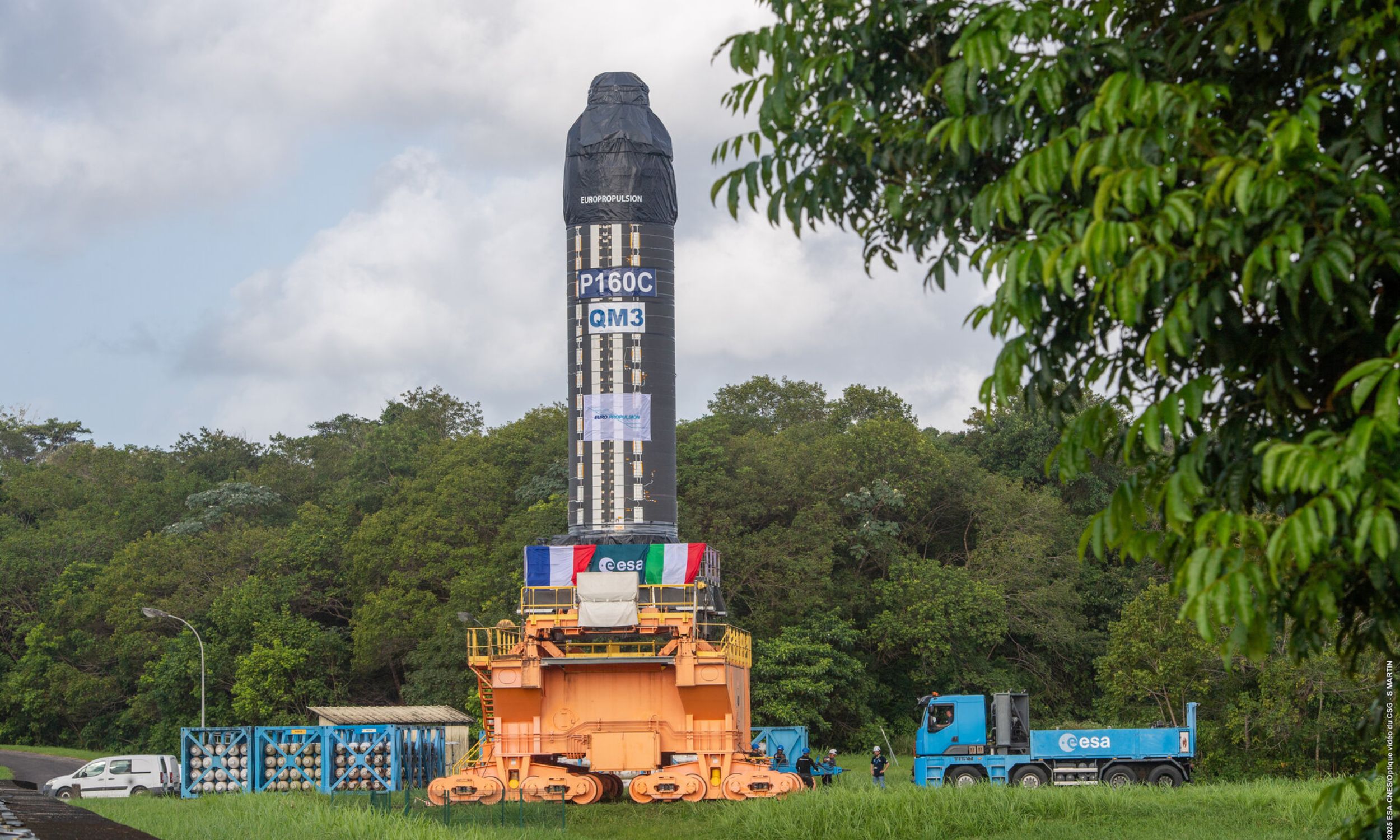
After a full-power ground firing in April, engineers confirmed that a new European rocket engine called the P160C is ready to fly from the continent’s main launch site in South America.
The upgraded engine holds roughly 31,000 pounds (14 metric tons) more fuel, allowing Europe’s primary launch vehicles to lift heavier satellites into space.
The European Space Agency (ESA) report confirmed a qualification review for the upgraded engine called the P160C motor.
“Independent teams have assessed the data packages, analysed the technical files and confirmed our design is robust,” says Alessandro Ciucci, ESA program manager.
Ciucci’s team at ESA focuses on common solid boosters, and the decision clears the path toward flight-ready units.
How P160C got larger
Added length, not new attachment points, is the main change that turns P120C into the P160C motor.
That extra 3.3 feet (1 meter) changes internal geometry, so engineers recheck stresses, vibrations, and separation timing across ascent.
Because solid motors cannot be refueled after casting, small design changes still demand full testing before any launch.
Solid boosters like the P160C motor trade fine control for simple, powerful thrust, which is why they are common at liftoff.
In a solid motor, solid propellant, fuel and oxidizer mixed into one grain, burns from the inside outward.
Once ignition starts, the burn rate mostly follows the grain shape, limiting throttle options during critical early flight.
Carbon-fiber case engineering
Composite motor cases cut dead weight, letting more of the liftoff mass go to propellant and payload.
Avio forms the case with filament winding, wrapping resin-soaked fibers into precise layers, then cures the shell into one piece.
One-piece construction reduces joints that can leak or crack, but it also demands tight control of every cure cycle.
A gimbaled nozzle on the P160C motor can swing during ascent, keeping a launcher on course when winds and mass changes fight stability.
Engineers call this thrust vector control, steering by redirecting the exhaust stream, using actuators that tilt the nozzle in flight.
ArianeGroup builds the nozzle hardware, and designers trade extra complexity for better control authority during ascent.
Ignition without surprises
Ignition needs a fast, even start, because uneven flame can create pressure spikes inside a sealed motor case.
The igniter, a small starter charge that lights the main grain, must deliver repeatable heat at the right moment.
A clean light reduces early loads on the launcher, but it also relies on careful storage and handling before launch.
Test stands measure thrust, pressure, and vibrations, because small instabilities can grow into large loads within seconds.
Data from hundreds of channels let analysts compare real curves to expected ones, spotting drift or unexpected oscillations.
A single good firing is not enough, so qualification also checks materials records and manufacturing history for every part.
Europe’s main launch rockets
Europe relies on two primary orbital rockets, Ariane 6 for larger missions and Vega-C for smaller, more targeted satellite launches.
Both vehicles lift payloads from the same equatorial spaceport, but they serve different customers, orbits, and launch schedules.
Understanding their roles helps explain why a single booster upgrade can affect Europe’s heavy and light launch capability at once.
Ariane 6 booster roles
Ariane 6 flies in two main versions, using two or four solid boosters to match different payload missions.
The user’s manual lists Equipped Solid Rockets attached to the core, then fired to boost liftoff thrust.
Future flights using the P160C motor will aim to raise performance, but the rest of the launch system still sets limits.
Vega-C and later missions
Vega-C begins with a solid first stage, which gives a quick push while the upper stages handle orbital targeting.
A program paper describes the P120C as a common motor, serving Vega-C first stage and Ariane 6 boosters.
Planned upgrades, including Vega-C+ and Vega-E, depend on stable booster supply as much as they depend on design.
Making 35 motors yearly
Launch cadence drives factory plans, because each Ariane 6 and Vega-C launch can consume multiple large solid motors.
One technical paper sets the target at 35 motors per year, forcing parallel assembly lines and strict inspections.
High volume can cut costs, but any quality slip could ground two rocket families at the same time.
Scaling P160C production
Ramp-up production means more work cycles on the factory floor, plus tighter tracking of materials from fiber to finished case.
Digital records tie each batch of resin, insulation, and propellant to its test history, so anomalies can be traced fast.
That paperwork slows production at first, but it protects schedule later when investigations would otherwise halt shipments.
Limits of solid motors
Pressure oscillations can rattle a launcher, especially late in the burn when less propellant dampens vibrations.
A recent study used large-eddy simulation, computer models that track big turbulent swirls, to predict solid-motor exhaust plumes.
Better plume predictions can reduce surprise loads, but test firings still matter because every motor has small differences.
Next steps for the P160C
Flight planning now turns to hardware, because the first four P160C motors are being integrated into Ariane 6 boosters.
The initial Ariane 6 mission is scheduled for 2026 in a four-booster layout, giving the heaviest liftoff yet.
Vega-C plans a debut with Space Rider in 2028, but that schedule depends on budget, demand, and readiness.
Together, the review, test data, and factory plans show how one booster upgrade can raise capability across two launchers.
Next steps will involve repeated flights and careful cost tracking, since global launch markets punish delays and uneven reliability.
Image credit: ESA/CNES/Optique video du CSG–S. Martin.
—–
Like what you read? Subscribe to our newsletter for engaging articles, exclusive content, and the latest updates.
Check us out on EarthSnap, a free app brought to you by Eric Ralls and Earth.com.
—–
Rate this article
Login to rate this article
Comments
Please login to comment
No comments yet. Be the first to comment!