
Space & Astronomy
18 min read
Earth's Core: Scientists Uncover a New 'Buttery' State of Matter
Earth.com
January 18, 2026•4 days ago
AI-Generated SummaryAuto-generated
New evidence suggests Earth's solid inner core is softer and more dynamic than previously believed. Laboratory experiments show carbon atoms can move freely through iron under extreme pressure, creating a "superionic" state that reduces stiffness. This behavior helps explain why seismic waves slow down in the core, impacting our understanding of Earth's magnetic field.
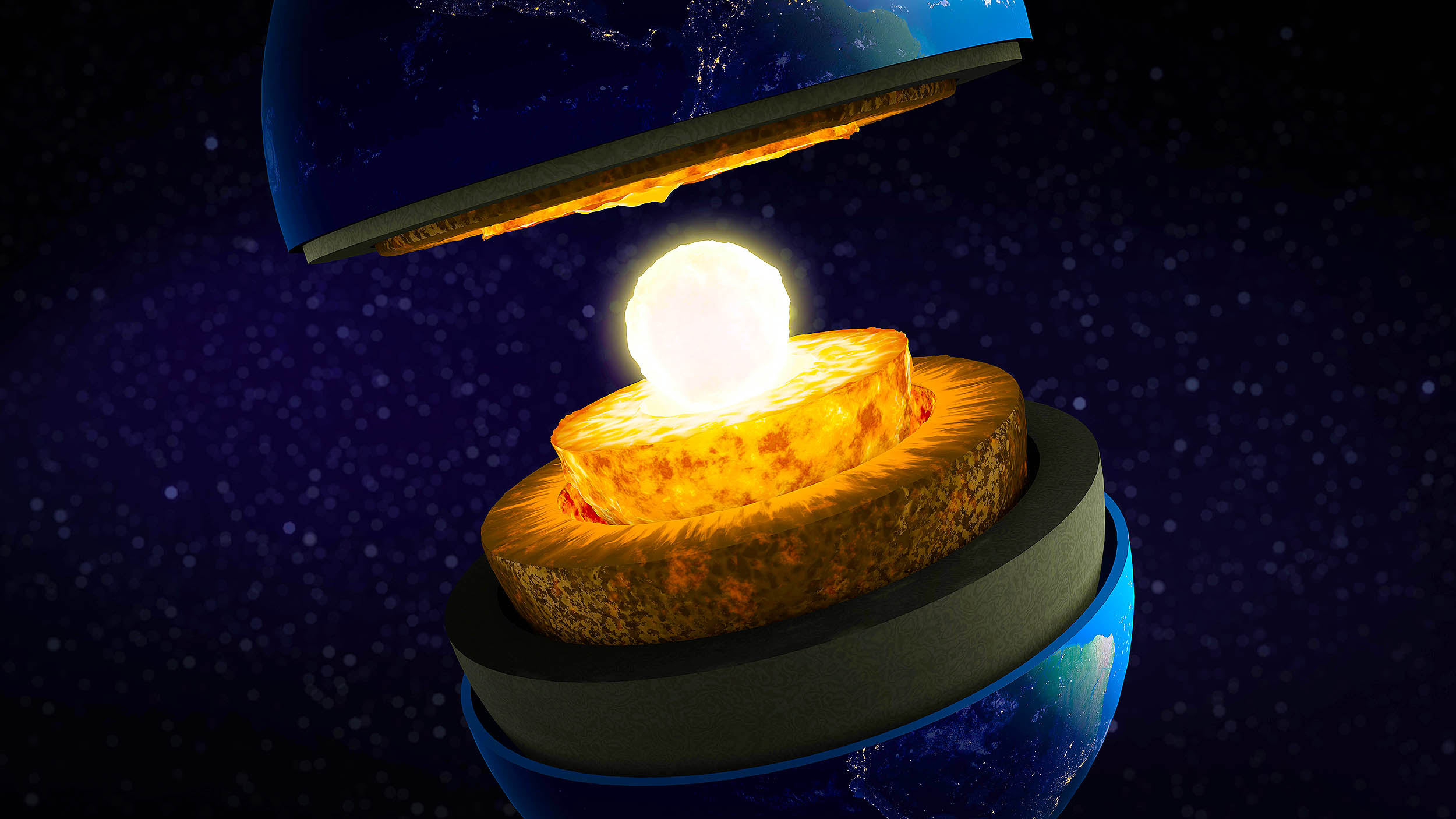
Deep beneath the planet’s surface, Earth’s core behaves in a way scientists have struggled to explain for decades, with consequences for how the planet moves and protects itself.
New evidence now suggests that the solid heart of Earth is softer and more dynamic than long assumed, reshaping ideas about what drives its magnetic shield.
Laboratory experiments show that under extreme pressure, carbon atoms can move freely through solid iron, reducing stiffness and slowing twisting seismic waves by about 23%.
Seismologists have long measured that the inner core slows certain earthquake waves, and Sichuan University (SCU) researchers set out to explain that softness.
The work was led by Prof. Youjun Zhang, a geophysicist at SCU and he tested iron alloys under sudden impacts.
His research links shock measurements to earthquake data, letting the team compare sound speeds in the alloy with seismic patterns.
By showing a solid can soften without melting, the team offers a way to reconcile inner-core strength with odd flexibility.
Crystals in a superionic state
Under enough heat and pressure, some crystals enter a superionic state, which is a solid where light atoms move freely.
The heavier framework atoms keep their ordered positions, while the mobile atoms hop between gaps instead of staying put.
Materials scientists have studied these conductors in battery solids, where moving ions carry charge through a crystal framework.
Finding a similar state in an iron-rich alloy matters because it changes how a core can be both solid and soft.
Waves traveling through Earth’s core
Earthquakes send shear waves, twisting vibrations that test rigidity, into the core, and Earth’s inner core slows them sharply.
A recent review puts those speeds near 2.2 miles per second, far lower than most solid iron should allow.
Because twisting waves depend on shear strength, the slow speeds point to a center with unusually low rigidity.
Any explanation must keep the core solid enough to transmit waves while letting atoms rearrange within that structure.
Recreating Earth’s core conditions
To test the idea in the lab, researchers used shock compression, a sudden squeeze from high-speed impact, on iron-carbon samples.
A two-stage gas gun at SCU drove projectiles at 4.3 miles per second and reached 140 gigapascals.
Temperatures rose to roughly 4200 degrees Fahrenheit while sensors tracked sound speeds inside the shocked alloy.
Those brief bursts cannot mimic years of slow core evolution, but they can reveal how atoms behave under stress.
Carbon mobility changes stiffness
At peak conditions, carbon atoms moved rapidly through a solid iron framework, and the material lost much of its shear strength.
Measured shear-wave speeds fell sharply, and Poisson’s ratio, a measure of sideways stretch under squeezing, climbed toward inner-core values.
“For the first time, we’ve experimentally shown that iron-carbon alloy under inner core conditions exhibits a remarkedly low shear velocity,” said Zhang.
Because the iron framework stays ordered, the core can remain solid while still behaving softer during deformation.
Light elements in iron
Earth’s inner core is mostly iron, but its density runs 3% to 5% low, hinting at lighter ingredients.
The team tested iron with 1.5% carbon by weight, added as an interstitial solid solution, small atoms sit in gaps.
That setup matters because carbon can dissolve into iron more easily than hydrogen or oxygen in lab-made samples.
If other light elements also move through iron under core conditions, the same mechanism could apply, but evidence remains thin.
Directional effects deep inside
Some inner-core measurements show seismic anisotropy, wave speed changes with travel direction, which hints that the material is not uniform.
Simulations in the new work suggest carbon prefers certain pathways between iron layers, which could help create directional differences.
Even slight alignment during core growth could make waves travel faster along some directions and slower along others.
Untangling these patterns will require models that mix crystal texture with moving light elements, not one factor alone.
Earth’s core and magnetic field
Earth’s magnetic field comes from the geodynamo, the flow that generates Earth’s magnetic field, in the liquid outer core.
Cooling of the core releases heat and also pushes light elements out of growing solid iron, which helps drive convection.
“In addition to heat and compositional convection, the fluid-like motion of light elements may help power Earth’s magnetic engine.” said Dr. Yuqian Huang, a geophysicist at SCU.
If that diffusion adds usable energy, it could extend how long the field stays strong, but the size remains uncertain.
Implications beyond our planet
Computer simulations suggested that a mixed solid and mobile phase could fit inner-core data.
Turning that prediction into evidence required molecular dynamics, computer simulations of atoms moving over time, alongside high-pressure measurements.
Similar physics could matter in other rocky worlds with iron-rich cores, because light elements change how solids deform.
Planet models that assume a fully rigid inner core may miss heat transport and magnetic history in some cases.
Together, the evidence points to a solid inner core that stays crystalline while carbon motion weakens it in shear.
Future tests at higher pressures and with other light elements will show how widely this behavior shapes magnetic evolution.
The study is published in National Science Review.
—–
Like what you read? Subscribe to our newsletter for engaging articles, exclusive content, and the latest updates.
Check us out on EarthSnap, a free app brought to you by Eric Ralls and Earth.com.
—–
Rate this article
Login to rate this article
Comments
Please login to comment
No comments yet. Be the first to comment!