
Politics
11 min read
Dublin Named 3rd Most Congested City Globally, Traffic Slowdown Confirmed
The Journal
January 21, 2026•1 day ago
AI-Generated SummaryAuto-generated
Dublin ranks as the third most congested and sixth slowest city globally for traffic. The 2025 TomTom Traffic Index reveals worsened congestion levels and longer travel times compared to the previous year. Motorists lost nearly eight additional hours due to rush hour traffic, highlighting a significant increase in delays.
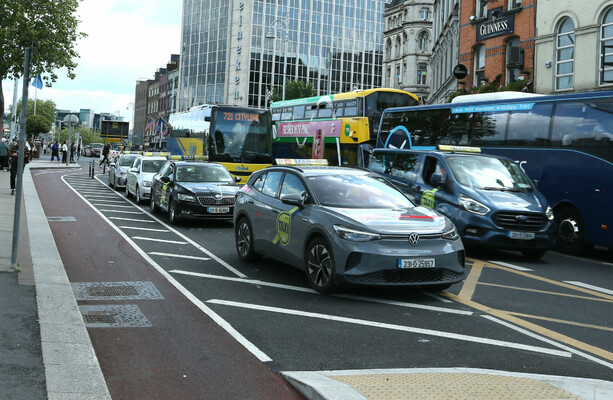
DUBLIN IS THE third most congested city in the world and the sixth slowest city for traffic.
That’s according to the TomTom Traffic Index for 2025 – TomTom is a Dutch company known for its Satnav products.
It said this year’s Traffic Index “tells a painfully familiar story” and “confirms that keeping traffic moving has never been more difficult”.
In Dublin City, the average speed during rush hour was 13.5 km/h, which is similar to 2024.
TomTom noted that traffic isn’t just about speed but is also about flow and congestion levels in Dublin worsened last year to an average of 72.9%, up 1.7% on 2024.
Congestion levels are calculated by collecting all the travel times recorded by TomTom in a given area and comparing them with the lowest travel times from when traffic is in a totally free-flowing state.
Congestion levels are then expressed as a percentage, which represents the increase in travel time due to excess traffic.
For example, a congestion level of 40 means that, on average, journey times across that area’s road network were 40% greater than when traffic is free flowing.
Meanwhile, the average time needed for a 10 km drive was 34 minutes and 29 seconds, some 58 seconds more than in 2024.
The average distance driven in the space of 15 minutes was 4.4 km, down 0.1 km on 2024.
The worst day to travel in Dublin last year was Thursday, 11 December.
On this date, the average congestion level was 122%, but rose to 225% at 5pm.
And at 5pm on 11 December, motorists travelled an average distance of 2.4 km in 15 minutes.
The research also shows that the evening rush hour in Dublin is slightly worse than the morning rush hour.
Advertisement
It took an average of 45 minutes and seven seconds to travel 10 km during the evening rush hour last year, with motorists driving at an average speed of 13.3 km/h.
During the morning rush hour, it took 43 minutes and 48 seconds to travel 10 km, with an average speed of 13.7 km/h.
In all, Dublin City motorists lost seven days and 23 hours due to traffic in rush hours, almost eight hours more than in 2024.
The Journal recently asked readers to outline some of their main traffic complaints, with one reader telling us that it took them 90 minutes just to get out of the car park.
Elsewhere in Ireland, TomTom found that the average speed during rush hour in Cork last year was 21.1 km/h, which was 1 km/h slower than in 2024.
It took an average of 23 minutes and ten seconds to travel 10 km in Cork City last year, 37 seconds longer than the year previous, and the average congestion level was 56.9%, some 4.7% higher than 2024.
Motorists in Cork lost 107 hours – or four days and 11 hours – to rush hour traffic last year.
This is seven hours and 40 minutes more than compared to 2024.
In Limerick City, the average congestion levels were 52.3%, the average speed during rush hour was 28.6 km/h, and the average time it took to drive 10 km was 18 minutes and 28 seconds, 14 seconds longer than in 2024.
Motorists in Limerick City lost 74 hours to rush hour traffic in 2025, one hour and 16 minutes more than in 2024.
And while Dublin was the third most congested city last year, Mexico City came out on top, followed by Bengaluru in India.
Meanwhile, the slowest city for traffic was Barranquilla in Colombia.
TomTom noted that traffic continued to worsen last year and that most cities show an increase in congestion and travel times.
“As people flock to cities never designed to house such vast populations, traffic will continue to worsen unless cities act now, arm themselves with the right data and the most useful and trusted insights,” said a TomTom spokesperson.
Rate this article
Login to rate this article
Comments
Please login to comment
No comments yet. Be the first to comment!