
Sports
8 min read
Referee Chief's Verdict on Diogo Dalot Red Card After Derby Incident
Sports Illustrated
January 21, 2026•1 day ago
AI-Generated SummaryAuto-generated
Referees' chief Howard Webb defended VAR's decision not to issue a red card to Diogo Dalot for a challenge on Jérémy Doku during the Manchester derby. Webb stated that while the tackle could be considered a red, the on-field referee's yellow card decision, made after considering full speed and force, should stand.
Premier League referees’ chief Howard Webb has insisted VAR was right not to suggest a red card for Diogo Dalot during the recent Manchester derby.
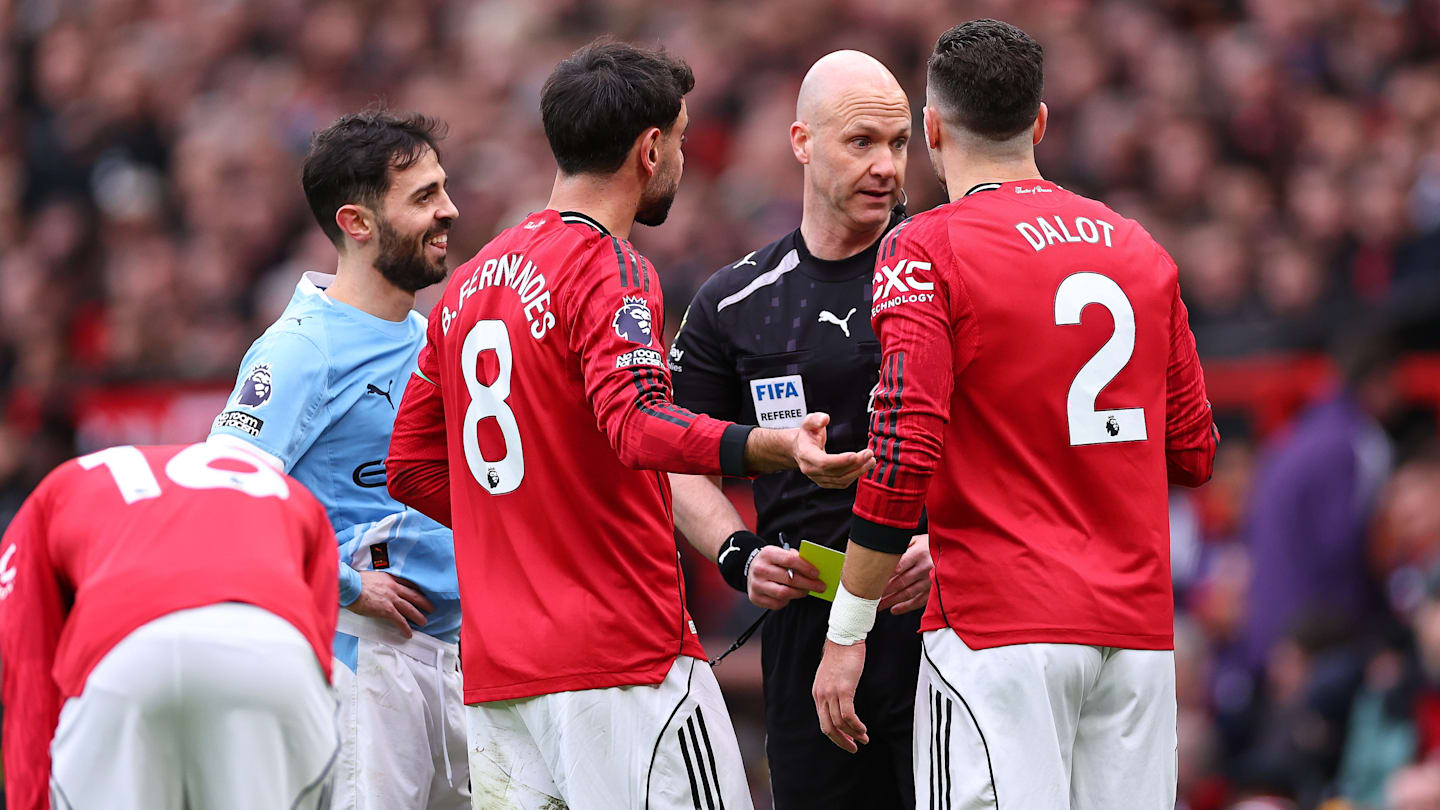
Just 11 minutes into the game, Dalot caught Manchester City’s Jérémy Doku high on the knee—a decision on-field official Anthony Taylor deemed worthy of a yellow card. A quick VAR check did not result in an upgrade.
As a result, Dalot was allowed to remain on the field for the full 90 minutes, helping to inspire a famous 2–0 victory for Manchester United.
The decision not to dismiss Dalot for what was objectively a high challenge has divided opinion, with a number of former referees claiming it was worthy of a red card. Webb, however, argued otherwise.
“Is there excessive force? Some will say, yes,” he told Match Officials Mic’d Up. “I’m not quite there, but I can see that there could be.
“It’s a subjective judgment ... but I’m absolutely aligned that once that decision is taken on the field, we leave it as referee’s call and we don’t intervene with the VAR.
“I think it’s one where the referee’s call should stand on the field. That’s what we’ve said we’ll do where there’s a mix of considerations.
“I think there is a mix, and therefore in this situation, it was right to leave it as the referee’s call.”
Webb: Slow Motion Makes Every Challenge Look Worse
Webb went on to remind unimpressed fans that incidents such as this should only be analysed at full speed, arguing the still image of the United defender’s boot connecting with Doku’s knee looks far more serious that it really was.
“At full speed, when you play it in real time, you can see there’s not a great deal of speed in the action, not a lot of intensity,” he continued.
“We were heavily criticised a few years ago for using slow motion and freeze frames because people said, ‘This is not reality, it’s not how the game is played.’
“When you slow it down, it can look a lot worse—and it does. When you freeze-frame it, you can make a lot of situations look like red card offences.
“Yes, it could be red, but you have to think about the need to look at it at full speed. We’ve done that for some time now. We thought it was a fair criticism some time ago when people said, ‘Stop using slow-mos as the main way of analysing these situations.’ And we’ve listened, and we agree. And we play it at full speed. Then we slow it down a little bit to see the exact point of contact to factor that in as well.
“But without speed and force and intensity, it’s unlikely to be a red card.”
READ THE LATEST MAN UTD NEWS, TRANSFER RUMORS AND MORE
Rate this article
Login to rate this article
Comments
Please login to comment
No comments yet. Be the first to comment!