
Health & Fitness
22 min read
Mastering Deep Inspiration Breath Hold for Safer Radiation Therapy
Cleveland Clinic Health Essentials
January 21, 2026•1 day ago
AI-Generated SummaryAuto-generated
Radiation therapy, especially for left-sided chest cancers, can increase the risk of heart disease. A deep inspiration breath hold (DIBH) technique is used to protect the heart. By holding one's breath for up to 20 seconds, the heart is moved away from the radiation field, significantly reducing its exposure. This method also aids in precise tumor targeting for other cancers.
When you’re undergoing radiation therapy, you’re already dealing with a lot. You’re focused on this health concern, and the last thing you want to think about is what kind of health issues you might face down the road.
But it’s important to know that in some cases, radiation can raise your risk of developing heart disease later on.
“If your heart receives radiation during cancer treatment, it puts you at greater risk for a range of heart problems in the future,” explains breast radiation oncologist Rahul Tendulkar, MD.
Your care team wants to do everything they can to help lower that risk. Dr. Tendulkar explains how a technique called a deep inspiration breath hold (DIBH) can help keep your heart safe during treatment.
How radiation can affect your heart
Radiation uses high-energy X-rays to kill cancer cells while minimizing damage to healthy cells. But if your heart directly receives radiation, it raises your risk for radiation heart disease, a range of heart problems that includes:
Congestive heart failure
Coronary artery disease (CAD)
Valvular heart disease
Radiation heart disease is most common in people who have had radiation therapy to the chest — especially the left side of the chest, where your heart is.
The American College of Cardiology warns that undergoing radiation therapy to your left breast doubles the risk of heart disease in young women, compared to right breast radiation therapy. That risk is even higher if you’re receiving chemotherapy at the same time, or if you’re at higher risk for heart disease in the first place.
You may also receive radiation that can affect your heart if you’re undergoing treatment for other types of cancer, including:
Esophageal cancer
Hodgkin lymphoma
Lung cancer
What is a deep inspiration breath hold?
Deep inspiration breath hold (DIBH) is a breathing technique that helps protect your heart while you’re undergoing radiation therapy for certain types of cancer — particularly breast cancer in your left breast.
“The left breast is closer to the heart, which means it may be in the radiation field,” Dr. Tendulkar explains. “But even a small shift in your heart’s position can make a meaningful difference in how much radiation it receives.”
The idea behind a deep inspiration breath hold, then, is to shift your heart out of the “danger zone” of radiation.
When you take a deep breath and hold it, your diaphragm — a large, dome-shaped muscle at the base of your lungs — gently pulls your heart away from your chest walls and away from the radiation field. It’s been shown to significantly decrease the amount of radiation to the heart, compared to breathing normally.
There’s another use for DIBH, too.
“If you’re undergoing radiation therapy to target a tumor in your lung, liver or pancreas, holding your breath helps keep your organs from moving during treatment,” Dr. Tendulkar further explains. “This allows radiation to target the tumor while minimizing its impact on your organs.”
How the deep inspiration breath hold works
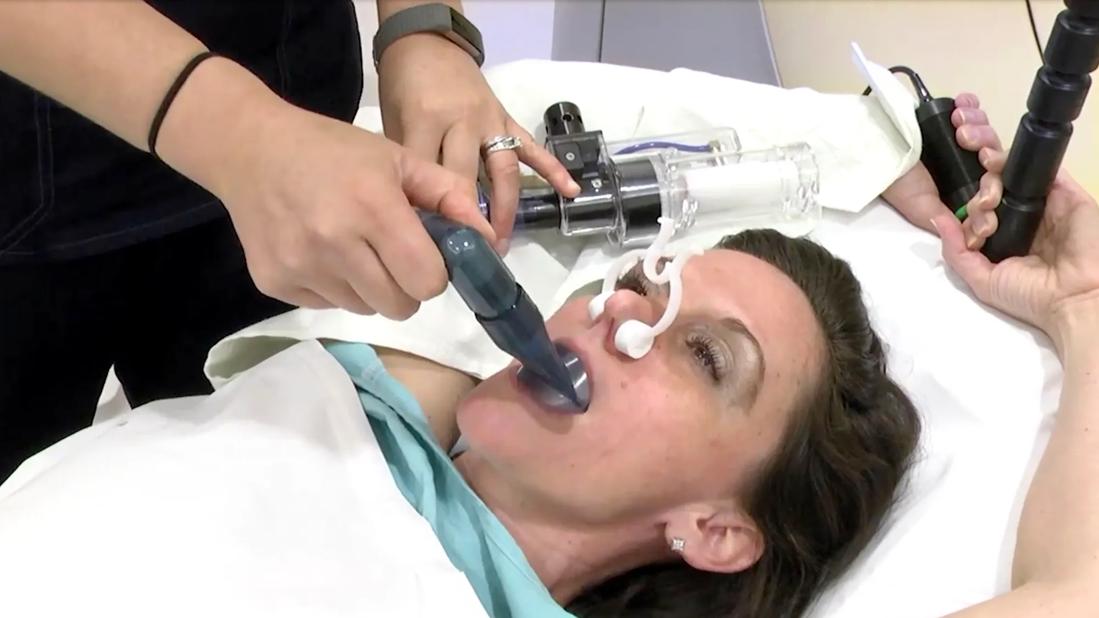
During DIBH, you hold your breath for up to 20 seconds while radiation is delivered. But you don’t have to do it alone: Your care team may use a device called an active breathing coordinator (ABC) to make it easier for you to hold your breath.
“The device is designed to be safe and comfortable,” Dr. Tendulkar notes, “and you’re always in control of when it starts or stops.”
An ABC looks like a snorkel with a nose clip. You’ll also hold on to a handheld element of the device, which has a button on top. It’s connected to a computer that’s monitored by a therapist from your care team.
Your therapist will teach you how to use the ABC to do a deep inspiration breath hold during your treatment. Here’s an overview of how it’s done:
Your therapist will get you set up. They’ll place the mouthpiece between your lips and put a clip on your nose to keep you from breathing through your nostrils. They’ll also give you a small device with a button on top, which you’ll hold in one hand.
Secure the mouthpiece. Bite down on the “teeth” of the mouthpiece to secure it. Place your lips tightly around the mouthpiece and try to breathe normally through your mouth into the snorkel.
Practice your breathing. Your therapist will ask you to take a few deep breaths. While you do, they’ll use a computer program to analyze how deeply you can breathe and how long you can hold your breath.
Breathe in and press the green button. When it’s time to begin, they’ll ask you to take a deep breath and press down on the green button on the handle. That tells the therapist that you’re ready for the deep inspiration breath hold.
The ABC device will activate. You’ll hold your breath while also holding down the green button. Once your breathing reaches the threshold established on the computer, the ABC device will activate. This will automatically hold your breath and keep you from exhaling.
Wait. “You don’t have to do anything to hold your breath,” Dr. Tendulkar says. “The ABC will do it for you.” But if at any time during the process, you need to breathe, you can let go of the green button. This will deactivate the ABC and pause your treatment.
Breathe normally again. Once it reaches the preset breath-holding time, the ABC will deactivate. You can breathe normally through the snorkel again.
“You’ll follow this process during each radiation treatment,” Dr. Tendulkar adds. “Your therapist will guide you and tell you how many times you’ll have to hold your breath throughout it.”
If you have any questions about the process, they’ll be there to answer them — every step of the way.
How to practice DIBH at home
Your care team will teach you everything you need to know about how to perform the deep inspiration breath hold, and the ABC device will make it easier for you to do. But practicing on your own can help get your body comfortable with it.
Studies show that just five days of practicing at home before treatment can help reduce the amount of radiation that ultimately reaches your heart during treatment.
“You can help prepare for deep inspiration breath holds by practicing deep breathing at home,” Dr. Tendulkar shares. “Just practice taking long, slow, deep breaths and holding them for a few seconds at a time.”
There’s no need to be perfect. But even gentle practice ahead of time can help you feel more confident as you head into treatment.
Who is a fit for DIBH?
Not everyone who’s going through radiation treatment needs or benefits from deep inspiration breath hold.
“It’s used only when we think it will be helpful, based on your anatomy, tumor location and breathing ability,” Dr. Tendulkar clarifies. “So, your radiation oncologist will recommend it only if it meaningfully improves your treatment plan.”
If your care team does recommend this technique as part of your radiation therapy, they’ll be there to teach you how to do it and to support you throughout the process. Though deep inspiration breath hold is a simple technique, it can play an important role in helping protect your heart while you focus on what matters most — healing.
Rate this article
Login to rate this article
Comments
Please login to comment
No comments yet. Be the first to comment!