
Geopolitics
17 min read
Davos Bombshell: What Australia Needs to Hear
theage.com.au
January 21, 2026•1 day ago
AI-Generated SummaryAuto-generated
Canadian Deputy Prime Minister Mark Carney's Davos speech declared a "rupture" in the international order, urging middle powers to acknowledge great powers weaponizing economic integration. He advocated for diversifying alliances and partnerships, moving beyond the "rules-based international order." The speech suggests a need for nations to form new coalitions based on values and interests, rather than relying on a defunct system.
January 21, 2026 — 3:12pm
You have reached your maximum number of saved items.
Remove items from your saved list to add more.
Save this article for later
Add articles to your saved list and come back to them anytime.
“We are an energy superpower. We hold vast reserves of critical minerals. We have the most educated population in the world. Our pension funds are among the world’s latest and most sophisticated investors. And we have the values to which many others aspire.”
Mark Carney could have been talking about Australia. He was, of course, talking about his own country, Canada, and why it, as a successful middle power, was capable of helping build a new system of alliances to replace the so-called “rules-based international order” that is being dismantled by the world’s hegemons.
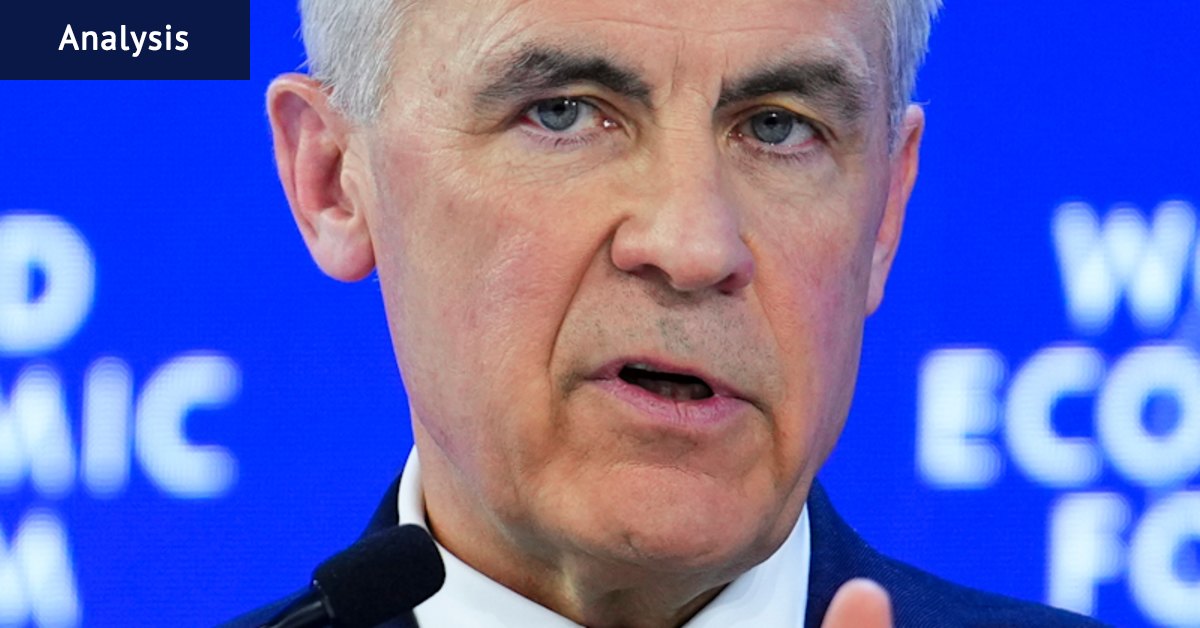
Carney’s blockbuster speech to the world’s political and business elite in Davos has been noticed around the world. He did not mention Donald Trump by name, but the context was clear. As Trump hits allies with tariffs, threatens to blow up NATO over his demands to seize Greenland, and casts doubt on America’s reliability as a friend, Carney’s message was: it’s time to call time.
“Let me be direct: we are in the midst of a rupture, not a transition,” he said. “Great powers have begun using economic integration as weapons. Tariffs as leverage. Financial infrastructure as coercion. Supply chains as vulnerabilities to be exploited. You cannot live within the lie of ‘mutual benefit through integration’ when integration becomes the source of your subordination.”
Advertisement
Rules-based order had always been a polite fiction, Carney said, with exceptions and loopholes that were often papered over. He likened it to Czech dissident (and later president) Vaclav Havel’s account of communism as “living within a lie”. Everyone repeats the same mantras, even though they know them to be untrue.
Now, Carney said, middle powers must live the truth. What does that mean? “First, it means naming reality. Stop invoking the rules-based international order as though it still functions as advertised. Call it what it is: a system of intensifying great power rivalry where the most powerful pursue their interests using economic integration as coercion.”
And it means diversifying alliances and partnerships. Carney noted Canada had signed 13 trade and security deals on four different continents in the past six months. It inked new strategic partnerships with China and Qatar and was negotiating free trade agreements with India, Thailand and the Philippines, among others.
Canada was pursuing what Carney called “variable geometry”: building different coalitions on different issues, based on values and interests.
Advertisement
And Canada had another valuable asset, he said: “We have a recognition of what’s happening and a determination to act accordingly. We understand that this rupture calls for more than adaption. It calls for honesty about the world as it is … we know the old order is not coming back. We shouldn’t mourn it.”
It was a remarkable address: direct, perfectly timed and intended to be noticed. George Magnus, an economist at Oxford University’s China Centre, called it a “cometh the hour speech, and an important lesson for anyone that’s not the US or China”. Dutch historian Rutger Bregman said it was “riveting, extraordinary and brutally honest”.
It was also not a speech that Anthony Albanese could have given. It is not his style, for one – but moreover, it runs counter to what Labor is doing, which is drawing closer to the US at a time when the world is starting to hedge its bets.
To be fair, the government has criticised Trump’s tariffs, and said it will not give into economic coercion on articles of faith like the Pharmaceutical Benefits Scheme. And Canada is in a different position to Australia, copping the full brunt of US economic coercion along with threats to its sovereignty.
Advertisement
This is not to say Carney’s instincts will prove correct, particularly the pivot towards China that he initiated in Beijing last week. Justin Logan, director of defence and foreign policy studies at the libertarian Cato Institute, says Canada is “the remora fish of international politics”, referring to a species that attaches itself to sharks.
“The reason it’s safe is because of where it lives,” Logan says. “If Carney believes Canada’s security is shaped more by something called ‘the rules-based order’ than by geography, and the solution is to play footsies with China, he may find that he’s just swum into the shark’s mouth.”
The US is the shark in this metaphor. But Carney had a defiant warning for the shark in his speech: the type of coercion we’ve seen from Trump has diminishing returns.
“The gains from transactionalism will become harder to replicate,” he said. “Hegemons cannot continually monetise their relationships. Allies will diversify to hedge against uncertainty. They’ll buy insurance, increase options in order to rebuild sovereignty.”
Advertisement
You have reached your maximum number of saved items.
Remove items from your saved list to add more.
More:
World politics
Canada
Trump diplomacy
Foreign relations
Analysis
Michael Koziol is the North America correspondent for The Age and Sydney Morning Herald. He is a former Sydney editor, Sun-Herald deputy editor and a federal political reporter in Canberra.Connect via Twitter or email.
Rate this article
Login to rate this article
Comments
Please login to comment
No comments yet. Be the first to comment!