
Space & Astronomy
10 min read
Cosmic Lens Reveals Hyperactive Cradle of Future Galaxy Cluster
Moneycontrol
January 18, 2026•4 days ago
AI-Generated SummaryAuto-generated
Astronomers discovered a hyperactive protocluster, a future galaxy cluster, over 11 billion light-years away. Using gravitational lensing as a cosmic magnifying glass, they observed eleven tightly packed, star-forming galaxies. This unprecedented view, enabled by ALMA and VLA, offers insights into early galaxy evolution and the formation of the universe's largest structures.
Astronomers have discovered an extraordinary region in the early universe. This distant protocluster lies more than 11 billion light-years away. The discovery shows a future galaxy cluster in formation. ALMA and the NSF’s Very Large Array revealed it in detail.
What Is a Hyperactive Cradle?
A hyperactive cradle is a dense region of star formation. It contains many young galaxies forming stars at furious rates. Such regions are the “nurseries” of future galaxy clusters. They represent the earliest stages of the universe’s largest structures. Studying them helps astronomers understand how massive clusters form and grow.
Did the Cosmic Lens See Something?
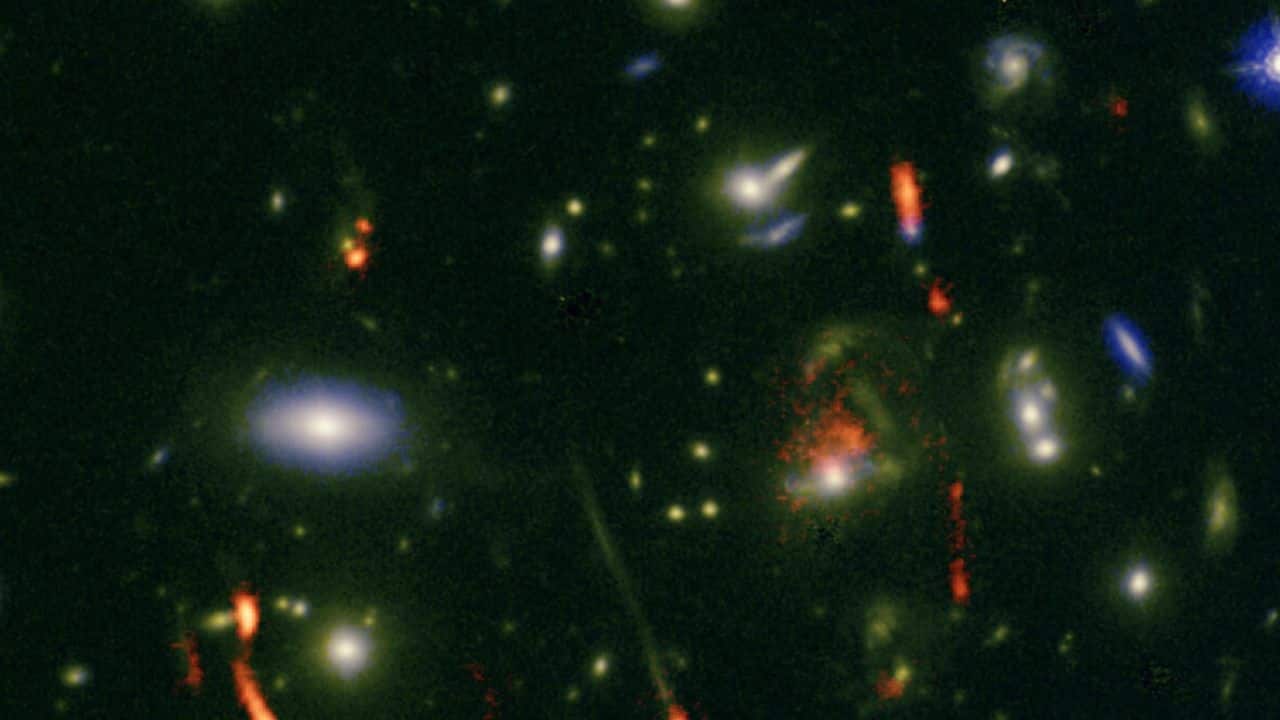
Astronomers observed the protocluster through a cosmic magnifying effect. A massive foreground cluster bent and brightened the light behind it. The lens revealed at least eleven individual galaxies in one compact region. Without the lens, these distant galaxies would have been invisible. It provided an unprecedented view of a galaxy cluster in formation.
Who Did This Study?
The study was conducted by an international team of astronomers. They used the Atacama Large Millimeter/submillimeter Array (ALMA) in Chile. They also relied on the NSF’s Very Large Array (VLA) in New Mexico. The collaboration combined high-resolution observations to map the distant galaxies. Their work shows how modern instruments can reveal hidden cosmic structures.
What Makes This Protocluster Special?
This is the first strongly lensed protocluster core ever discovered. The galaxies are tightly packed and extremely active in star formation. Older survey data could only detect a single blurry source. ALMA and VLA revealed the detailed structure and interactions between galaxies. It is a rare glimpse into the early universe’s densest regions.
How Did Astronomers See It?
ALMA detected cold dust and molecular gas inside the galaxies. The VLA provided radio observations to map the lensing cluster and background. These data confirmed the galaxies are physically connected at the same distance. The combined observations revealed star formation rates and galactic interactions. Dusty galaxies, normally hidden in visible light, became visible in detail.
What Is the Role of Gravitational Lensing?
Gravitational lensing acts as a natural cosmic magnifying glass. It bends and amplifies light from distant objects behind it. This allows astronomers to study otherwise invisible galaxies in detail. It reveals structure, star formation and galaxy interactions in the early universe. The lens was crucial for observing this hyperactive protocluster core.
Why This Discovery Matters?
Galaxy clusters are the universe’s largest gravitationally bound systems. Protoclusters like this show how clusters assembled over billions of years. It provides insights into early galaxy evolution and star formation. The discovery allows scientists to test theories of cosmic structure formation. This hyperactive cradle gives a rare, direct glimpse into our universe’s past.
Rate this article
Login to rate this article
Comments
Please login to comment
No comments yet. Be the first to comment!