
Technology
6 min read
Unveiling the Architects of Modern Constellations and Their Zigzags
Astronomy Magazine
January 19, 2026•3 days ago
AI-Generated SummaryAuto-generated
The present-day 88 official constellations, with their often zigzagging boundaries, were formalized in 1930 by the International Astronomical Union. Before this, constellation lines were inconsistent and varied among mapmakers. The IAU committee established these boundaries using lines of right ascension and declination, bringing order and standardization to celestial mapping.
Who made the present-day official outlines of the 88 constellations and why do they contain so many zigzags?
Caitlin McAlister
Cottonwood, Arizona
If you look at any star atlas published before 1930, you will see what appear to be random lines defining the constellations. Before this date, constellation boundaries had not been formalized. Modern astronomy still uses 47 of the 48 traditional constellations from the ancient Greeks. (The massive constellation Argo Navis has been subdivided into Carina, Puppis, and Vela.) Later astronomers and mapmakers brought the total to the current 88 official constellations. For example, Antlia the Air Pump was created by French astronomer Nicolas Louis de Lacaille in 1754, Vulpecula the Fox was introduced by Polish astronomer Johannes Hevelius in 1687, and Monoceros the Unicorn was invented by Dutch cartographer Petrus Plancius in 1612.
For centuries, the stars of these constellations were bounded by random wavy lines on sky maps. There was some agreement about which stars belonged to each constellation, but there were also possible variations depending on the mapmaker. For example, Gamma (γ) Pegasi was placed in the constellation Pisces on one of Tycho Brahe’s star maps. Similar discrepancies can be found throughout the history of celestial cartography.
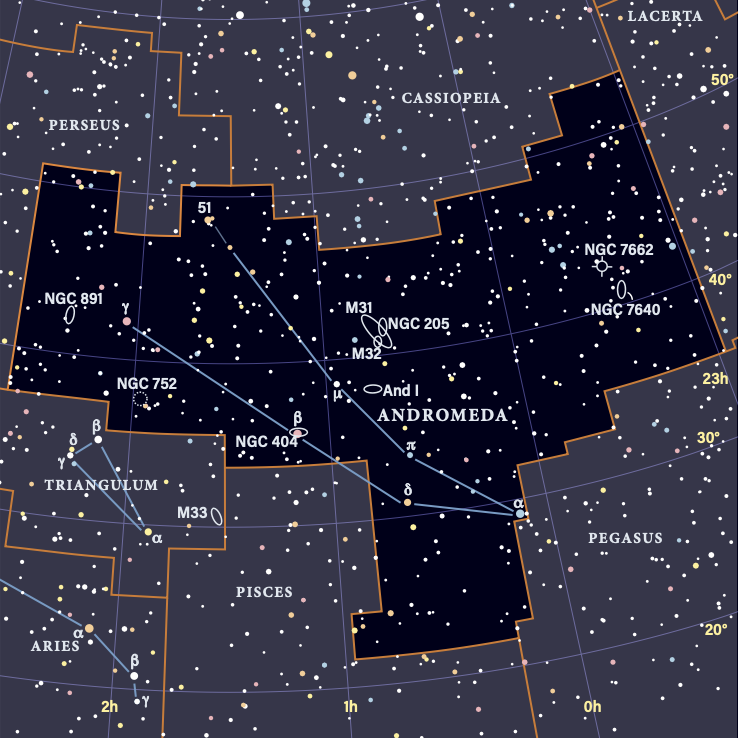
In 1928, the International Astronomical Union (IAU), the body responsible for the common definitions and constants utilized by professional astronomers, formalized the constellation boundaries. To provide order and structure the IAU committee followed lines of right ascension and declination. These new boundaries were officially published in 1930. So, what may look like a random patchwork of right-angle lines has provided order to the sky.
Rate this article
Login to rate this article
Comments
Please login to comment
No comments yet. Be the first to comment!