
Space & Astronomy
10 min read
Can You See Comet Wierzchos Buzz the Sun Today?
Space
January 20, 2026•2 days ago
AI-Generated SummaryAuto-generated
Comet C/2024 E1 (Wierzchos) reached perihelion on January 20, passing 52.6 million miles from the sun. This event significantly increased its brightness due to solar radiation vaporizing its icy nucleus. While not visible to the naked eye, the comet can be seen with a small telescope. Northern Hemisphere observers will have another viewing opportunity around February 17.
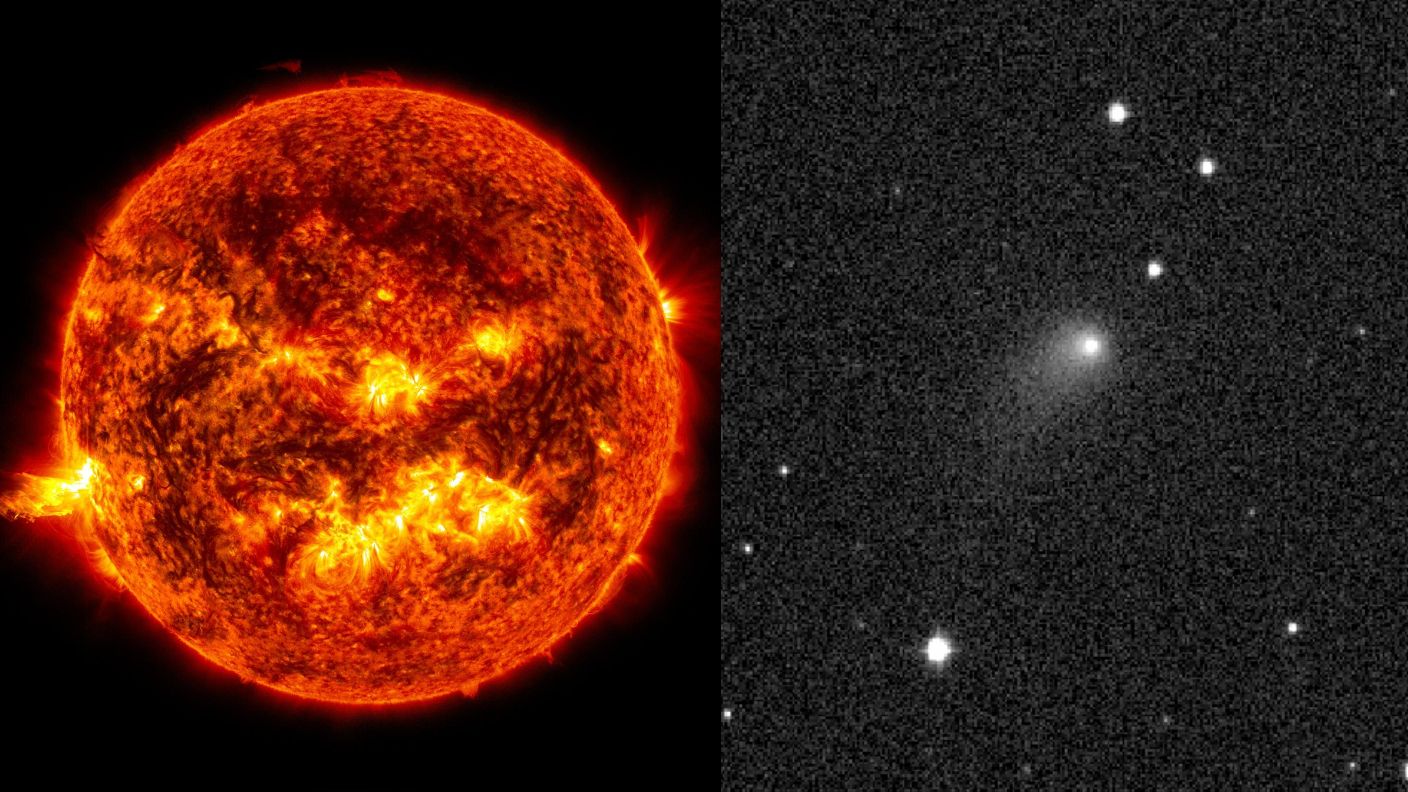
Solar system comet C/2024 E1 (Wierzchos) makes its closest approach to the sun today (Jan. 20) during an event known as perihelion, when it will pass a little over half the Earth-sun distance from our parent star, causing it to brighten significantly.
Comet Wierzchos makes its closest flyby at 1:24 p.m.EST (1824 GMT) on Jan. 20, passing the sun at a distance of 52.6 million miles (84.6 million km).
At perihelion, a combination of proximity and the increase in solar radiation is expected to boost the comet's visibility. Heat from the sun vaporizes ice material in the comet's solid nucleus, releasing masses of gas and dust that forms a reflective cocoon, or coma, around the nucleus. Charged particles streaming outward from the sun sweep this material into the comet's characteristic tail.
The comet is expected to reach a peak brightness, or magnitude, of around +8.1 in the days following perihelion, according to the Comet Observation Database (COBS) run by the Crni Vrh Observatory in Slovenia (the lower the number, the brighter the object in the night sky). That puts C/2024 E1 (Wierzchos) beyond naked-eye visibility, which allows us to see objects down to a magnitude of approximately +6.5 under dark sky conditions. However, the comet should be visible with the aid of a small backyard telescope, assuming that you're in the right part of the world to see it.
By mid-January, comet Wierzchos will be traveling through the stars of the southerly constellation Microscopium and will be lost from sight below the horizon during the nighttime hours for stargazers in the U.S.
Northern Hemisphere observers will get another chance to see C/2024 E1 (Wierzchos) in the weeks following its close approach to Earth on Feb. 17, when it will pass a little over 93 million miles (1 Astronomical Unit) from our Blue Marble. During this event, known as perigee, the comet will appear low on the southwestern horizon at sunset for stargazers in the U.S. with an estimated magnitude of +8.9. C/2024 E1 (Wierzchos)'s brightness will continue to recede as it rises higher in the evening sky in the following weeks, as it travels away from the warming influence of the sun.
C/2024 E1 (Wierzchos) was discovered in March 2024 by astronomers analyzing data collected by the Catalina Sky Survey — a NASA-funded project at the University of Arizona, which continuously scans the night sky for potentially hazardous near-Earth objects.
The wandering body is thought to have originated from the shell of icy material that surrounds the solar system known as the Oort Cloud and was first spotted as it raced sunward at a distance of 8 AU. It has since been observed by the James Webb Space Telescope, which recorded a distinct lack of cobalt in its light fingerprint, suggesting that the element may have been lost prior to being expelled by giant inner solar system planets shortly after its formation.
Photographers hoping to capture the silent majesty of wandering comets should read our guide to photographing comets with a DSLR, while those looking to update their equipment would do well to read our roundups of the top cameras and lenses for astrophotography.
Rate this article
Login to rate this article
Comments
Please login to comment
No comments yet. Be the first to comment!