
Space & Astronomy
5 min read
China Previews the Immense Power of its New Xuntian Space Telescope
Space
January 19, 2026•3 days ago
AI-Generated SummaryAuto-generated
China is preparing to launch its Xuntian space telescope, also known as the Chinese Space Station Telescope (CSST), as early as 2027. This large telescope, featuring a 2-meter mirror and a 2.5-billion-pixel camera, will have a field of view 300 times larger than Hubble. Scientists have completed observation simulations, confirming Xuntian's capability for high-resolution sky surveys across various wavelengths, promising major contributions to cosmology and astronomical studies.
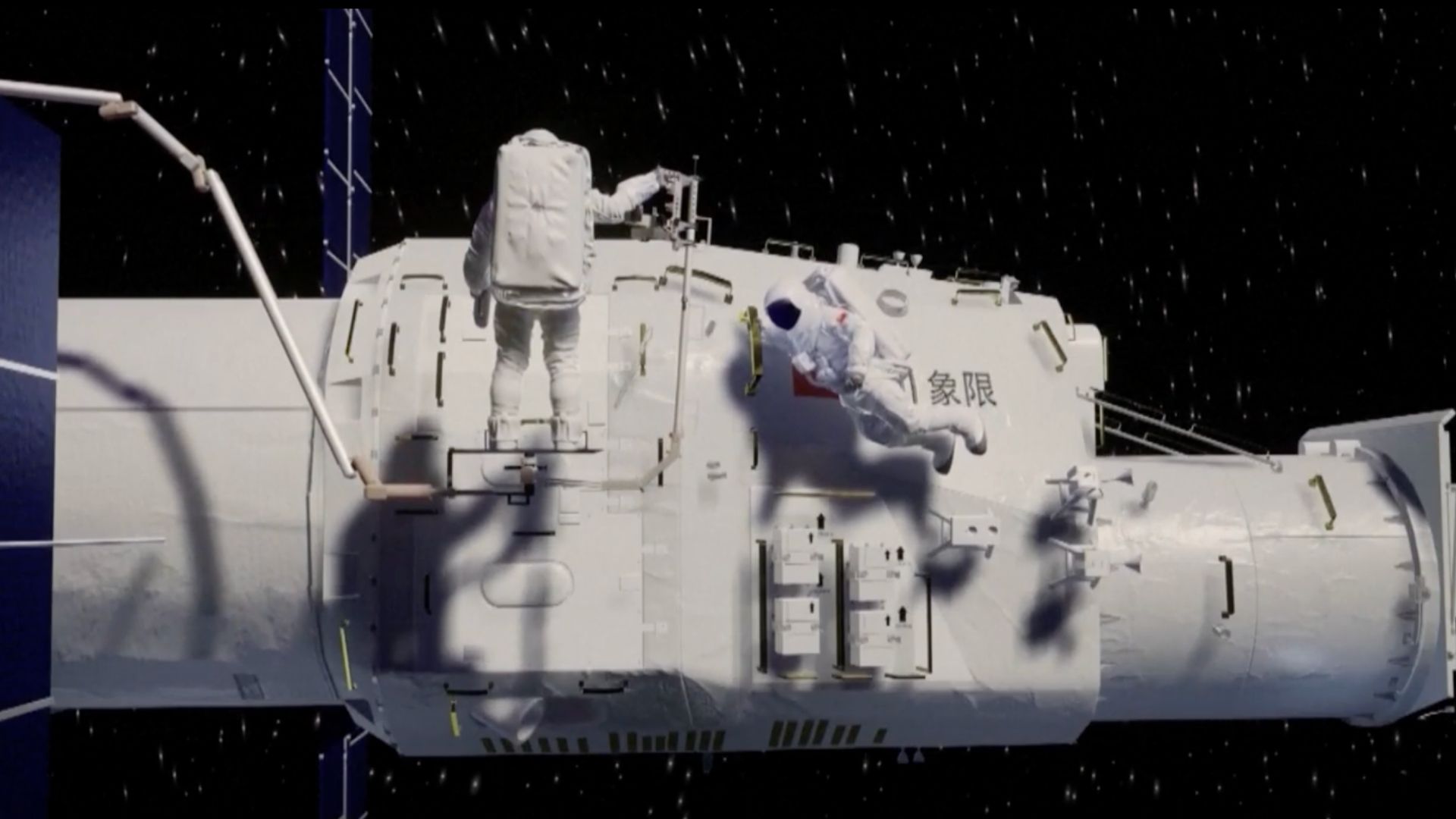
China is getting close to launching a large space telescope to orbit along with its Tiangong space station, and scientists have just completed a full observation simulation in preparation.
The bus-sized Chinese Space Station Telescope (CSST) — also known as Xuntian, or "surveying the heavens" — is being readied for a launch as soon as early 2027. It features a 6.6-foot-wide (2 meters) primary mirror, slightly smaller than that of the Hubble Space Telescope.
Xuntian will, however, be a much more capable sky survey instrument, according to Chinese space officials. It carries a 2.5-billion-pixel camera and boasts a field of view around 300 times larger than the venerable Hubble, surveying the sky from near-ultraviolet to near-infrared wavelengths and delivering high spatial resolution imagery.
As preparations for launch enter the final stages, a collaborative Chinese research team built an end-to-end simulation suite to provide mock observations for both the telescope's optical and other observation systems to replicate expected instrumental and observational conditions and evaluate the telescope's overall performance. The results were published in the journal Research in Astronomy and Astrophysics in early January.
The Chinese Space Station Telescope is expected to make major contributions to a range of fields, including cosmology, the study of galaxies, the evolution of the Milky Way and stars and planets. It could also provide insights into dark matter and dark energy, according to the National Astronomical Observatories under the Chinese Academy of Sciences (NAOC), which led the mock observation study.
Rate this article
Login to rate this article
Comments
Please login to comment
No comments yet. Be the first to comment!