
Economy & Markets
24 min read
New Headrest Tech Measures Brainwaves to Warn of Driver Distress
Shifting Gears with Phoebe Wall Howard
January 19, 2026•3 days ago
AI-Generated SummaryAuto-generated
A Detroit startup has developed headrest technology using EEG to measure brainwaves, potentially alerting drivers to distraction or medical distress before they are aware. This non-medical device aims to enhance road safety by detecting issues like drowsiness or seizures earlier than current methods. The technology could be integrated into vehicles as soon as 2029.
Las Vegas — A Detroit startup has developed sensor technology that measures brainwaves so drivers may be alerted to potential safety threats even before their mind realizes what’s happening — extreme distraction, drowsiness, heart attack, epilepsy.
Based on recent discussion with global automakers and suppliers, CEO Niall Berkery of Neumo based at NewLab on the Michigan Central campus in Corktown, believes the product could be embedded into headrests — and installed into vehicles — as soon as 2029 with an estimated cost of fewer than $10 per vehicle, he told me.
This product uses electrical brain activity science commonly used for evaluating head injuries, sleep disorders and seizures — known as EEG or electroencephalography.
“EEG is the gold standard for sleep and drowsiness and we’re the only ones who can do that in the vehicle,” Berkery said. “We have a breakthrough.”
Sort of like getting an EKG (or electrocardiogram) to diagnose an irregular heartbeat.
The technology doesn’t emit or radiate anything. There are no harmful effects.
This is not a medical device. The NeuroBioMonitor tech is used for warning only — that your brain is signaling something is not right. Current vehicle technology involves cameras that observe physical change such as eye movement or head bobbing. This new science alerts a driver that their body is at risk of falling asleep at the wheel before the mind realizes what’s happening.
In order to work, a head must be within 12 inches of the headrest.
This sort of tech is also used with athletes and astronauts to monitor heart rate, respiration and brain activity.
“Every thought you’re having in your head fires a neuron, an electrical signal,” Berkery explained. “When you do an EEG, it measures a voltage. We’re measuring the power. Your head is essentially a low-powered transmitter — at nanowatt level.”
Berkery told “Autoline” host John McElroy that there are defense applications, too, and early discussions with the U.S. Air Force about pilot safety opportunity.
Installed in trucks first, cars soon after
The company is doing evaluations with two global automakers and pilot studies with two global suppliers who would sell the products to automakers, Berkery said. Prototypes are available today but it’s not in production yet.
Earlier this month during the Consumer Electronics Show (CES) in Las Vegas, a senior vice president of research and development for one major supplier made a commitment to moving ahead with proof of concept and joint development, Berkery said.
Note: The product for truckers will come to market more quickly, in fewer than 18 months or the middle of 2027, because it’s an aftermarket product that can be retrofitted to the vehicle, likely integrated with the dash cam, to alert fleet management operators, Berkery said. For trucking companies, it’s about improving safety and avoiding massive lawsuits that lead to so-called nuclear verdicts.
Mindy Long, an Arizona-based freelance reporter who covers the trucking industry, said driving coaches have noted that drivers going through rough divorce or financial troubles can lead to distracted driving and potential safety issues.
Connecting the brainwave tech to the assisted driving systems in a car could signal the vehicle to slow down and pull off the road in case of a medical event.
Don’t worry: Not reading your thoughts
Reading brainwaves is one thing but reading the mind is another.
“That’s one thing we don’t do, we can’t do,” Berkery said. “It’s kind of like people saying, ‘You do an EKG on my heart, you can tell who I’m in love with.’ No. You cannot read someone’s thoughts. We’re looking at, almost like, vital signs of the brain and deriving insights from that. Your thoughts and things like that are not anything anybody has any capability to understand.”
The brain can alert to a heart attack, a stroke, a seizure. This is about advanced warning, one of a suite of devices meant to make roads safer.
Berkery is getting inquiries from companies in the U.S. and other parts of the world now. He said that Europe has especially strong safety criteria and this could potentially assist companies in getting five-star safety ratings.
Extreme fatigue, health issues create danger
A top issue for risky driving behavior is fatigue, and Neumo can measure in real time with an analog signal a driver getting tired. Anyone who has been to a sleep clinic understands what it means to put on a cap to get brainwaves measured.
In the car, this brain science is touchless. No cap required.
“The more you understand about a person, the more you can deliver better services, Berkery said. “Everyone is talking about the AI piece. Well, AI will learn a lot but it’s got to come from something. Sensors are a key part.”
Tech in vehicles now alerts the progression of somebody getting tired in response to physical signs. This is sooner.
“We can detect stress and relaxation. Stress is an impairment,” Berkery said.
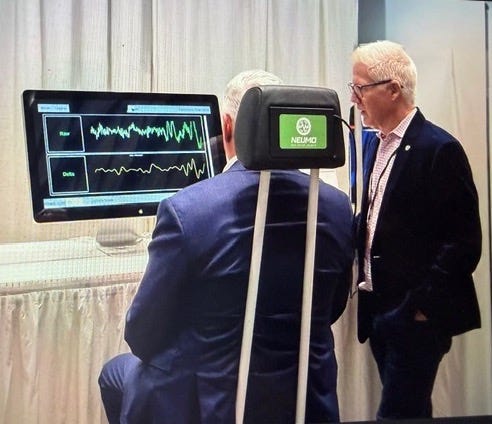
He asked Long to sit in a demo chair so that the headrest could read her brainwaves while driving. As she took the wheel, the demo screen indicated a dramatic change in data when she listened to conversation or talked or heard a loud noise from behind.
“You don’t realize you’re distracted,” Long told Berkery. “You feel like you’re paying attention.”
This 23-second video below, taken on Jan. 7, 2026, gives an idea how EEG-based neurotech detects distraction. (Credit: Phoebe Wall Howard)
Innovation in Corktown, Detroit
Berkery, an electrical engineer who lives in Birmingham, Mich., is a native of Dublin, Ireland, with family ties to County Cork, after which Corktown in Detroit is named because immigrants arrived in great numbers.
He has spent more than 30 years in automotive technology innovation, from infotainment and navigation to connectivity and automated driving.
Peter Freer, chief technology officer and co-founder of Neumo, patented the sensor technology. Freer is also behind a long-established product, backed by Tufts University School of Medicine, that trains children to build focus and self-regulation.
This tech is also used to train NASCAR drivers and Olympic athletes.
The neumo.ai website mentions a University of Connecticut study that “demonstrated Neumo detects driver fatigue minutes earlier than … the current gold standard in drowsiness detection.” UConn researchers have studied distracted driving extensively.
Deadly data creates opportunity
At issue is the deadly nature of potentially preventable crashes — and increasing the safety of drivers and others. The most recent data available says that in 2023:
Distracted driving took at least 3,275 lives according to the National Highway Traffic Safety Administration (NHTSA).
Another 324,819 were injured that same year in crashes related to distracted driving, reports the Governors Highway Safety Association.
A study from NHTSA indicated 84% of the drivers in crashes precipitated by medical emergencies experienced seizures, blackouts, or diabetic reactions.
Auto industry analyst Sam Abuelsamid, vice president of market research at Telemetry, said the brainwave technology “holds a lot of promise” for drivers.
“If you can see what’s happening — before you get to a condition where you may not be able to respond — it’s a new safety opportunity,” he said. “With what Neumo is doing, you could potentially start to detect some of those things a little bit earlier while the driver is still able to bring the vehicle to a safe stop. That is definitely a safety benefit.”
More:
What happens in Vegas does NOT stay in Vegas: Life at House of Journalists
Why she went from pastry chef to Rivian
Sleek Zeekr brand targets Gen Z car buyers with insane pricing, tech
Can Mary Barra helm GM while juggling board gig at Disney?
Rate this article
Login to rate this article
Comments
Please login to comment
No comments yet. Be the first to comment!