
Politics
23 min read
Australia's New Surrogacy Plan: Paying for Pregnancy's Toll
The Age
January 18, 2026•4 days ago
AI-Generated SummaryAuto-generated
Australia's Law Reform Commission proposes significant surrogacy law changes, including monthly payments up to $2000 for surrogates to cover pregnancy's toll. Recommendations aim for consistent national laws and a new regulator to address overseas surrogacy risks and domestic surrogate shortages. The goal is to make domestic arrangements safer and more accessible.
Advertisement
ExclusiveNationalHealthcare
‘Building that village here’: Plan to pay surrogates for the toll of pregnancy
January 19, 2026 — 5:00am
You have reached your maximum number of saved items.
Remove items from your saved list to add more.
Save this article for later
Add articles to your saved list and come back to them anytime.
Surrogates would receive monthly payments of up to $2000 for the “pain and discomfort of pregnancy” under a proposed overhaul of Australia’s surrogacy laws.
Labelling the current system “confusing, restrictive and not fit for purpose”, the Australian Law Reform Commission has also recommended consistent surrogacy laws across the country and a new national regulator.
The recommendations come as a record number of Australians go overseas for surrogacy arrangements due to a shortage of domestic surrogates.
Last financial year, 369 children born through surrogacy arrangements became Australian citizens, up from 218 in 2021. It has been reported that in 2020, about 76 children were born through domestic surrogacy.
Advertisement
However, international surrogacy comes with significant risks.
This masthead on Sunday highlighted the ordeal of Melbourne father Jamie Roberts and his daughter, who have been stranded in Argentina for more than 11 months after discovering serious procedural issues with their surrogacy paperwork.
In a discussion paper recently published online, the federal government’s independent legal advisory body said: “The limited availability of domestic surrogates drives intended parents to access surrogacy arrangements overseas.
“These arrangements may be exploitative, and create other harms experienced in Australia for intended parents and children born through surrogacy, such as challenges obtaining legal parentage.”
Advertisement
In Australia, only altruistic surrogacy is allowed. While intended parents are legally permitted to reimburse the surrogate for direct costs such as medical, travel and legal fees, any form of commercial payment is prohibited.
There’s also a patchwork of surrogacy laws across the country. Some states and territories, including NSW, Queensland and the ACT, may apply criminal sanctions for engaging in overseas commercial surrogacy.
In a bid to boost the number of domestic surrogates, the commission recommended reimbursing Australian surrogates for more of the real costs and losses of surrogacy to ensure they are not out of pocket.
This could include “optional monthly payment to recognise the ordinary pain and discomfort of pregnancy”, as well as optional payments if extraordinary medical complications arise. These would be in addition to existing payments for medical costs, travel, maternity clothes and other costs associated with being a surrogate.
Advertisement
“The law does not currently allow payment that recognises the full range of costs and losses associated with being a surrogate,” the commission said.
“It fails to acknowledge the significant physical, emotional and sometimes ongoing costs to the surrogate. It can also symbolise a lack of respect for the surrogate within a highly monetised system, where many others are paid.”
The commission said its proposed changes would ensure that surrogacy remained not for profit. It anticipates that the maximum monthly payment could fall between $1000 and $2000.
Surrogacy Australia operations manager Anna McKie said the new hardship payments were not about profit, but that they acknowledged the profound “wear and tear” on a woman’s body and mind during and after pregnancy.
“That’s a small amount to thank her for the physical and emotional toll that stays with her for the rest of her life,” she said.
Advertisement
McKie, who has been a surrogate, said while hundreds of Australians went overseas each year for surrogacy, many would prefer to stay in the domestic system if it were more accessible.
“It takes a village to raise a child, but in the case of surrogacy, it takes a village to make a child,” she said. “These reforms are about building that village safely here at home so fewer Aussies have to face the nightmare of being stranded overseas.”
One of the most exciting proposals, McKie said, was the introduction of surrogacy support organisations that could oversee financial arrangements between surrogates and intended parents and co-ordinate payments in a trust account.
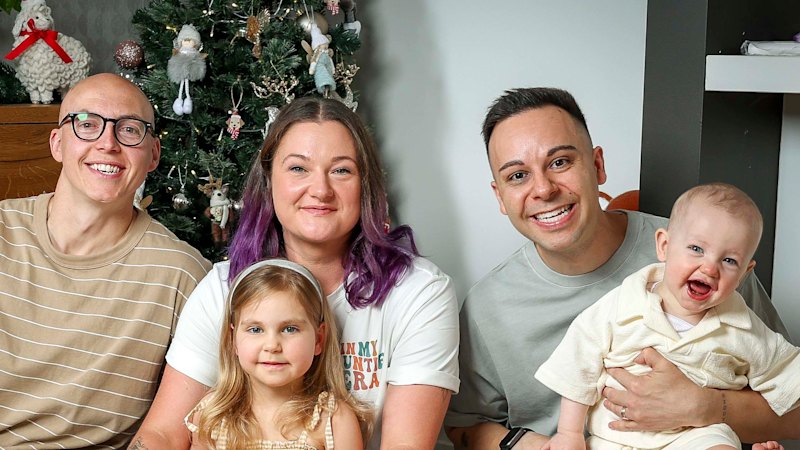
Beth, who does not want her surname published for privacy reasons, became a surrogate in 2021 after meeting Melbourne couple Tyson and Dan on a Facebook page.
Advertisement
She gave birth to the pair’s daughter, London, in December 2021 and then their son, River, in November 2024. She is a strong advocate for queer families and found the surrogacy experience empowering.
“It sounds crazy when you put it on paper,” the 35-year-old said. “I met people on Facebook and then birthed their baby.”
While she welcomes many of the proposals put forward by the commission (particularly the nationally consistent laws), she’s unsure about monthly hardship payments for surrogates.
She says once you attach a price tag to the “pain and discomfort” of pregnancy, it risks turning a deeply personal gift into a commercial transaction. She fears this could lead to “bidding wars” where parents are priced out of the market, or worse, it could create a system where vulnerable women are taken advantage of – similar to the “horror stories” she has heard from countries like Georgia.
Advertisement
Beth, who has two children of her own, said Tyson and Dan “generously” reimbursed her for costs associated with the pregnancies, including pelvic floor physiotherapy, dental care, counselling and maternity clothes.
“There is nothing that will ever compare to delivering a baby and then being able to say, ‘Here is your daughter, here is your son’.”
“There is nothing that will ever compare to delivering a baby and then being able to say, ‘Here is your daughter, here is your son’.”
Beth, a surrogate for Melbourne couple Tyson and Dan
A spokesman for Attorney-General Michelle Rowland said surrogacy arrangements were medically, emotionally, financially and legally complex.
He said the Albanese government had asked the commission to review surrogacy laws to ensure they were “consistent with Australia’s international obligations and the protection of human rights”.
Advertisement
“It is vitally important that all Australians considering an overseas surrogacy arrangement seek specialist legal advice on their proposed arrangement, and whether it is permitted under the surrogacy laws of their state or territory,” the spokesman said.
A Victorian government spokeswoman welcomed the national review, and said the state would consider the recommendations when the final report was delivered to the federal government in 2026.
“Our priority is to ensure that when surrogacy occurs in Victoria, it is conducted safely, ethically, and in the best interests of all parties involved,” she said.
Start the day with a summary of the day’s most important and interesting stories, analysis and insights. Sign up for our Morning Edition newsletter.
You have reached your maximum number of saved items.
Remove items from your saved list to add more.
More:
Healthcare
For subscribers
Parenting
Pregnancy
Henrietta Cook is a senior reporter covering health for The Age. Henrietta joined The Age in 2012 and has previously covered state politics, education and consumer affairs.Connect via Twitter, Facebook or email.
Rate this article
Login to rate this article
Comments
Please login to comment
No comments yet. Be the first to comment!