
Space & Astronomy
13 min read
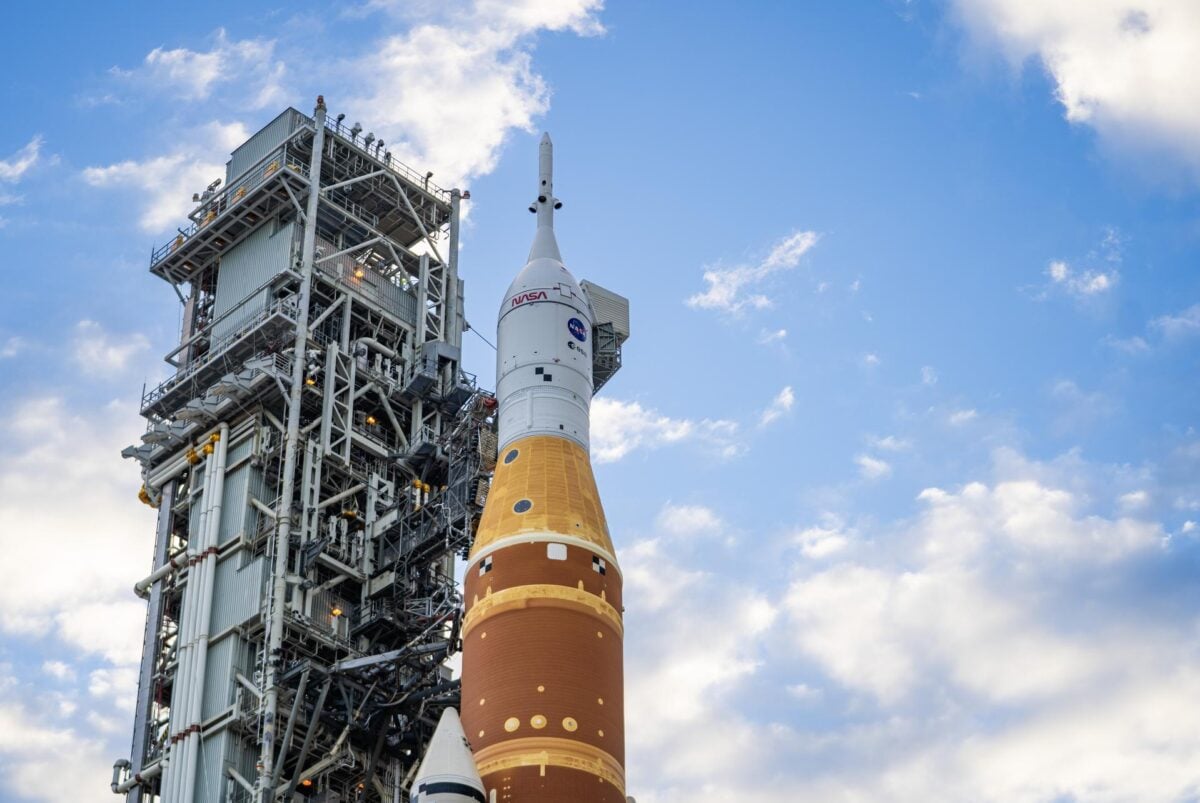
Artemis II Rocket Rolls Out for Potential February Launch
Canadian Geographic
January 21, 2026•1 day ago
AI-Generated SummaryAuto-generated
NASA's Artemis II rocket has rolled out to the launch pad for a potential February launch. The mission, with Canadian astronaut Jeremy Hansen aboard, will test the Orion spacecraft and human responses to deep space travel. This mission marks a significant milestone for Canada and advances lunar exploration science, preparing for future journeys to the Moon and Mars.
To observers, NASA’s crawler is more like a creeper. Like a server carrying drinks to a table, the crawler’s goal is to keep the rocket as steady as possible while driving. A great suspension system does some of the job, but the driving also needs to be slow. When fully loaded, the top speed of the crawler is less than two kilometres per hour.
Now that the rocket is safely at the launch pad, it will be hooked up to ground systems and undergo tests of fuelling operations and countdown procedures. It will only launch if all that goes to plan — but when it does, with Hansen aboard, it will mark a major milestone for Canada.
“Truly extraordinary”
A handful of Canadians participated in the Apollo moon missions in ground roles, including a few who were recruited to NASA after they lost their jobs from the cancellation of the now-iconic Avro Arrow in 1959. We also saw Canadian tech fly to the moon, including, famously, the “legs” of the lunar lander built by the company today known as Héroux-Devtek.
It took a little longer to get a Canadian into space. Hansen was born in 1976, four years after Apollo 17 last brought humans to the moon. All crew members then were American, but consider what happened next: Hansen is just old enough to remember the first Canadarm flight, Canada’s contribution to the Space Shuttle program, which spurred the first Canadian astronaut selection in 1983 and the first Canadian astronaut flight by Marc Garneau the following year.
Hansen appears to have spent his life getting ready for this next step toward the stars. Since his selection as a Canadian Space Agency astronaut in 2009, Hansen has remained busy: supporting other astronauts (including Canadians) in space, managing basic training schedules for an entire group of astronauts (U.S. and Canadian) hired in 2017, and helping to develop spacewalk tools to repair a dark-matter detector on the International Space Station.
Hansen at last received his call for space in 2023, and after a lifetime of imagining himself inside rockets, he shared the experience of standing beside his own during a practice test for the final countdown.
“It didn’t look super-scary,” he said during a crew press conference within view of the rocket Jan. 17, “but in that moment, one of the things that I felt was gratitude. When I look at that rocket, and [think of the people who have] poured their heart and soul into this vehicle, it’s truly extraordinary.”
A new generation of space exploration
A handful of people have been to the moon already, but the science of space exploration has far advanced since the last crewed lunar mission. “There will be a number of firsts that we will be proving out on this flight,” said Jacob Bleacher, NASA’s chief exploration scientist, at the Jan. 16 briefing.
Hansen and his three NASA crewmates (Reid Wiseman, Victor Glover and Christina Koch) will rigorously test the Orion spacecraft and perform several experiments to test how the human body behaves in microgravity. “It truly is exploration,” said Bleacher.
The moon will only be the size of a basketball outside Orion’s window as the spacecraft flies by roughly 8,000 kilometres above the surface. That’s worse viewing than Apollo, but Bleacher said the new astronauts may have an advantage: “depending on when the mission launches and the final flight path, it’s possible they’ll see parts of the moon that have never been viewed by human eyes.”
The hope is the astronauts will see variations in the greyscale of the moon’s colour that hint at the lunar rocks’ composition. But with the actual lunar flyby only lasting a few hours, most of the science on the 10-day mission will be devoted to studying the astronauts themselves in order to better understand how deep-space travel impacts the human body, mind and behaviour. The ultimate goal of this research is to prepare astronauts for future journeys to the moon and, eventually, Mars.
If Artemis II doesn’t launch by Feb. 11, the next opportunity will be in early March. But with nearly 55 years passed since the last Apollo mission, what’s a few more weeks?
Rate this article
Login to rate this article
Comments
Please login to comment
No comments yet. Be the first to comment!