
Entertainment
29 min read
Amy Ching-Yan Lam's 'Property Journal': An Encounter with Artists' Books
BOMB Magazine
January 21, 2026•1 day ago
AI-Generated SummaryAuto-generated
Amy Ching-Yan Lam's exhibition "83% Perfect" explores themes of memory, institutional power, and protest through artists' books and installations. Key works include "Property Journal," documenting housing conversations, and "First Test," a series of stairs based on childhood fear. The animated piece "Acceptable Protest" critiques university rules on demonstrations. The exhibition's curator was recently terminated, which Lam suggests is linked to her work.
Amy Ching-Yan Lam’s recent projects are incisive examples of how artists’ books can be actively encountered by viewers rather than sealed inside vitrines. For a full year, Amy documented in writing every time real estate, property, or housing came up in conversation, either directly with her or surreptitiously overheard. This material became the basis for her artist’s book Property Journal. I initially encountered it in her 2023 exhibition, a small but comfy house and maybe a dog, when it took the form of a risograph tear-away wall calendar with the pages of the multiple copies that were presented accumulating over time on the floor of the Richmond Art Gallery in Canada. The next year that institution in collaboration with Book Works copublished an edition of Property Journal in a high-contrast design by Rosen Eveleigh that reformatted Amy’s research as a bound, softcover book.
83% Perfect is both the title of her current solo show at the Goldfarb Gallery and her artist’s book published by the same institution at York University. These two projects find her returning to the Treaty 13 territory known as Tkaronto/Toronto where she first developed her practice from her current home in Lenapehoking/Brooklyn. The exhibition foregrounds her long-term partnerships with other artists via Acceptable Protest (2025), her second animated collaboration with Emerson Maxwell. Other works manifest the disembodied familiarity of everyday objects. The accompanying eponymous artist’s book doesn’t augment the exhibition but instead is pivotal to organizing an encounter with it.
Jacob Korczynski Your artist’s book 83% Perfect marks your second collaboration with designer Rosen Eveleigh. Just as Property Journal took on different forms inside and outside your previous exhibition, so too does 83% Perfect; but here the shift is more subtle, including the difference between the colors of the pages in both iterations. A parable in two parts that centers upon a character named OhNo, both halves of the book are presented as individual pages pinned to unframed corkboards alongside other works that you are presenting for the first time. I wanted to begin by asking how the publication developed from the initial iteration when some portions were part of a poem?
Amy Ching-Yan Lam The publication started with a poem that I wrote in the spring of 2023 titled “Excess Deaths.” That poem is a catalog of frustration and anger with what, at that time, was becoming solidified as a “post”-Covid era, when everything that Covid revealed or enacted was being tidied up and neutralized. I was thinking of the fake social-justice projects that art institutions took up after 2020 and their obvious, if not intentional, failures. The title “Excess Deaths” refers to a statistical term about mortality rates. It’s really a euphemism for all the deaths caused by eugenics that happen every day.
I originally intended to write a collection of poems to accompany this exhibition, but I struggled to make it work. Then at some point I realized I could turn the poems into a story following one character, OhNo, and that this story could organize the entire show. “Excess Deaths” became the poem that remained at the core of the story because its assortment of ideas somehow resonates with both my childhood fears and our present-day horrors—not least Israel’s genocide in Gaza and our mass denial of responsibility toward it. The protagonist’s name, OhNo, comes from my three-year-old nephew, who used to say, “Oh, no!!!” all the time with so much feeling.
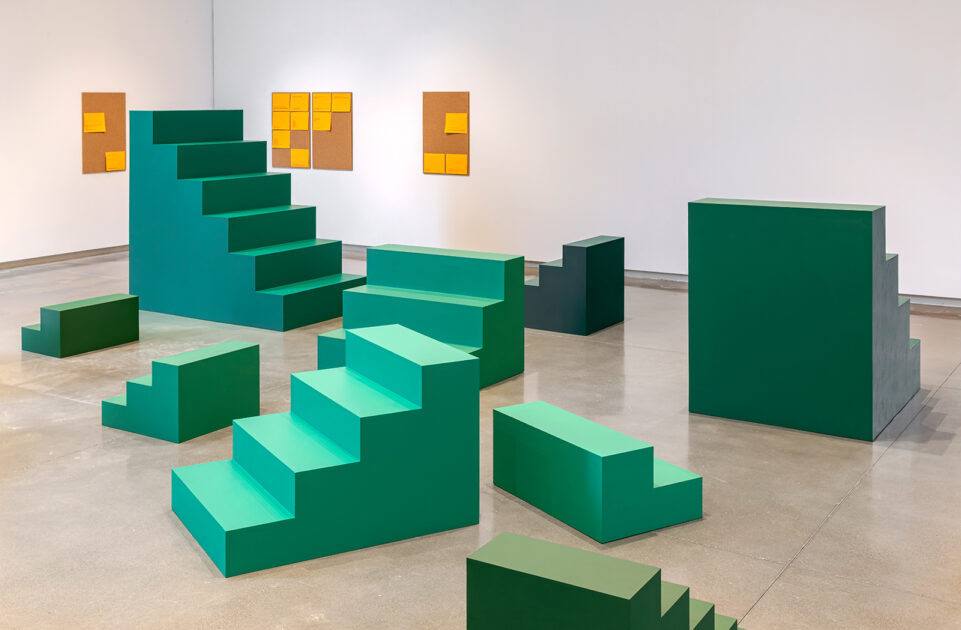
JK One of OhNo’s formative experiences in the first half of the book connects visitors to the work that commands the largest space in your exhibition. First Test (2025) consists of stairs in various shades of green all oriented in different directions. The distance between each allows for possible passage between, but the gallery’s safety protocols do not allow one to ascend. Some only hold a couple of steps, and other sets contain as many as six. At the Richmond Art Gallery, furniture taken from your family home found its way into the exhibition and provided a place of rest. Here, the multiplication of an everyday architectural feature could be understood as a figment calling itself into question even as it becomes concrete multiple times over. Does the possibility of fabrication allow for ideas to be tested in ways that found objects cannot?
ACYL The structures collected in First Test had to be fabricated, not found, because they’re based on an imprecise and distant memory. I think it’s my first conscious memory of feeling fear, which was provoked by doing a physical test as part of an entrance exam for a preschool in Hong Kong. I was three or four years old, and I had to walk up a set of green stairs in front of an audience of nuns. So this collection of stairs is somewhere between a figment of my imagination and a memory device. In having them fabricated, I left certain elements up to chance or other people: I used a random-number generator to come up with the different sizes of steps, and the painter at the fabrication shop chose the shades of green. For me, seeing both these stairs and the family couches you referenced—even though the former are imaginary representations and the latter are actual objects I lived with—incited similar feelings of estrangement, like a sense of time intruding on itself.
When my mom saw the artwork at the opening, she told me that she remembered that I had actually done two entrance exams for two different preschools, not only one. And that maybe this test didn’t happen at the preschool that I thought it did. I was shocked to find this out—at the opening! So having made the work actually further complicates my memory.
JK Brought together in adjacent galleries, First Test and Acceptable Protest (2025) could be considered bookends of your experience with the hierarchies of power imposed by educational institutions. The former traces how your schooling would commence, and the latter makes clear the limits imposed upon direct political action in post-secondary settings, including at York University where your exhibition is currently presented. Taking as its point of departure the recommendations and rules outlined for student demonstrators in an actual poster that circulated recently, is Acceptable Protest pushing the proposed restrictions upon organized dissent to their illogical conclusions?
ACYL Yes, absolutely. The animation was sparked by my collaborator, Emerson Maxwell, and I laughing together at a “Peaceful Protest” poster from the University of Southern California. One of the policies is “Don’t damage property,” and the image illustrating it is of a humanoid figure breaking a Doric column with a stick. Emerson is an animator and often works with corporate how-to imagery, so finding that poster led to us trying to deconstruct that binary “do” and “don’t” policy world from within by making it come to life.
What none of the university protest policies explain is how they repress protest and which types they are especially motivated to repress. They don’t illustrate police or private security assaulting students, or students’ livelihoods being threatened by criminalization. But the policies do all emphasize how they’re meant to support free expression. That’s the illogic that Acceptable Protest explores. This illogic extends to the liberal pablum produced by the Palestine exception: some of the dialogue is taken directly from excuses that administrators have given in the name of inaction.
JK The projection of Acceptable Protest is not gently suspended or seamlessly incorporated into the architecture, but abutted from wall to wall, effectively cutting off a corner of one gallery. This decisive demarcation of space throughout the exhibition does not so much culminate as accumulate in Furniture for Three Doors (2025). A selection of furnishings approved by the university are pulled from their usual roles into an improvised assemblage. Is the pile a placeholder for the potential of collective action to begin from what is at hand?
ACYL To start from what is at hand and also what may have been categorized as useless or extraneous. The pile is based on a calculation of approximately how much furniture would be needed to barricade the gallery’s three entrances. We moved discarded university furniture from the basement of the business school next door to supplement what’s already there. My friend Jody Chan, a poet, organizer, and former physics student, helped me to make the calculation of how many items based on their weight and unwieldiness. The accompanying poster, also designed by Rosen Eveleigh, provides a checklist for each entrance and some tips on construction. It’s speculation, but hopefully informative in some way.
And finally, the termination of the curator of 83% Perfect and director of the Goldfarb Gallery, Jenifer Papararo, was announced by York University on December 2, 2025. The reason for her firing was not clearly articulated, and I, along with many other colleagues, find it hard to believe, after the university’s objections to my work and specifically Acceptable Protest, that these events are not related. My exhibition represents some of the mechanisms of repression; though no longer shocking, it remains very disturbing to see them continually reproduced outside of the artworks, over and over.
Rate this article
Login to rate this article
Comments
Please login to comment
No comments yet. Be the first to comment!