
Entertainment
31 min read
Designing Amanda Seyfried's Dance-Ready Wardrobe for "The Testament of Ann Lee"
Motion Picture Association
January 21, 2026•1 day ago
AI-Generated SummaryAuto-generated
Costume designer Małgorzata Karpiuk created dance-ready Shaker-style wardrobes for Amanda Seyfried in "The Testament of Ann Lee" within six weeks. Facing budget constraints, Karpiuk adapted existing costumes and designed new ones with special cuts for movement. The film portrays Ann Lee's spiritual journey and the origins of the Shaker movement.
In Mona Fastvold’s newest film, The Testament of Ann Lee, the story of the Shaker movement’s origins in the 18th century is told through the unique lens of a mystical, at times even absurd, musical.
With Amanda Seyfried playing the titular role, the film follows Ann Lee as she has multiple traumatic birthing experiences that result in her children dying in infancy. Turning to religion to seek answers, Ann has a spiritual awakening and begins to claim that Jesus Christ is within her. Ann dedicates her life to converting the general public to the Shaker way, choosing celibacy and taking her religious gospel to colonial America.
Like the Oscar-winning The Brutalist, which was directed by Brady Corbet and co-written by Fastvold, The Testament of Ann Lee is a huge historical epic told on a tiny budget (estimated at just around $10-$11 million). For the below-the-line artisans, including costume designer Małgorzata Karpiuk, this required extra practical consideration to bring this ambitious tale to life.
While most of the shooting took place in Budapest, Hungary, filming also occurred in Sweden and the United States. Karpiuk spoke to The Credits about collaborating with Fastvold to bring this original take on the Shaker movement to life, how she navigated budget constraints, and the unique methods she used to design period-accurate costumes that the actors could still comfortably dance in. This interview has been edited and condensed.
When you first read Mona Fastvold and Brady Corbet’s script and came on board, what was your overall vision and approach for this story?
My first thought, of course, was to draw inspiration mostly from the paintings. I didn’t want to watch other movies made by different costume designers and directors because I knew from the beginning that we would tell our own story. There’s a great book about Shakers that helped me understand this community. We had access to the museum as well, and the movie ended with the real museum, with its furniture and everything. In my opinion, it helped me understand how brilliant and modern they were. It was really important for me to understand their philosophy.
And what about the film’s inimitable style?
We knew it would be shot in this raw, wild documentary style, so the details were really important — the fabric’s structure and pattern, the colors. Sometimes when you’re doing a musical, you’re thinking it can be this kind of fairy tale. But we really wanted to combine the fairy tale with the natural world, so this was a big challenge for us.
How much time did you have in pre-production to actually prepare the costumes? I know the film had very few shooting days relative to its scale.
I will ask you, how much time do you think I had?
Maybe a couple of months?
The story is that I had six weeks to make everything! From the moment I got the script, I immediately flew to the rental house to check what was there and what wasn’t available. Then we decided, “Okay, let’s make what we need.” The whole process for me was a crazy, amazing six weeks, and then we were shooting for 34 days. But sometimes we had two camera units, so we packed as much as we could into the regular schedule. And with the additional second-unit days, we were working on the details and special scenes.
Since this film is a musical, can you speak to how you designed these outfits with movement and practicality in mind?
I got some rehearsal videos from New York when Amanda Seyfried was practicing. I started to imagine what was most important in these moves. Which movement will be the most characteristic for us? It was really helpful to understand how modern the dancing will be, and how flexible the costumes should be. I then saw the videos of the rest of the dancers and background actors.
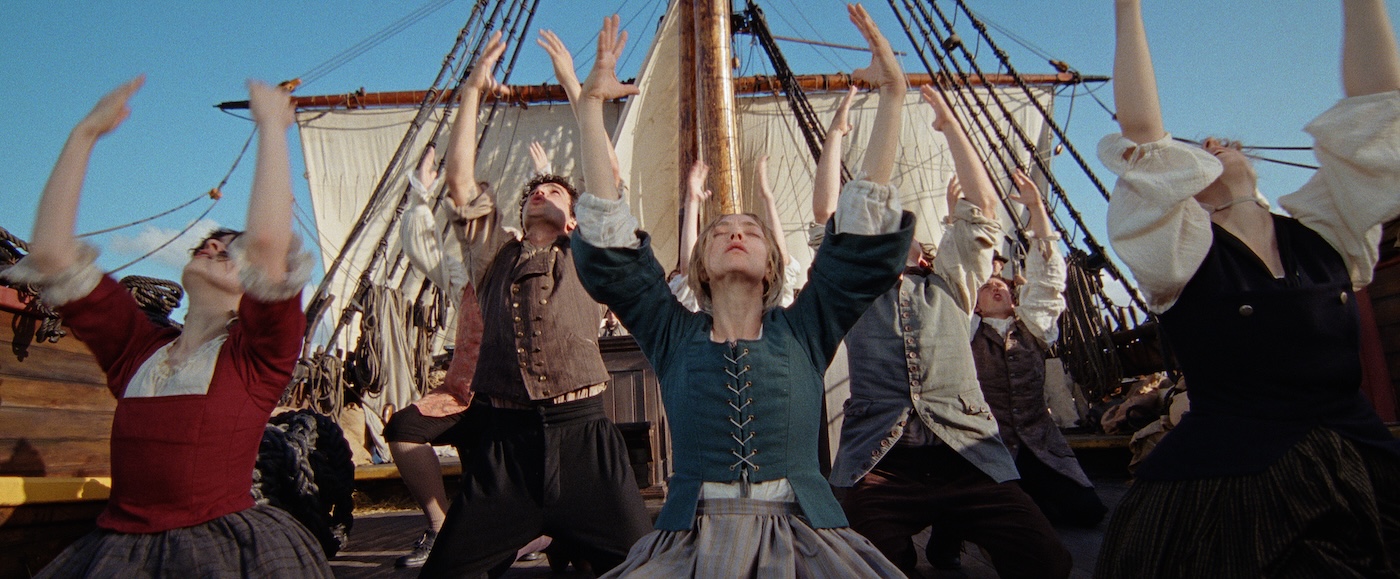
Not all the costumes from the rental houses were made for dance because they didn’t allow people to move their arms, or they were too uncomfortable, or we couldn’t cover or hide the knee pads. After one week, I decided we needed to do as much as we could. My great cutter helped me design the dresses for the Shakers with this special sleeve cut that looks natural, but allows the actors to do everything. The dresses were made to be easy to put on the actors and very comfortable. We painted all the dresses to build this palette. For the men, most of the trousers were a bit longer and had a special elastic to hide the knee pads and make them feel comfortable. All of the costumes were designed [by hand] for the main characters.
That’s really impressive. Similar to Brady Corbet’s The Brutalist, I know the budget for The Testament of Ann Lee was incredibly low, considering just how massive the scale is. How did working on a smaller budget impact your workflow?
To do this kind of movie, you have to think about the logistics. What do you need to have, and where? The most important thing was to make a list of priorities. When I finished the priorities, and we could start shooting, I saw what we saved to fulfill the rest of my needs. But you need to think about the crew and be clever to know what will [actually] be seen in the film. So, where are you gonna see the money that you have?
You need to love cinema. You should just give your heart to the process and to the project, and then everything is possible. I have the feeling that if you love the project, there is no limit — time is no limit, budget is no limit. And when you have good collaboration, you are going with the flow. From the beginning, when we were facing budget and timing issues, we were talking and trying to figure out what we could do to have more. I never wanted Mona to feel limited.
How did you design the look of the main character, Ann Lee, to represent the radical transformation she undergoes?
We see her through almost 40 years. From the script, Ann definitely thinks that in the future, she will live in celibacy. But in general, when she was young, she was really attractive and searching for a sense of life. She thought she would live a normal life. I wanted to build a normal teenager at that time, drawing my inspiration from the paintings. I tried to understand the circumstances and what these characters should look like.
A very important moment was when she lost her children during the song “Beautiful Treasures.” At each stage of the song, I wanted to show her emotional state and how her body was changing — starting as a pregnant woman, then in mourning, then once again pregnant. At the end, she’s almost destroyed, just dancing with her own feet, thinking this is her child. I said to Mona that she could be without the bonnet and barefoot, emotionally naked, because it was so tragic. So, from this moment when she was in prison, she wanted to be less attractive because she just started to figure out her future path. Slowly, her costumes were changing as she hid her chest. The bonnet got bigger, so we started covering her hair. Ultimately, the final Shaker look proved to be the most challenging costume. I know the Shakers, I know their history, I know the colors from the book, but somehow we wanted to do our own vision of them. So we took some creative license to build this final look. To be 100% sure, we spent a couple of meetings together to decide on the sky palette and colors — almost like heaven.
Speaking of challenges, what was it like filming the dance scene on the ship? With the changes in weather and amount of extras, I imagine that must have been difficult too.
Oh yes, the ship was definitely challenging. The biggest part was in Sweden because we found a great ship there, so the exteriors and some interiors were filmed there. Of course, I’m always optimistic, so I thought, “OK, there will be snow, rain, they’re gonna dance in the sun. Easy!” Then it was almost like a storm for me — everything was wet and impossible to wear the next day. But I had a really great Swedish crew who supported me with the background actors. We shipped all the costumes and the doubles, and we were filming in almost a guerrilla style. I love this song; the whole sequence and editing are so beautiful, but it was challenging because we were shooting one full song, then changing costumes for the second, third, and fourth [takes]. The rain was really heavy, and Amanda was almost unable to dance because of the heavy coat I gave her. But she did it!
She’s so amazing in this.
And of course, the interiors were difficult too because everything was wet. But it was fun as well. I like this kind of challenge!
Finally, you previously worked on The Zone of Interest and Quo Vadis, Aida?,which were both Oscar-nominated. Like Ann Lee, they are also unique historical dramas with unexpected elements. How did those creative experiences shape your approach? How have you developed as an artist through these projects?
Thank you for this question. I have to say thatThe Zone of Interest was an absolutely unique experience for me because of the method. We were shooting simultaneously, sometimes with 10 cameras, and the set wasn’t exactly the same because we acted like the crew preparing everything. But when the actors entered the set, there were none of us. There were challenging moments for us, as well as with the subject matter and script. Working with Jonathan Glazer, an amazing director, helped me understand the different processes involved in making films. It’s a totally unique experience that’s probably never going to happen [again] because you just need to immerse and switch your brain to a totally different way of working. It’s really helped me to be brave.
Quo Vadis, Aida?, the movie I did about the Srebrenica genocide, was also challenging. We were working with a not-so-big budget, but everyone was so involved because the subject was so important. In total, we had more than 4,000 extras. That helped me understand another process, another way of making films. Each director and each film was my teacher. Ann Lee was also different. For us, Mona was a mother because of how she created a special community. She had this dream, which was probably impossible to realize with such a big film in such difficult circumstances. I’m from Poland, she’s based in New York, and we had never heard of each other. It’s a miracle we found each other.
The Testament of Ann Lee releases in theaters on December 25.
Rate this article
Login to rate this article
Comments
Please login to comment
No comments yet. Be the first to comment!