
Space & Astronomy
12 min read
ALMA Delivers Unprecedented High-Resolution Views of Exoplanetary Debris Disks
Sci.News
January 20, 2026•2 days ago
AI-Generated SummaryAuto-generated
ALMA has captured the sharpest images yet of 24 exoplanetary debris disks, revealing the dynamic "teenage years" of planetary system formation. These dusty belts, remnants of planet building, show diverse structures like rings and gaps, indicating ongoing planet sculpting and violent impacts. The findings offer insights into whether our Solar System's history is unique or common.
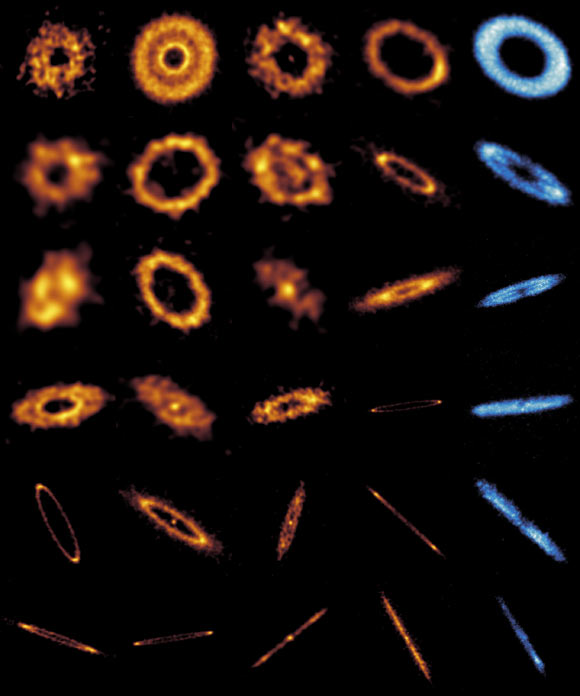
Astronomers using the Atacama Large Millimeter/submillimeter Array (ALMA) have produced the unprecedented high-resolution images of 24 debris disks — the dusty belts left after planets finish forming — revealing the dynamic, transitional phase between planet birth and mature exoplanetary systems.
Young and mature planetary systems contain tenuous dust belts called debris disks.
Due to the dust’s short lifetime against radiation and collisional processes, it has long been known that the dust is likely a product of collisions between kilometer-sized or even larger planetesimals.
Debris disks are therefore the extrasolar analogues of the Solar System’s asteroid and Kuiper belts.
With ages ranging from tens to thousands of millions of years, they provide a unique window into the final assembly of planetary systems.
Moreover, they allow us to connect the structure seen in protoplanetary disks with the currently known mature exoplanet population.
Debris disks are faint, hundreds or even thousands of times dimmer than the bright, gas-rich disks where planets are born.
Wesleyan University astronomer Meredith Hughes and her colleagues overcame these challenges and produced images of these disks in unprecedented detail.
They used ALMA to capture the high-resolution images 24 debris disks around other stars.
The observations were part of the ALMA survey to Resolve exoKuiper belt Substructures (ARKS).
“We’ve often seen the ‘baby pictures’ of planets forming, but until now, the ‘teenage years’ have been a missing link,” Dr. Hughes said.
“We’re seeing real diversity — not just simple rings, but multi-ringed belts, halos, and strong asymmetries, revealing a dynamic and violent chapter in planetary histories,” added Dr. Sebastián Marino, an astronomer at the University of Exeter.
ARKS is the largest, highest-resolution survey of debris disks, akin to a DSHARP-for-debris-disks, setting a new gold standard.
About one-third of observed disks show clear substructures — multiple rings or distinct gaps — suggesting legacy features left from earlier, planet-building stages or sculpted by planets over much longer timescales.
While some disks inherit intricate structures from their earlier years, others mellow out and spread into broad belts, similar to how we expect the Solar System to have developed.
Many disks show evidence for zones of calm and chaos, with vertically puffed-up regions, akin to our Solar System’s own mix of serene classical Kuiper Belt objects and those scattered by Neptune’s long-ago migration.
Several disks retain gas much longer than expected. In some systems, lingering gas may shape the chemistry of growing planets, or even push dust into wide halos.
Many disks are lopsided, with bright arcs or eccentric shapes, hinting at gravitational shoves from unseen planets, leftover birth scars from planetary migration, or interactions between the gas and dust.
“These disks record a period when planetary orbits were being scrambled and huge impacts, like the one that forged Earth’s Moon, were shaping young solar systems,” said Dr. Luca Matrà, an astronomer at Trinity College Dublin.
“By looking at dozens of disks around stars of different ages and types, ARKS helped decode whether chaotic features are inherited, sculpted by planets, or arise from other cosmic forces.”
“Answering these questions could reveal whether our Solar System’s history was unique, or the norm.”
The results were published today in the journal Astronomy & Astrophysics.
_____
S. Marino et al. 2026. The ALMA survey to Resolve exoKuiper belt Substructures (ARKS). I. Motivation, sample, data reduction, and results overview. A&A 705, A195; doi: 10.1051/0004-6361/202556489
Rate this article
Login to rate this article
Comments
Please login to comment
No comments yet. Be the first to comment!