
Technology
12 min read
Why Top AI Models Can't Do What Toddlers Can: Visual Task Failures
the-decoder.com
January 18, 2026•4 days ago
AI-Generated SummaryAuto-generated
A new study reveals advanced AI models struggle with visual tasks easily mastered by toddlers. Despite high scores on knowledge tests, leading models like Gemini-3-Pro-Preview scored only 49.7% on basic visual discrimination, spatial perception, and pattern recognition. Researchers attribute this to a "verbalization bottleneck," where visual information is lost when translated into language. This benchmark highlights a significant gap in AI's visual intelligence.
A new study exposes a fundamental weakness in today's AI systems: even the most capable multimodal language models can't handle basic visual tasks that toddlers master before they learn to speak.
Multimodal AI models score above 90 percent on expert knowledge tests like MMMU. But a new study by UniPat AI reveals a striking gap: these same systems fall apart on basic visual tasks that humans learn before they can talk. The best model tested, Gemini-3-Pro-Preview, managed just 49.7 percent. Human adults hit 94.1 percent.
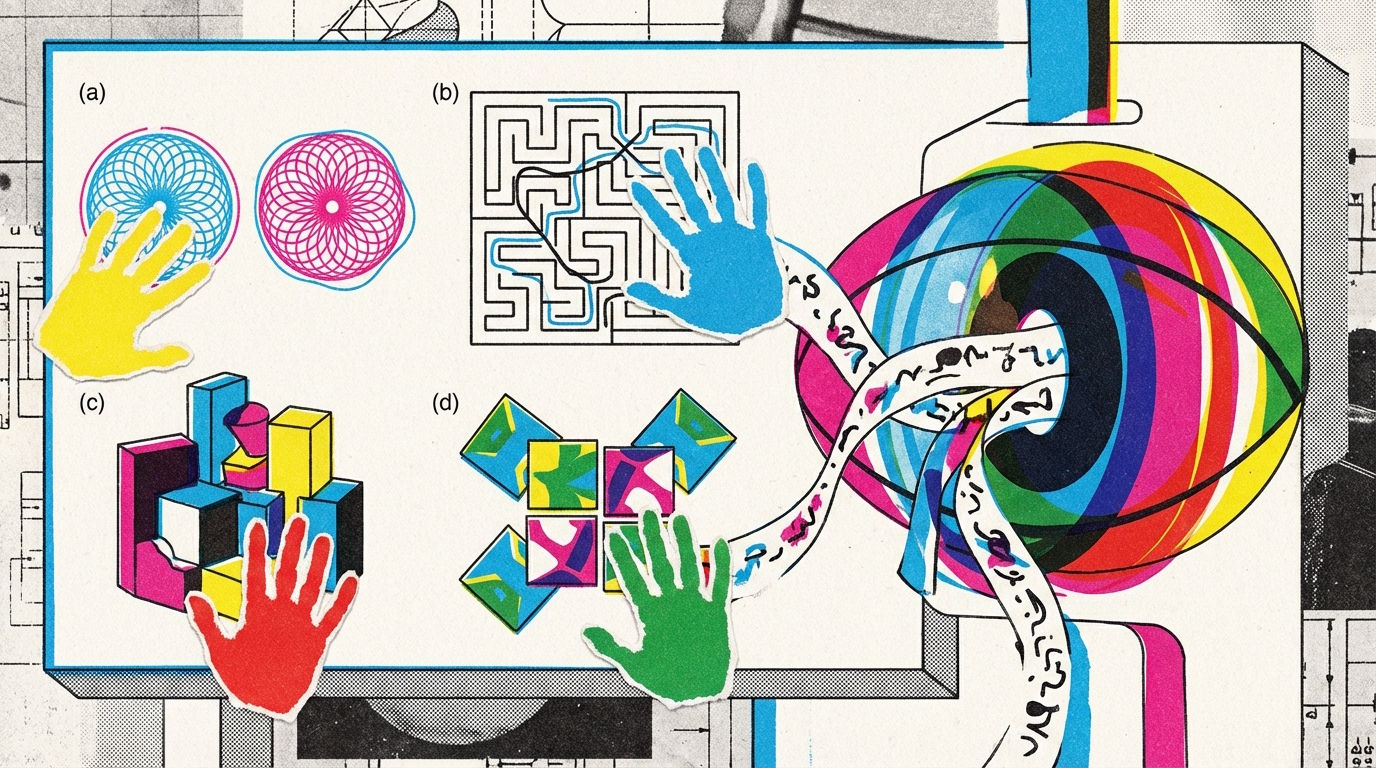
Researchers from Chinese institutions including UniPat AI, Peking University, Alibaba Group, and MoonShot AI built the "BabyVision" benchmark with 388 tasks across four categories. These test skills that developmental psychology research shows humans develop in their first months of life: fine-grained visual discrimination (like spotting subtle differences between similar patterns), following lines through mazes or across intersections, spatial perception (counting hidden 3D blocks, for example), and visual pattern recognition involving rotations and reflections.
Most frontier models score below the average three-year-old
A comparison test with 80 children across different age groups showed just how wide the gap really is. Most frontier models tested scored below the average for three-year-olds. Only Gemini3-Pro-Preview consistently beat this group, but it still trailed typical six-year-olds by about 20 percentage points.
Among proprietary models, Gemini 3 Pro leads by a wide margin. GPT-5.2 follows with 34.4 percent, Bytedance's Doubao-1.8 hits 30.2 percent, and Claude 4.5 Opus manages just 14.2 percent. Open source models fared even worse. The best performer, Qwen3VL-235B-Thinking, scored only 22.2 percent.
The results get especially stark for specific task types. On counting 3D blocks, even the best model reaches just 20.5 percent while humans score 100 percent. On the "Lines Observation" task, where lines must be traced through intersections, only Gemini hits 83.3 percent. Most other models scored zero.
Language-first processing creates a visual blind spot
The researchers trace all these failures to a single problem they call the "verbalization bottleneck." Current multimodal models translate visual input into language representations before reasoning about it. Any visual information that can't be expressed in words gets lost along the way.
Semantic content like "a red car on a road" translates easily into language. Geometric relationships resist this conversion because the exact curvature of a boundary or the precise position of an intersection can't be captured in words without losing information. The researchers say BabyVision specifically targets these non-descriptive visual properties.
Mazes remain a major challenge
The researchers also developed "BabyVision-Gen," an extension with 280 questions. Here, models had to show their solutions by generating images, drawing paths, or highlighting differences. People often solve these tasks by drawing instead of verbalizing, and children externalize visual reasoning through drawing before they can verbalize solutions.
The tested image generators showed some promise. Nano Banana Pro hit 18.3 percent, and GPT-Image-1.5 reached 9.8 percent. On tasks like finding differences, Nano Banana Pro scored 35.4 percent. But every generator failed completely on maze tasks and connecting lines. These tasks require continuous spatial coherence over longer sequences, something current architectures can't maintain.
The researchers point to "unified multimodal models" that natively integrate visual processing and generation as a potential solution. These architectures could maintain visual representations throughout the reasoning process instead of compressing everything into a linguistic bottleneck. The BabyVision benchmark, available on GitHub, is meant to serve as a diagnostic tool for measuring progress toward true visual intelligence.
Rate this article
Login to rate this article
Comments
Please login to comment
No comments yet. Be the first to comment!