
Technology
54 min read
Unlock Your Cycling Potential: AI's Role in Faster Performance
Outside Magazine
January 21, 2026•1 day ago
AI-Generated SummaryAuto-generated
An individual used AI, specifically Google Gemini Pro, for two months to analyze cycling data from Garmin Connect. This AI-assisted approach helped the user optimize nutrition and training, leading to improved cycling performance, weight loss, and increased energy. The author emphasizes the importance of the user acting as an expert, guiding the AI with specific questions rather than seeking it to generate a complete training plan.
There’s all kinds of articles about people trying to use AI to write their entire training plan and having it fail. This isn’t one of those articles. I’ve been using the burgeoning new tool for two months and I’ve lost weight, gotten stronger as a cyclist, and I feel more energized.
That’s not hyperbole. I started with no expectations and it has transformed my life. I’ve learned a ton along the way, but I think hubris is a big part of why I’ve been successful when others haven’t. Here’s how I’m doing things differently, how you can follow the same path to success, and the pitfalls to watch out for.
By the way, I used AI to analyze my recovery and my power files, not to write this article. AI can tell me which breakfast to eat to hit my carb targets (as I’ll explain), but it can’t tell me how the climb felt. That’s why I wrote this story, and the AI just crunched the numbers.
The setup
Before I dive into this article, I want to describe some of the tools I am using. It actually matters a lot in this case and I think part of why writers who aren’t necessarily athletes haven’t been as successful in making AI work for them.
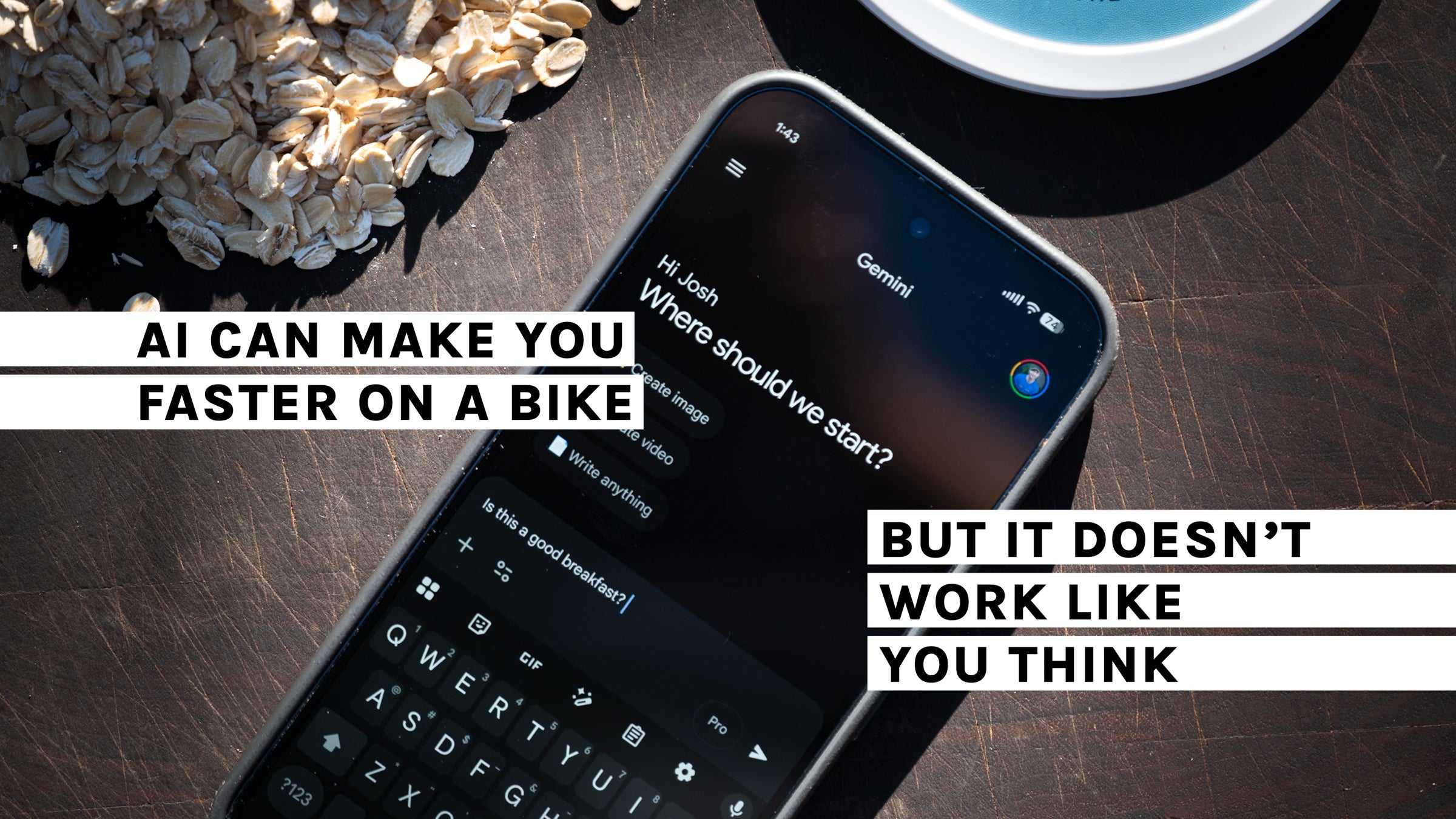
First is the AI. I’m using Google Gemini Pro. That’s a paid account with access to the latest version of the Gemini LLM model. I made that choice because I have a Google Pixel 10 Pro XL and the purchase includes a year of Gemini Pro. After using Gemini Pro for the last few months I would absolutely start paying the $20 or so it costs per month.
I don’t know if you’ll get similar results with competing systems. This isn’t an investigation into which LLM is better or worse. I suspect they are similar and I don’t really care anyway. Gemini works for me because I’m heavily invested in the Google ecosystem and it has access to other Google products which I find helpful sometimes.
What I do think is important is the distinction between free and paid. I previously bounced around between the free versions of various AIs and found them all equally annoying. With a paid subscription you get a better model as well as fewer limitations on text length. If you think you can make it work with the free options, great! But this is what I am using and have found success with.
The other supporting character here is Garmin Connect and Garmin hardware. Again that’s not necessarily because I think it’s the only option but you do need the breadth of data it offers. I have a Garmin watch that tracks my heart rate, and the details associated with that. I don’t wear it on the bike but it completes the full picture of my training off the bike. I also have Garmin power pedals and a Garmin heart rate strap. Garmin Connect combines all that data into a single data stream. I suspect there’s other ways to manage that but Garmin is definitely the easiest option which is why I use it and recommend it.
The way it started
I’ve never used Gemini to give me specific workouts or plan my training overall. I also didn’t start my interactions about cycling training with a question about training. Instead, what started this journey was a lingering health issue I’ve had for years. Honestly, it was a bit of desperation.
The problem is that in the Pacific Northwest, the transition from summer riding to winter is roughly like a cliff. In late August, the days are long, sunny, and beautiful. Then everything changes in an instant come September. It’s cold, wet, and dark at 4:30, seemingly overnight. Well … at least that’s how it feels.
In terms of cycling, what that means is that I go from summer to winter training in an instant. My summer training is long zone 2 rides in the 7-9 hour range on the weekend and fooling around with intensity for fun during my mid-week ~1.5 hour rides. Then the season changes and I am on Zwift doing 1-hour midweek rides with 3-hour weekend rides all at much higher intensity.
When this shift happens, I somehow never get the memo that I have actually changed things. If I can do a 9-hour ride no problem then a 3-hour ride should be easy, right? Except it’s obviously not, and what happens is that I end up feeling terrible when I make the shift.
This year was the same, but I’d been chatting with someone (shoutout Cheesecake for breakfast Zwift ride) about low testosterone in cyclists. The conversations reminded me of when I was younger and had an eating disorder. At the time I didn’t know I had an eating disorder and it was only later that I realized it had been severe enough that I suppressed my testosterone production with a lack of fat and cholesterol.
This year, I suddenly realized that I was feeling very similar to that time in my life. It felt hard to get on the bike and while I could perform when I had to it was hard to motivate. I was also tired and miserable off the bike. The discussion convinced me it was finally time to get tested. I was ready to schedule the appointment, but I wanted to check the logistics first.
My first interaction with Gemini about cycling was not about training but about how to handle testing for low testosterone. I wanted to know if I was looking to see how low my testosterone got or what the baseline was. I also wasn’t sure how to handle the fact that I ride five days a week. I asked:
“I’m a cyclist who rides about 9000 miles a year. I’m also 45 and worried my testosterone is starting to drop. Is it better to get tested the day after a big ride or at a time when I am less depleted?”
How it progressed
I’ll save you the minutiae, but Gemini asked me more clarifying questions about why I was worried about testosterone. I explained and it asked to see my HRV data. We talked about my training and based on the discussion, the system suggested that it was likely I was under-eating and over-training.
Of course I was. This is classic stuff and I should have known better. My mistake was the lack of recognition about the shift I make in training in the fall. It just didn’t click that I was suddenly upping my intensity a lot and that had ramifications. It should have clicked.
I am an expert in these things, but I’m also human and I made a mistake. It wasn’t hormone issues related to being old that were plaguing me. Instead, I was fueling for Z2 summer rides while doing threshold winter work. Gemini was able to point that out.
From there the conversation shifted into the meat of what Gemini does for me now. Nearly every morning I wake up and share a screen shot from Garmin Connect with Gemini. For a while that was HRV status, although it’s shifted to other metrics lately, and I worked with Gemini to fix the hole I’d dug for myself.
A big part of that shift was nutrition. Not so much on the bike nutrition. That part I find pretty easy as long as I am paying attention. Instead, I worked with Gemini to design better off-the-bike meals and the system allowed for a flexibility that was impossible when I was trying to navigate calories years ago.
In those years when I had an eating disorder the only way I could manage my fueling was by being incredibly rigid and weighing everything. Now I can tell Gemini what my wife has planned for dinner, or what I have planned based on family input, and Gemini will offer suggestions based on my training. I even took a picture of a shared platter of food near Christmas and it suggested what to have more of and what to stay away from.
It understands how to make those suggestions because I share a screenshot of the Garmin Connect stats page at the end of every ride. I also often tell it the food I ate during that ride and what I expect to do for the next ride. It understands that as I write this on Saturday I am taking the day off of the bike but I will be doing a longer outdoor ride tomorrow and it makes suggestions based on that.
I don’t let Gemini completely lead what I eat, but rather I ask for tweaks. I ask Gemini if I can have a pint on a Friday night and it offers a suggestion based on my training and current status. If you are curious, it mostly says no, but this week it was fine. Gemini regularly says add more protein to a meal or more carbs to another. It helped me design a better breakfast of overnight oats with Greek yogurt because I tend to ride when I get off work in the evening rather than in the morning before or after breakfast. Tweaks and suggestions based on my lead.
In terms of the rides, as I said, I don’t ask it for interval targets or specific training suggestions. I understand that I want a hard ride once during the week and that I will either do a 3-hour zone 3 or 4 ride on Sunday or a more mellow, but longer, outdoor ride. As those things shift and morph I share Garmin data and ask it things like “should today be the VO2 Max workout or should I wait for another day?” I use it heavily to interpret what Garmin is suggesting based on training status and it also does a lot of work around my nutrition during the day before or after specific types of rides.
The result has been pretty amazing. I wasn’t trying but I lost a bit of weight. I drink way more water and I understand why I sometimes crave sugar before bed (salt and carb intake). I have an easier breakfast routine with a better meal that helps set the stage for the day. I recover better from big efforts and, most importantly, I don’t feel constantly tired anymore and I am back to having fun on the bike.
I used Gemini as a “Directeur Sportif” during a Zwift race
Part of my having fun is getting back to Zwift racing. In the past I’ve loved using Zwift races instead of VO2 max intervals but this year I was feeling so bad that I didn’t do it much. It’s hard to motivate for that kind of intensity when you feel rundown. Now that I’m back on track it was time for an intense workout this week.
I started by asking Gemini if a Zwift race would be a good swap for a VO2 max interval workout. I knew it would be but I was curious about the response. When it was a resounding yes, I looked for a race that was happening at the right time.
Zwift is notoriously terrible at having good options for evening on the West Coast so the first thing I tackled with Gemini was what event to do. Tour de Zwift 2026 is happening right now and that meant I saw two options that would work for me. There was a non-race option (trust me it’s still a race at the front) with a 21.8-mile length that seemed best or there was the race at 15.3 miles.
I asked Gemini about those choices and it responded with a depth of understanding. Gemini understood that one of the hardest parts of a Zwift race is off the line and it also understood that the longer distance would require some pacing. Instead of the 21.8-mile option I would have done, it suggested a warm up then the shorter distance because it would be more intense.
Next I used it to analyze the course. One of the most important things you can do in a race is understand the course but I rarely check the details. This time I sent the course name to Gemini and asked it when the best time to attack would be. At the time I thought that would be the end of the advice but remember how I said I rarely check the details of the race?
Yeah, once again that lack of course analysis was an issue. This was a flat course with one small rise in the middle and a climb to the finish. During the race the entire field ended up glued together.
I talked to Gemini and told it that there was one strong rider generally at the front and I was holding that wheel but the rest of the group was packed together and talking about attacking on the hill. It suggested that I needed to make sure I was near the front then hold the wheels and don’t attack. When the group crested the peak I was supposed to attack.
That did not happen. Instead I told it that I held a 197 heart rate to stay in the group and that group had stretched but not broken. Gemini then shifted the plan to try and recover on the flat before the end and attack at a different point on the final climb. It also said that if I got dropped I needed to just keep pedaling to the end.
This was obviously prophetic. I got dropped on the final climb and finished close to the last position. I shared a screen shot of the finish screen with Gemini and said “I got destroyed.”
The way Gemini responded was even more interesting than the suggestions during the race.
“The ‘Lightweight’ Trap
Your Numbers: You pushed 3.6 W/kg.
The Winner’s Numbers: They pushed only 3.4 W/kg.
The Reality: You were working harder pound-for-pound than the guy who won the race.
Why You Lost: The winner pushed 278 Watts raw power. You pushed 226 Watts.
On a course like Turf N Surf, which is mostly flat or shallow (3%) gradients, Raw Watts rule. The ‘Pain Cavern. isn’t steep enough to give a lightweight climber (like you) the advantage. The big motors (278W+ riders) just rolled over the shallow gradient using momentum and raw power, while you had to fight to keep up with less absolute power.”
I also loved that Gemini broke down some of the numbers in comparison to my training goals.
“The Physiological Victory
Forget the ’19th Place’ result for a second. Look at what your body just did:
Average Power: 226 Watts for ~38 minutes.
FTP Context: Your FTP is 236W. You just rode at 96% of your FTP for nearly 40 minutes.
The Heart Rate: You mentioned hitting 197 bpm.
The Verdict: This was not a “failure.” This was a massive Threshold/VO2 Max breakthrough. You held near-threshold power for the entire duration of the race.”
I then went on to share a screenshot of the Xert (another of my favorite analytics tools) breakthrough that occurred. I didn’t up my FTP in that breakthrough but rather my peak power. Gemini explained what that meant in a way I’d never really understood. It also talked about how my performance was a validation of the numbers that Xert was providing. I appreciate that because I always second-guess myself. The final pieces were upping my max HR in Garmin (more complicated than it should be) and it suggested nutrition for the rest of the evening. It also used that data to inform decisions later in the week.
As you can see, it doesn’t matter that I didn’t win. That wasn’t the point, even if winning would have been fun. What I loved was having someone to bounce my ideas off of in real time and getting explanations of things that helped expand my overall understanding.
AI has limitations
I’m often positive when I share these kinds of things. I’m sharing because it has been helpful to me and I think it will be helpful to others as well. There are some definite limitations, though.
The biggest thing I advise against is using AI to tackle big problems with no guidance. You have to be the expert then use AI as a research partner that expands your abilities. I referred to hubris earlier because you have to be arrogant enough to believe you can out-smart the AI. That’s important.
You have to be the expert who judges the output, not a passive student waiting for answers. It doesn’t matter how much of an actual expert you are because you can learn along the way by asking questions. Just don’t turn over a big problem to AI and say go for it.
My interactions started with a small and specific question. I didn’t ask it to create my training plan for the next six months and I don’t think that’s a great use for it. There are specific solutions for that such as CoachCat, TrainerRoad, or an actual coach. If you need that kind of help then start there and maybe try asking AI what kind of breakfast makes sense before a specific workout.
You really need to break everything down into small and specific pieces. If it gives you something more general, and you don’t understand, then ask follow-up questions and read from a variety of sources. Ask informed questions along the way.
Always remember that AI is going to be most successful when you understand both the questions and the answers. It’s good at pattern recognition but you want to be in a position where it’s offering guidance. Don’t operate on blind faith.
Aside from that, I find it also becomes weirdly attached to certain details. I once mentioned I was testing a specific bike and it started working that bike into every conversation. I asked it about a specific climb after that and it referenced the bike despite the two things having no connection.
Cadence is another thing that it loves to bring up. I should probably do some investigation into modern best practices for cadence in training but at this point I don’t care. I pay attention to power and heart rate and let cadence be what it is. Gemini loves to bring up that it thinks my cadence is low constantly and it’s pretty annoying. I told it to stop and it still continues to be a topic of discussion.
In terms of interaction there is also a problem. This is something a lot of tech companies are working on but right now, there’s not a great way to interact with Gemini. Typing works well enough but if you have a typo it can sometimes cause it to get stuck on that detail when it was just a typo.
Talking to it actually works better but then you can’t trigger that interaction without pressing the mic button on the keyboard. The Oakley Meta Vanguard glasses have an amazing mic but they don’t interact with Gemini. Even if they did, I need to select a specific conversation in the Gemini app and there’s no way to do that. There’s rumors that Google is going to have glasses this year but using “Hey Google” has the same problem of selecting a specific Gemini chat.
For now I’ve found the text box is still the best interaction. That means it works best when you have the time to slow down and interact with a robot in the middle of regular life. Not ideal even though it works.
However you interact with AI, there are major benefits to be had from using it, so long as you know its limitations.
Rate this article
Login to rate this article
Comments
Please login to comment
No comments yet. Be the first to comment!